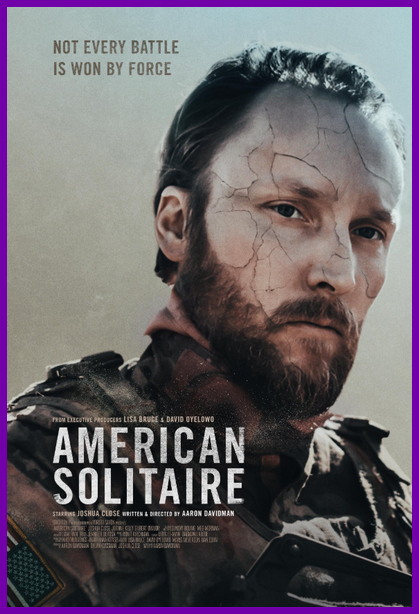
With AMERICAN SOLITAIRE, writer/director Aaron Davidman sets out to do something few first-time narrative filmmakers attempt: tackle not one issue, but an entire constellation of them.
PTSD. Returning veterans. Military reintegration. Masculinity. Generational trauma. Gun culture. Faith. Identity. The psychological inheritance of violence.
It’s an ambitious undertaking—and one that immediately distinguishes the film from more conventional “returning veteran” narratives. Davidman is not interested in a single-issue story. He is probing the ecosystem surrounding trauma, the cultural and familial frameworks that shape it, sustain it, and too often leave it unresolved.
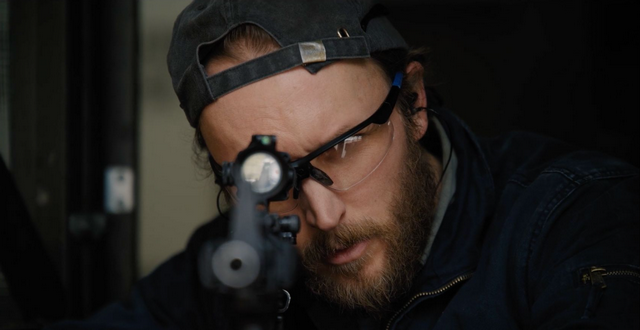
At the center of the film is Slinger, played with quiet, internalized gravity by Joshua Close. A wounded veteran struggling to recalibrate in civilian life, Slinger is less explosive than many cinematic portrayals of PTSD and far more watchful. Close resists showy breakdowns, instead giving us a man whose damage is cumulative, embedded, and often unspoken.
That restraint is one of the film’s greatest strengths.
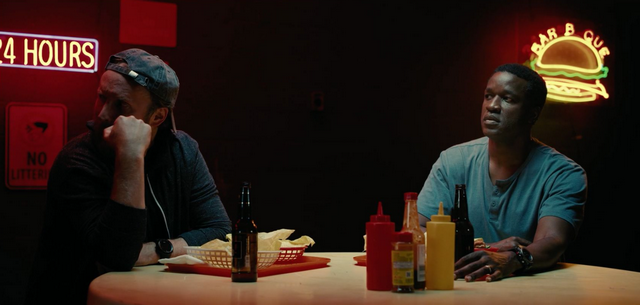
Slinger’s best friend, Auggie, is beautifully played by Gilbert Owuor, who infuses Auggie with the unsettling frustration of a man confused and on the edge. Auggie is still on active duty and ready to redeploy, but he has his own struggles, which are exacerbated in his mind as being a Black man and a major in the Army.
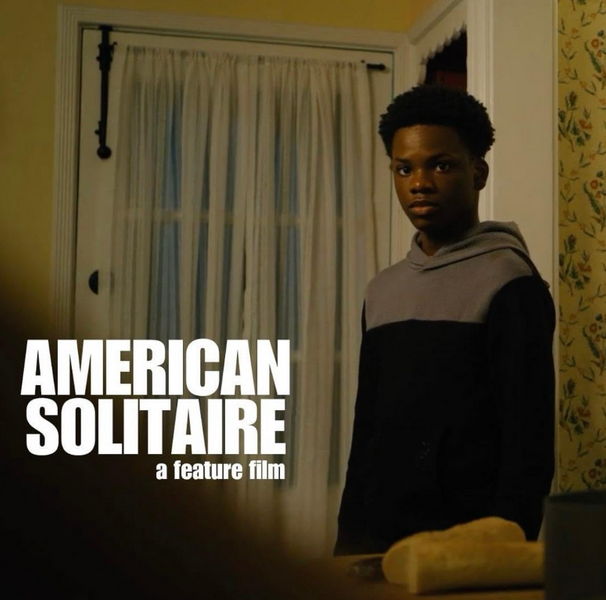
Where AMERICAN SOLITAIRE finds its most compelling footing is in its relational dynamics—particularly between Slinger and Emmett, the young nephew of Auggie. Played by Jamir Vega, Emmett becomes both a mirror and a warning, a child already absorbing the logic of fear and armed self-protection before he has the emotional tools to process it.
The scenes between Close and Vega are among the film’s most effective. There is a tenderness and quiet urgency to their interactions that cuts through the film’s heavier thematic layering. In these moments, Davidman’s larger ideas about generational transmission of violence become immediate, human, and tangible.
Equally effective is the film’s exploration of inherited masculinity, particularly in the strained relationship between Slinger and his father. The emotional residue of that dynamic—rigid expectations, emotional withholding, and a lifetime of weaponized toughness—echoes forward into Slinger’s inability to connect with his own son. It’s here that the film most clearly articulates its central question: how does violence, in its many forms, get passed down—and can it be interrupted?
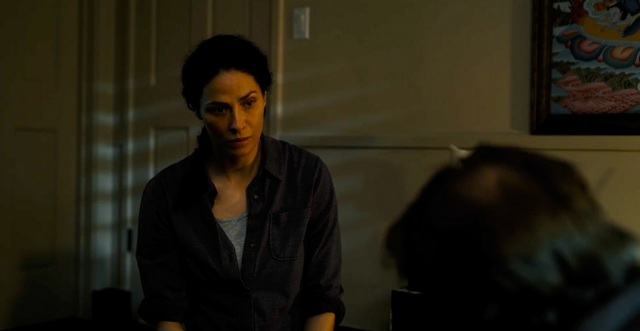
Striking are the distinct journeys which we see unfold and converge – Slinger as a man who is suffering with PTSD and just learning to reintegrate into society; Athena, who rents a room to Slinger, and who herself is former military and has worked through her reintegration and PTSD and come out on the other side whole and alive; and Auggie who is in the thick of stress, pressure, and confusion which he doesn’t know how to deal with. And then there’s Emmett, a by-product of generations of gun violence, masculinity, and racism, who is at a juncture in his young life where a decision as to which road to take will affect him for the rest of his life.
Visually, AMERICAN SOLITAIRE makes a smart and somewhat unexpected choice. Rather than plunging its subject matter into shadow, Davidman and cinematographer Hana Kitasei keep much of the film in light. The result is a grounded, observational aesthetic that resists the visual clichés often associated with trauma narratives.
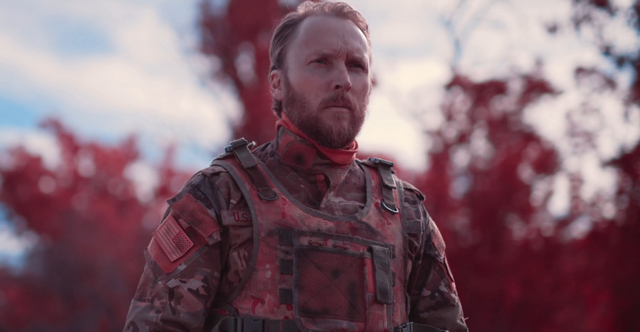
Where the film does embrace stylization is in Slinger’s nightmare sequences, which stand out as some of its most striking imagery. Rendered in deep, pervasive reds, these moments evoke both memory and guilt, transforming the subconscious into a landscape of blood and consequence. The effect is both unsettling and visually compelling, offering a welcome contrast to the otherwise restrained visual language.
But for all its strengths, AMERICAN SOLITAIRE is also a film that struggles under the weight of its own ambitions.
Davidman’s desire to address multiple facets of American gun culture and psychological trauma is admirable, but the sheer number of thematic threads occasionally diffuses the narrative focus, leaving some ideas more fully realized than others. Certain storylines and character dynamics are introduced with real potential, only to recede before they are fully explored, leaving the film feeling, at times, more expansive than cohesive.
This is most evident in the film’s middle passages, where the accumulation of ideas begins to outpace the story’s ability to integrate them smoothly. The result is not confusion, but a sense of uneven emphasis—some threads resonate deeply, while others feel less fully realized.
The editing, credited to Libya El-Amin and Dagmawi Abebe, reflects this challenge. There are moments of strong structural clarity—particularly in the parallel trajectories of Slinger, Auggie, and Athena—but also moments where pacing and narrative balance feel in flux, as though the film is still searching for the precise rhythm that best serves its many concerns.
And yet, even in these moments, the film remains engaging. That is largely due to the sincerity of Davidman’s intent and the grounded performances at its core. There is no sense of opportunism here, no attempt to sensationalize trauma or reduce complex issues to easy conclusions. Instead, AMERICAN SOLITAIRE operates from a place of genuine inquiry.
That inquiry ultimately leads the film toward a resolution that feels both earned and unexpectedly hopeful. Without veering into sentimentality, Davidman gestures toward the possibility of breaking cycles—of violence, of silence, of inherited harm—and suggests that healing, while difficult, is not beyond reach.
For a first narrative feature, that is no small achievement.
AMERICAN SOLITAIRE may not resolve every thread it introduces, but its willingness to engage deeply with the complexities of its subject matter—and to do so with empathy rather than judgment—marks it as a film of real intention and substance.
It is, above all, a film that asks its audience to look inward as much as outward. And in that, it finds its most lasting impact.
Written and Directed by Aaron Davidman
Cast: Joshua Close, Gilbert Owuor, Joanne Kelly, Jamir Vega, Cooper Huckabee, and Hudson Brooks
by debbie elias, 04/12/2026
AMERICAN SOLITAIRE is now playing at Cinema Village in New York City.