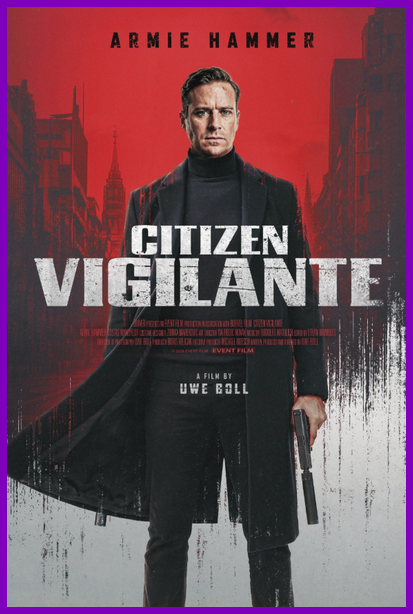
Sanders doesn’t wrestle with his conscience. He doesn’t pace the floor wondering whether two wrongs make a right. He doesn’t ask permission—from the police, the courts, society, or himself. By the time we meet the wealthy American expatriate at the center of Uwe Boll’s CITIZEN VIGILANTE, he has already drawn his line between justice and law. And God help anyone he believes has crossed it.
Written and directed by Boll and starring Armie Hammer and Costas Mandylor, CITIZEN VIGILANTE is a brutal, bloody, provocative contemporary Western, trading horses and dusty frontier towns for the streets of Europe, social media, the dark web, and an international manhunt. Hammer’s Sanders is our gunslinger, a man operating by a moral code entirely his own, dispensing what he sees as justice when courts and institutions fail to do so. But unlike so many cinematic vigilantes, Sanders suffers no crisis of conscience. He has already made his decision. There is no hand-wringing and no tortured debate over what he is becoming. He knows exactly who he is.
And Hammer understands that distinction beautifully.
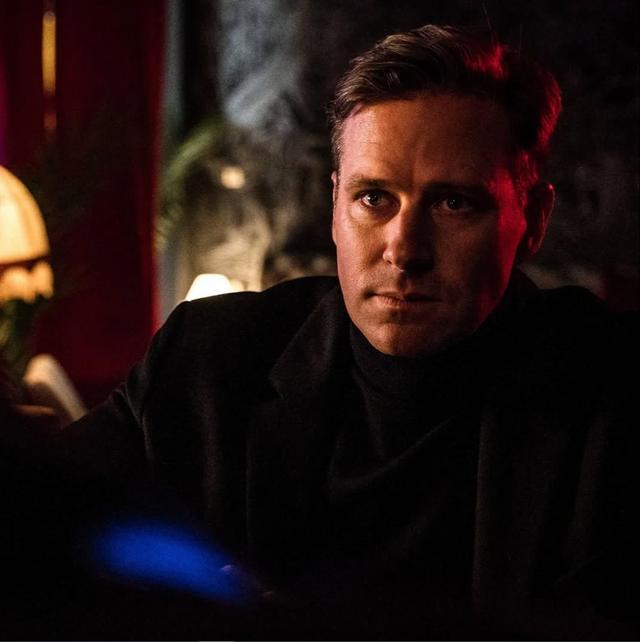
There is an economy to his performance that is striking. Sanders is methodical, unflinching, and almost unnervingly still. Hammer never pushes for action-hero swagger or grandstanding machismo. His power comes from restraint. He listens. He watches. He waits. And then he acts. Even when violence erupts around him, Sanders maintains the composure of an Old West gunslinger who knows he is the fastest draw in the room and has no reason to prove it until necessary.
But Hammer also gives Sanders an emotional dimension that prevents him from becoming merely a killing machine. A hospital visit with Elsa, a young victim whose attackers have escaped meaningful punishment, is particularly effective. The stillness remains, but its character changes. What reads as cold calculation elsewhere becomes empathy here. Sanders listens to victims and their families, and Hammer lets us see that their pain matters to him. Whether that empathy justifies what Sanders subsequently does is another question entirely—and one Boll wisely leaves hanging over the film.
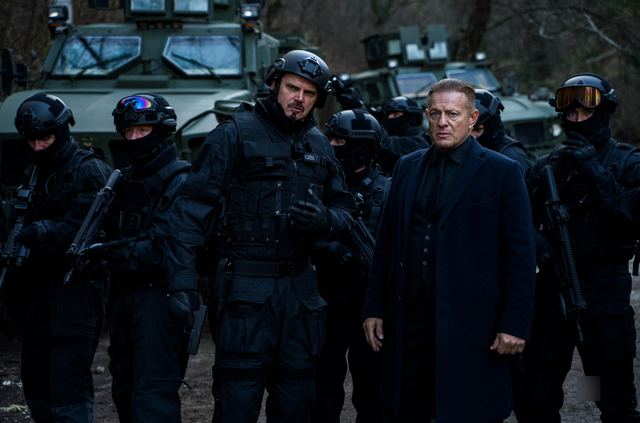
Standing on the opposite side of the law is Interpol Chief Henry, played by Costas Mandylor. If Sanders is the solitary gunslinger, Henry is the sheriff tasked with restoring order. Mandylor brings a looser energy to Henry, creating a welcome contrast with Hammer’s tightly controlled physicality. Henry understands that Sanders is dangerous not simply because he kills but because his actions are gaining an audience. Videos circulate online. Victims see them. People begin talking. The vigilante becomes a media phenomenon, and the hunt for one man starts becoming a battle over an idea.
Boll doesn’t pussyfoot around any of this. CITIZEN VIGILANTE is built around an uncomfortable dramatic question: what happens when the distance between law and perceived justice becomes so great that someone decides to fill that void himself?
Legality and justice are not presented as synonyms.
Inspired in part by real cases, including a rape case in Hamburg that Boll discussed as an inspiration for elements of the film, CITIZEN VIGILANTE places victims and institutional failures squarely within Sanders’ field of vision. Boll’s film knows precisely where its sympathies lie, but he doesn’t need lengthy philosophical arguments to communicate them. Faces, reactions, actions, and consequences do much of the work.
So does the camera.
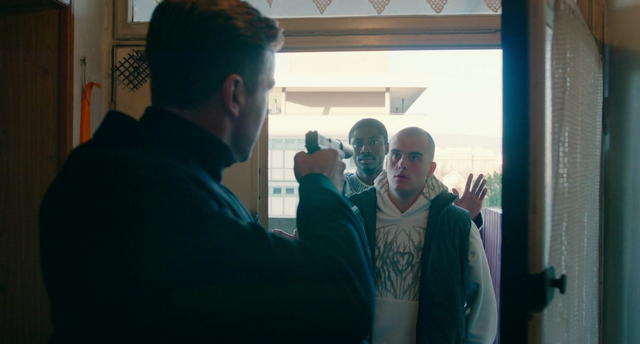
The visual language Boll oversees favors mid-shots and close-ups, particularly effective with Hammer’s minimalist performance. Rather than repeatedly mythologizing Sanders in heroic wides, the camera studies him, searching his face for minute changes. It brings us uncomfortably close during interrogations and confrontations while allowing Hammer’s restraint to dictate the frame. Sanders rarely needs to announce what he is thinking because the visual construction invites us to watch him think.
There is also a fascinating tension between the clarity of individual scenes and the deliberately disrupted chronology of the film as a whole. Editor Ethan Maniquis cuts the action with precision, while Boll rearranges events so that interrogations, vigilante acts, social-media declarations, and the investigation don’t always arrive in neat temporal order. Boll specifically wanted viewers to determine for themselves where certain events fall in Sanders’ timeline. Pasted text The result keeps Sanders simultaneously functioning as hunter, hunted man, suspect, interrogated subject, and online personality. The action is lucid. Time is slippery.
Nowhere does the marriage of camera, editing, production design, practical effects, and music work better than in the spectacular assault on Sanders’ fortified apartment.
This is where Boll lets loose.
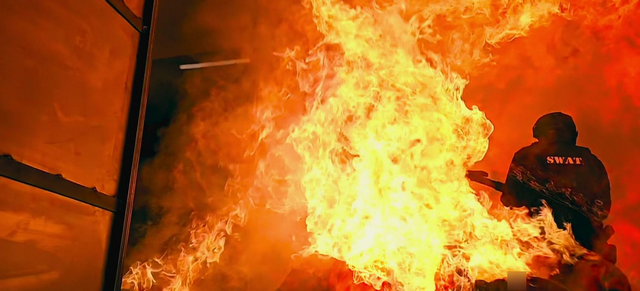
The apartment has essentially become a private fortress, complete with traps, reinforced positions, hidden elements, and enough firepower to welcome an army. Once the assault begins, Boll unleashes slow motion, explosions, breaking glass, gunfire, blood, and glorious flying splatter. Much of the destruction has wonderful tactile weight because Boll and his crew physically prepared the location for punishment, installing replaceable walls, windows and doors along with constructed bunker elements that could be destroyed during filming. Pasted text
And then composer Rodolfo Matulich does something delicious.
Against this orgy of destruction comes music with an almost jazz-salsa quality, an unexpectedly playful elegance dancing against the brutality onscreen. The juxtaposition is inspired. Instead of simply pounding us with the usual ominous action scoring, the music counterpoints the violence, turning the sequence into a macabre piece of choreography. Beauty meets bloodshed while Maniquis moves us back and forth between Sanders inside his fortress and Henry and the forces converging outside. Geography remains clear even as all hell breaks loose.
It’s a bravura sequence and the technical high point of the film.
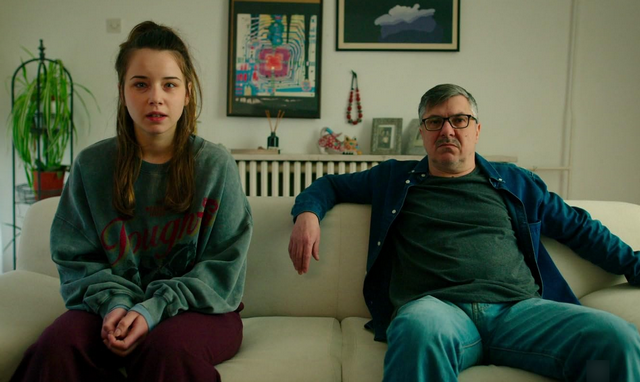
Production design also does some quiet storytelling throughout, from rich reds and browns giving warmth and texture to a bar setting to colder, more utilitarian spaces associated with Sanders’ work. Nothing feels unnecessarily polished. Boll embraces the rougher edges of independent filmmaking and uses them to his advantage, giving CITIZEN VIGILANTE a gritty immediacy that would likely disappear beneath the gloss of a larger studio production.
But spectacle never completely overtakes the people whose suffering set Sanders in motion. That’s important. For all the bullets, blood, confrontations, monologues, and swagger of its Western DNA, Boll keeps returning to victims.
And ultimately, that’s where CITIZEN VIGILANTE lands its hardest blow.
As Sanders’ actions become news and his crusade can no longer be contained in private rooms, dark-web videos, or police files, we return to a young victim watching what has happened. Tears come. And then, slowly, a smile begins to emerge.
Boll doesn’t need Sanders standing there to explain it.
He doesn’t need Henry to explain it.
And he doesn’t need us to pass judgment on it.
The reaction speaks for itself.
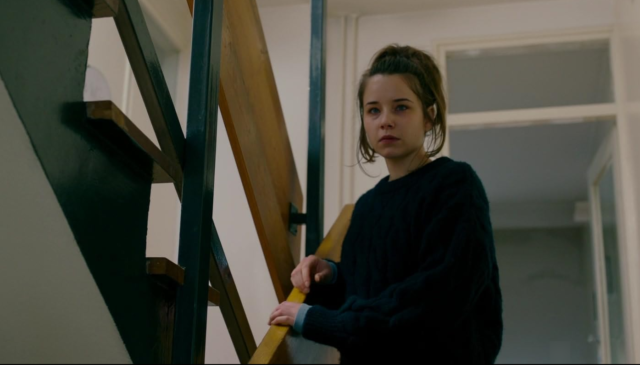
CITIZEN VIGILANTE closes with a dedication to victims of rape and murder whom the film says were betrayed by the legal system. By that point, Boll has already spent the film showing us what can happen when one man decides that the failure of law gives him license to become judge, jury, and executioner.
Is Sanders a hero? A murderer? An avenging gunslinger? A dangerous symbol? Perhaps the most provocative thing Boll does is refuse to make that decision for us.
He simply puts Sanders in our sights.
You decide whether to pull the trigger.
Written and directed by Uwe Boll
Cast: Armie Hammer and Costas Mandylor
by debbie elias, 06/15/2026