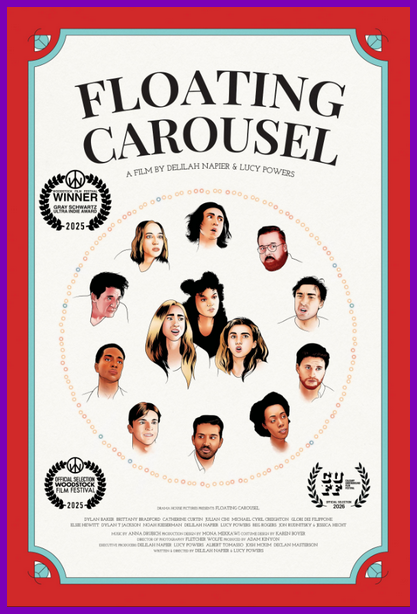
The more dating changes, the more dating stays exactly the same.
Apps may replace answering machines. Professional cuddling may now qualify as employment. The terminology changes, the technology changes, and the ways in which we can investigate, embarrass, deceive and humiliate one another have certainly become more sophisticated. But lousy dates, lousy sex, questionable romantic judgment and the indispensable best friend who helps you survive all three appear to be timeless.
Co-written, co-directed, co-edited and starring Delilah Napier and Lucy Powers, FLOATING CAROUSEL takes that eternal truth and sends it spinning through a decidedly contemporary collection of New York relationships. Funny, messy, occasionally absurd and ultimately rather sweet, it’s a lo-budget/no-budget/micro-budget indie that understands something essential about both dating and comedy: sometimes the funniest thing you can do with an outrageous situation is simply let it happen.
Napier and Powers play Olivia and Ruby, best friends navigating their own assortment of romantic entanglements while encountering a revolving collection of lovers, would-be lovers, ex-lovers and people for whom the word “relationship” may be applied only with considerable generosity. Among them are Alex (Glori Dei Filippone), Dafna (Brittany Bradford), Isaac (Jon Rudnitsky), Eric (Reg Rogers), Sebastian (Dylan T. Jackson) and Shanay (Julian Cihi).
And then there’s a professional cuddler.
I’m saying no more.
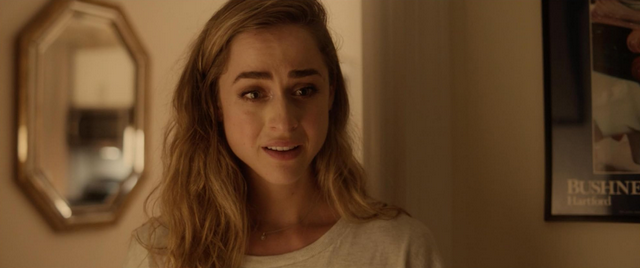
What makes much of FLOATING CAROUSEL work is that Napier and Powers don’t strain for jokes. The humor generally comes from behavior. An encounter goes badly. Someone says exactly the wrong thing—or, deliciously, exactly the right thing at the worst possible moment. A transactional relationship starts becoming something else. A seemingly innocuous visual detail suddenly becomes the punchline. And one particularly memorable romantic encounter ends with a revelation involving a man’s mother that is funnier because of what Fletcher Wolfe’s camera has already allowed us to see.
There is an observational quality to the comedy that gives even the film’s more outrageous turns a recognizable foundation. Anyone who has spent enough time dating has eventually accumulated stories that sound like fiction when repeated years later. Napier and Powers merely push that phenomenon a little farther, until bad dates, bad decisions and romantic revenge begin colliding with one another.
And collide they do.
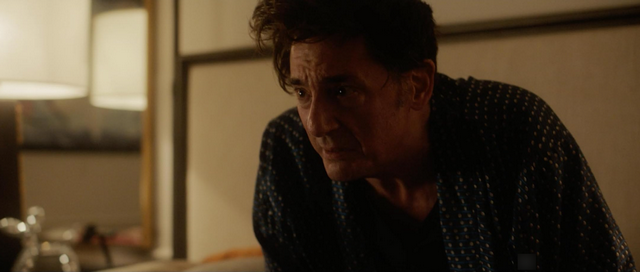
Originally conceived around separate stories before being woven into a feature, FLOATING CAROUSEL increasingly allows its characters and situations to intersect. A face glimpsed in one context resurfaces somewhere else. Relationships overlap. Information travels. Friends compare notes. And an escalating plot involving Shanay eventually sends the film careening into territory involving bedbugs, a restaurant, a cabaret and the sort of revenge scheme that can only end well if your definition of “well” is extremely flexible.
The title proves particularly apt because the carousel isn’t merely a metaphor for dating. Napier and Powers gradually build it into the language of the film itself.
People circle one another. They get on and off relationships. Characters disappear only to revolve back into view. Connections that initially seem incidental become part of a larger pattern. Even Anna Dubrich’s score gets into the act, bringing touches of bells, xylophone and a lilting 3/4 waltz rhythm that subtly keeps the carousel turning beneath the comedy.
Visually, Wolfe helps distinguish the different stages of that ride. Much of the New York material favors tighter framing—two-shots, mids and close-ups that keep these people pressed against one another and reinforce the claustrophobia of relationships from which nobody seems capable of escaping. It’s busy, intimate and sometimes intentionally dizzying.
Then comes the third act.
Suddenly there is air.
Blue sky. Ocean. Sunshine. Whites and bright yellows. Wider compositions.
Without spoiling how Olivia and Ruby get there—and believe me, getting there is half the fun—the visual release is immediate. After spending so much of the film trapped within the emotional and physical clutter of everybody’s lives, Napier, Powers and Wolfe finally give the women and the audience room to breathe. Even the imagery becomes more surreal as the movie moves toward its conclusion, culminating in the wonderfully peculiar sight of deteriorating carousel horses washed ashore.
The ride has literally come apart.
Unfortunately, FLOATING CAROUSEL could stand to lose a few horses before it reaches that beach.
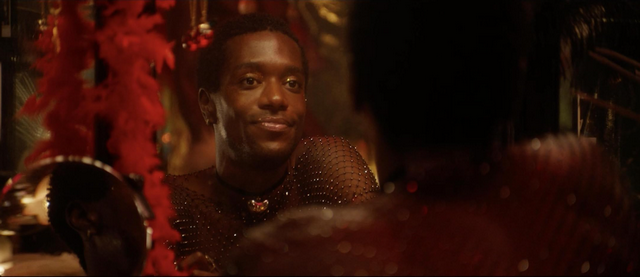
At approximately 90 minutes, the problem isn’t running time in the abstract. It’s narrative real estate. Napier and Powers have created an ensemble filled with amusing characters and situations, but not every one of them requires the amount of attention afforded it. Reg Rogers is hilarious and exasperating as Eric, but less Eric wouldn’t diminish Eric. Sebastian is engaging, but his storyline could be compressed. Even the professional cuddler thread, which contains some terrific visual comedy and one of my favorite reveals in the film, adds another full rotation to an already crowded ride.
The interconnected construction isn’t the problem. In fact, that’s part of the film’s charm.
Every horse on this carousel simply doesn’t require the same amount of riding time.

That’s particularly noticeable because Napier and Powers also edited the film. There are moments when one can almost feel the understandable reluctance of filmmakers who have fought to get something onto the screen to remove it once it’s there. On what I like to call a lo-budget/no-budget/micro-budget indie film, shot in only 21 days plus a pickup day, getting the necessary footage at all is an accomplishment.
But editing ultimately asks a different question.
Not “Can we keep it?”, but “Does the movie need it?”
A tighter cut and slightly narrower character scope would give the comedy greater propulsion and make the eventual opening-up of the third act even more effective. Instead of occasionally feeling as though the carousel has made one revolution too many, we’d be propelled toward that final destination.
Still, excess is a considerably more forgivable problem when what’s being served up is this much fun.
Napier and Powers have an appealing chemistry as Olivia and Ruby, and the friendship between the women gives FLOATING CAROUSEL its center. For all the romantic permutations surrounding them, theirs is the relationship that matters. Men arrive. Men leave. Dates implode. Sex disappoints. Schemes escalate. Bedbugs happen.
The friend remains.
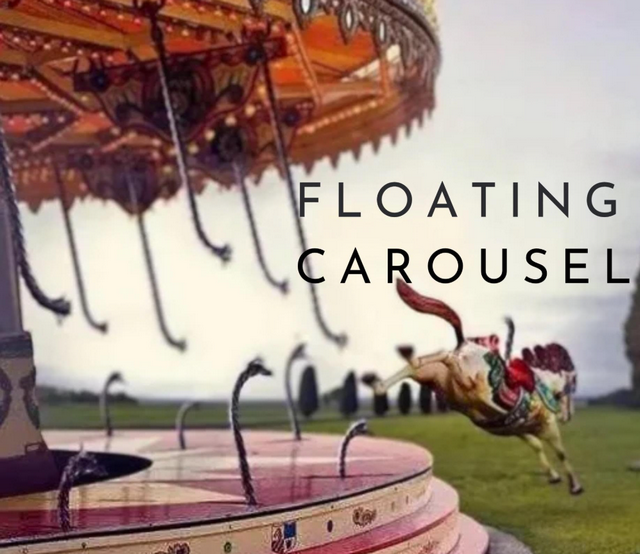
And perhaps that’s why those broken carousel horses on the beach resonate beyond the sheer oddity of the image. The romantic ride may be battered, waterlogged and considerably worse for wear, but Olivia and Ruby are still there to look at the wreckage together.
Dating may change its vocabulary, technology and preferred methods of humiliation.
But apparently the carousel keeps turning.
And thank heaven your best friend is riding beside you.
Written and directed by Delilah Napier and Lucy Powers
Cast: Delilah Napier, Lucy Powers, Glori Dei Filippone, Brittany Bradford, Jon Rudnitsky, Reg Rogers, Dylan T. Jackson, Julian Cihi
by debbie elias, 09/24/2026
FLOATING CAROUSEL is currently playing in New York City and expanding from there.