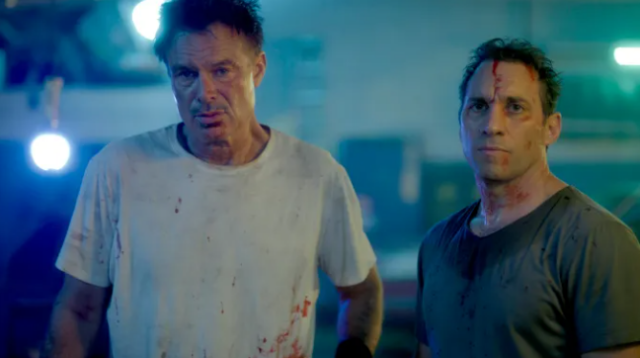
There’s a moment early in DIRTY HANDS when the Denton brothers—Danny and Richie—are catching their breath inside a mechanic’s garage, blood still fresh, adrenaline still spiking, the outside world closing in. It’s quiet. Too quiet. And yet, everything in that silence is screaming.
That’s where writer/director/star Kevin Interdonato plants his flag.
Not in spectacle. Not in stylized action. But in the messy, volatile, deeply human space between two brothers who love each other just enough to destroy each other.
And possibly die trying to save one another. Brotherhood Before Bullets.
On its surface, DIRTY HANDS is simple: a drug deal goes bad, and the Denton brothers have one night to survive the fallout. But Interdonato isn’t interested in plot mechanics as much as he is in emotional mechanics.
This is not about what happens. This is about who stays.
Interdonato builds the entire film around that central question—what does loyalty look like when it costs you everything? And more importantly, what does it look like when you don’t deserve it?
Danny (Interdonato) is reckless, volatile, the kind of guy who creates problems faster than he can solve them. Richie, played by the late Patrick Muldoon, is the older brother carrying the weight—of responsibility, of history, of a life that might finally offer something more… if he can just walk away.
But walking away isn’t that simple when blood isn’t just on your hands—it’s in your DNA.
Muldoon’s performance lands with a quiet, devastating weight. There’s an internal war playing out behind his eyes in nearly every frame, a calculation of love versus survival that never tips into melodrama. Instead, it simmers. It aches. It lingers.
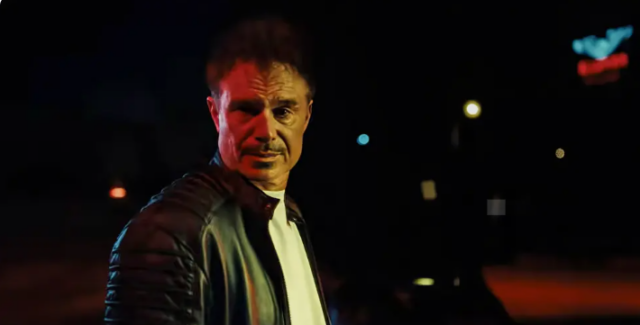
Interdonato, meanwhile, leans into Danny’s volatility with unapologetic authenticity. There’s no softening the edges here. No attempt to make him palatable. And that’s precisely what makes the dynamic work. You believe these men. You recognize them. You’ve met them—on a street corner, at a family dinner, in your own past.
And when they collide, it’s not pretty.
It’s real.
Working with cinematographer and production designer Eric Muller, Interdonato constructs a visual language that is deceptively simple and remarkably effective. Claustrophobia becomes a character. The mechanic’s garage becomes the film’s beating heart.
Half sanctuary. Half trap.
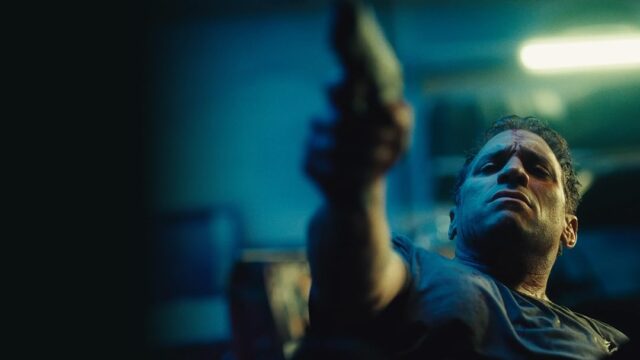
Bathed in a cool blue wash, the space feels at once calming and suffocating—a visual contradiction that mirrors the brothers themselves. The blue doesn’t soothe. It numbs. It cloaks. It buys time. But it never promises escape.
Interdonato embraces containment not as a budgetary limitation, but as a narrative weapon. By locking his characters into this space, he strips away distraction and forces confrontation—between the brothers, between past and present, between instinct and consequence.
Every element within that garage serves a purpose. Nothing is ornamental.
A blinking work light becomes both visual punctuation and psychological irritant. The geometry of the space dictates movement, tension, and proximity. Even the placement of objects feels intentional, reinforcing the sense that there is nowhere left to run.
Outside, the world is fragmented—headlights, taillights, alleyways—glimpses of danger rather than fully realized escape routes.
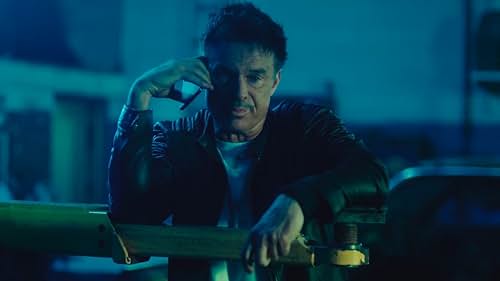
Inside, everything is immediate.
And inescapable.
If the visuals trap you, the sound design tightens the grip.
Interdonato and his team understand something many films overlook: silence is never truly silent. Especially at night.
Crickets, distant movement, the hum and buzz of artificial light—these aren’t background elements. They are active participants in the tension-building process. Each sound is amplified just enough to unsettle, to suggest movement, to imply threat.
At times, it feels as if the environment itself is breathing.
Watching.
Waiting.
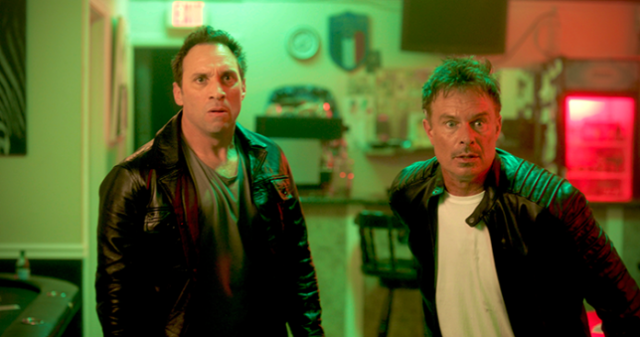
It’s a subtle but powerful technique, one that draws the audience deeper into the brothers’ headspace, where every noise could be danger and every pause could be the last moment of calm.
Interdonato makes a very clear choice with DIRTY HANDS: violence is not choreography. It’s impact.
Gone are the slick, stylized fight sequences of mainstream action cinema. In their place is something far more uncomfortable—violence that feels abrupt, disorganized, and painfully real. Hits land awkwardly. Bodies react. Pain registers.
You feel it.
And that’s by design.
Despite meticulous stunt coordination behind the scenes, the end result never feels “performed.” Instead, it carries the unpredictability of real confrontation—the kind that doesn’t follow rhythm or spectacle.
It just happens.
And sometimes, it’s over before you fully process it.
While the film is firmly anchored by the Denton brothers, Interdonato smartly expands the emotional field through supporting performances.
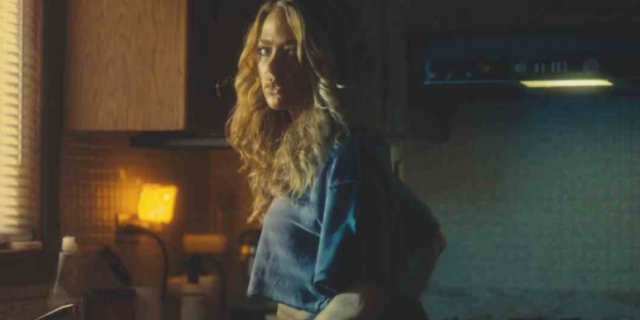
Denise Richards delivers a surprisingly grounded and emotionally layered turn as Sheila, Richie’s wife. There’s a quiet devastation in her performance—a woman caught in the crossfire of choices she didn’t make but must endure. She becomes the film’s moral center, not through grand gestures, but through presence. Through stillness. Through the simple act of being the one left to absorb the fallout.
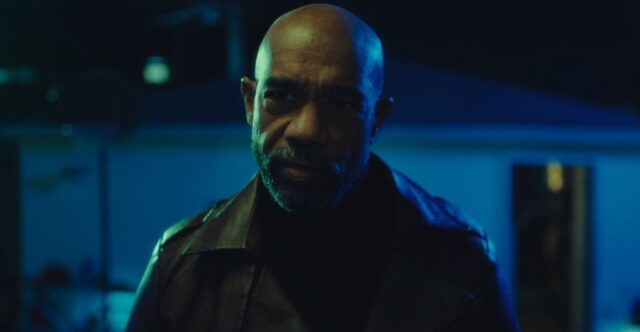
Michael Beach, as always, brings a commanding authenticity to his role as Dally, elevating every moment he’s on screen with a lived-in authority that never feels forced.
One of the most impressive aspects of DIRTY HANDS is how seamlessly its independent filmmaking roots are woven into its aesthetic.
This is a film that understands how to do more with less—and never apologizes for it.
Contained locations. Minimal wardrobe. A small, committed crew. Practical lighting. Near-chronological shooting.
These are not compromises.
They are choices.
And those choices result in a film that feels cohesive, intentional, and deeply connected to its own identity.
There’s no excess here. No wasted movement. No unnecessary flourish.
Just story. Character. Atmosphere.
And a filmmaker who trusts all three.
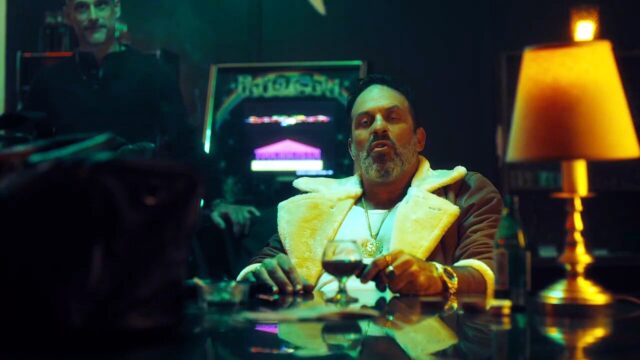
DIRTY HANDS is not interested in being flashy. It’s not chasing genre expectations or trying to reinvent the wheel. What it does instead is far more difficult.
It commits—fully and unapologetically—to authenticity.
To brotherhood that is messy, complicated, and, at times, brutal.
To violence that hurts.
To silence that speaks.
To spaces that confine as much as they protect.
And at the center of it all is the bond between Danny and Richie—a bond that, in light of Patrick Muldoon’s passing, resonates even more deeply.
Because what remains isn’t just the story of two brothers trying to survive the night.
It’s the imprint of a performance—and a partnership—that feels lived, not played.
And that is something you can’t fake.
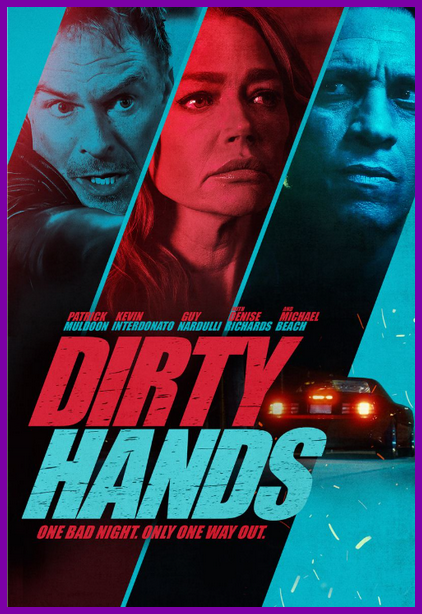
Written and Directed by Kevin Interdonato
Cast: Patrick Muldoon, Kevin Interdonato, Denise Richards, Michael Beach, Guy Nardulli
by debbie elias, 04/26/2026
DIRTY HANDS is now available On Digital and On Demand