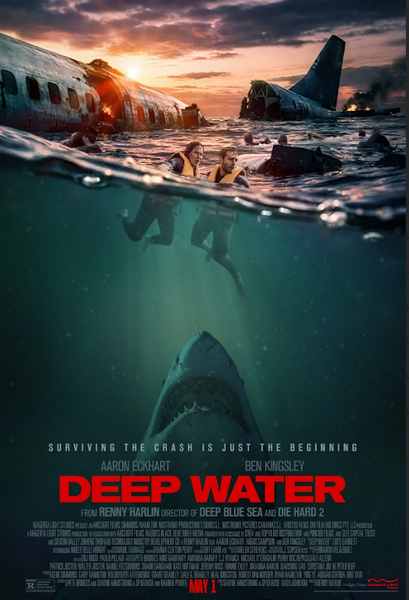
There are shark movies, and then there are shark movies that make you reach for tissues.
Yes, tissues.
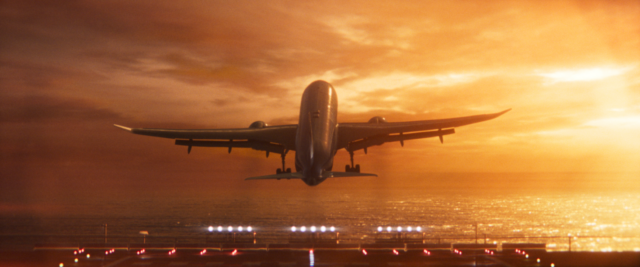
That is one of the great surprises of Renny Harlin’s DEEP WATER, a full-throttle survival thriller that begins with a flight from Los Angeles to Shanghai and very quickly turns into a nightmare of fire, water, wreckage, panic, and circling fins. The premise is pure genre fuel: a plane crashes in the middle of the Pacific, survivors fight to stay alive, and the ocean is not remotely interested in mercy.
But Harlin, being Harlin, does not stop at spectacle. He builds DEEP WATER as an immersive experience—one driven by sound, spatial geography, practical filmmaking, and unexpected humanity. This is a film where the sharks deliver the jolts, but the people give the story its pulse.
And when those people are lost, it hurts.
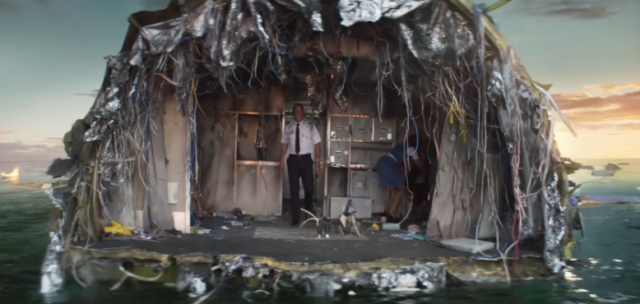
The first key to DEEP WATER is fear. Not cheap fear. Palpable fear. Harlin and editor Geoff Lamb structure the film with extraordinary control, allowing moments of calm to settle just long enough before they are ripped away by explosions, impact, sudden shark strikes, or the terrifying realization that there is no land, no help, and very little time. The editing is taut and lucid, especially once the plane breaks apart into distinct sections—the cockpit, the fuselage, and the tail—each with its own danger, geography, and emotional stakes.
That plane crash is a stunner.
At roughly the 32-minute mark, DEEP WATER delivers one of its most technically and emotionally gripping sequences as the aircraft plummets into the ocean, tumbling from nose to side fuselage to tail and back again before slamming into the water and splitting apart. Bodies, baggage, water, metal, flame, and terror collide in a seamless blend of live action and visual effects. Then Harlin cuts to black.
When the image slowly returns, it emerges through water: carnage, wreckage, fire, floating debris, survivors, and death.
It is breathtaking filmmaking.
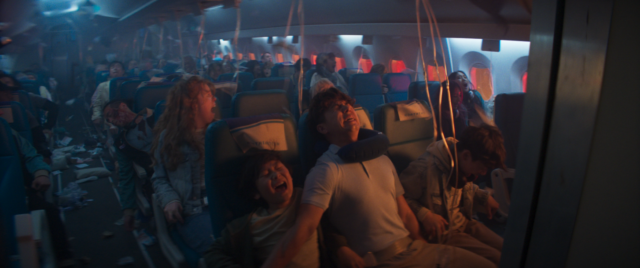
But what makes it work is not just the scale. It is the immersion. Harlin reportedly built a plane for the shoot, filled it with real extras, flooded it with water, and used stunt performers strapped into seats as bodies within the wreckage. That kind of practical foundation matters. You feel the difference. The underwater sequences are not sterile or weightless. They have texture, danger, and physicality. The bodies feel real. The panic feels real. The water feels like it is closing in around you.
Cinematographer D.J. Stipsen brings remarkable visual range to the film, from the gorgeous warmth of the opening sunset and night flight to the eerie green-blue washes of the underwater wreckage. The color design is not random. Blue begins early, with Captain Rich’s karaoke rendition of “Fly Me to the Moon” in a bar awash in aquatic tones, followed by a dissolve through an aquarium into bubbling water and Aaron Eckhart’s First Officer Ben surfacing from a bathroom sink. It is a visual seed planted early and paid off beautifully once the film plunges into the Pacific.
Water is everywhere before it is everywhere.
Once the crash occurs, Stipsen and Harlin constantly shift perspective: eye-level in the water, aerial views of devastation, underwater views looking up through debris, tight shots of fear-stricken faces, and wide images of survivors dwarfed by endless ocean. The camera keeps us oriented even as the characters are disoriented, which is no small feat in a film with multiple survival pockets and constantly changing danger.
And then there is the sound.
The sound in DEEP WATER is exceptional. Oriol Tarragó’s sound design and supervising sound edit create a soundscape that is immersive from the opening frames. The recurring single-note piano motif in Fernando Velázquez’s score becomes almost a heartbeat—sometimes somber, sometimes fragile, sometimes eerily calm against escalating catastrophe. Marc Blanes’ score mix is meticulous, allowing the music to rise, recede, and haunt without telegraphing every shark attack.
This is not Jaws territory where the music announces the monster. Harlin is after something more human and more unsettling.


During the crash, the sound mix layers voices, screams, prayers, explosions, water, tearing metal, and muffled distortion until the experience becomes overwhelming. Then, at key moments, sound drops away. We hear less. We feel more. The muffled underwater panic, the crack of glass, the sizzle of fire in cargo, the soft lap of water against a raft, the ticking clock beneath mounting dread—all of it works to pull the viewer inside the disaster rather than merely watch it.
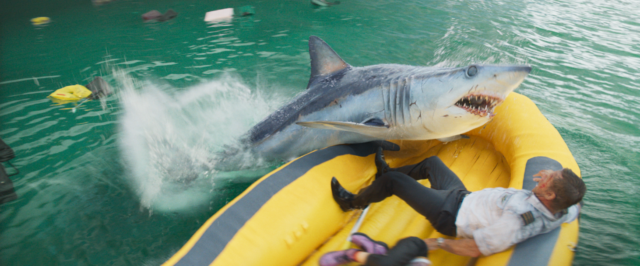
That is why the shark attacks land so hard. Harlin does not overplay them. Some are sudden. Some are suggested before they are seen. Some come from below, bumping against rafts, unseen and terrifying. In one of the film’s most effective choices, we do not always need to see the shark to feel the threat. A raft floor jolting upward again and again is enough. Hitchcock would approve.
And when the sharks do attack, they do not nibble.
They arrive with shocking force: Penny being taken in the water, a survivor grabbed mid-chaos, a diver attacked during a rescue attempt, the helicopter dragged into disaster, and—yes—the inevitable and deeply satisfying fate of Angus Sampson’s Dan, the passenger so obnoxious from the beginning that one practically starts rooting for the sharks to develop discerning taste.
They do.
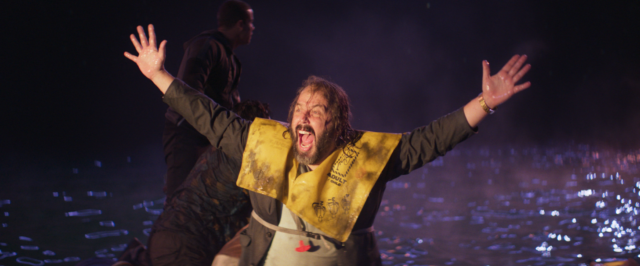
But even Dan is not written as a flat cartoon. Harlin gives him enough humanity late in the film to remind us that even the worst person in the raft is still a person with someone at home. That does not make any potential shark dinner any less satisfying, but it does keep the film from slipping into pure caricature.
That balance is what elevates DEEP WATER. The film is loaded with carnage, but it is not careless with its characters. Aaron Eckhart is terrific as Ben, a disciplined former Air Force pilot whose calm under pressure becomes the survivors’ best chance. Eckhart has always had an ease with child actors, and his scenes with Molly Belle Wright (who is a scene stealer) as Cora, as well as Elijah Tamati as Cora’s younger step-brother Finn, give the film an emotional center beyond survival mechanics. Sir Ben Kingsley brings warmth and gravitas as Captain Rich, whose final moments are among the film’s most poignant. His quiet sacrifice, his “It’s your plane, Ben,” and the return of “Fly Me to the Moon” give the film a melancholy grace note amid disaster.
The supporting characters are not throwaways. Penny, Becky, Matt, Zoey, Lilly, the young athletes, Cora, Finn—each gets enough definition to matter. Becky, especially, is a heartbreaker. Exquisitely played by Kate Fitzpatrick, her scenes with young Elijah Tamati’s Finn inside the airlocked tail section provide tenderness amid terror, and her final moments, as water rises around her and she speaks softly to the image of her granddaughter on her phone, are devastating.
Damn you, Renny. I do not expect tears and tissues in a shark movie.
But there they are.
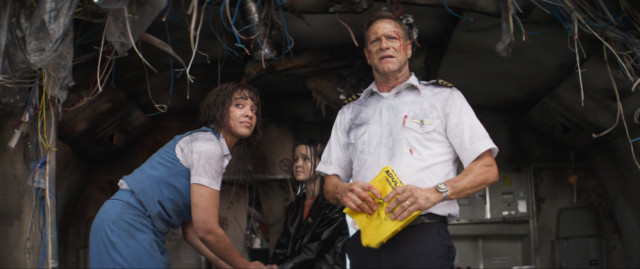
The film’s third act keeps escalating without losing sight of geography or humanity. A helicopter rescue turns into catastrophe. A Chinese trawler becomes hope. The reef creates another obstacle. Sharks circle. Survivors cling to rafts and wreckage. Ben swims through danger. A captain makes a humane choice, releasing fish into the water to draw the sharks away and save people he does not know. That sequence, cut with tight precision between binocular POV, raft panic, water danger, and shipboard decision-making, is one of the film’s most satisfying examples of suspense built around decency.
That is the secret weapon of DEEP WATER. It is not merely about who survives. It is about who helps.
For all the blood in the water, Harlin continually returns to grace notes: a child holding onto someone’s shoes because that small promise matters; a grandmother comforting a boy she barely knows; a pilot showing a grieving girl a picture of his sick son; a captain choosing compassion over distance; strangers forming temporary families because the ocean has stripped everything else away.
And yes, in the middle of all this wreckage and water, the toilet paper in the bathroom survives dry until the flood rushes in. A miracle worthy of its own citation.
DEEP WATER is built for audiences who want immersion, tension, and shark-movie thrills, and Harlin delivers all of that with muscle and precision. But what makes the film linger is not only the frenzy of fins and blood. It is the craft beneath the chaos—the sound design that traps us inside panic, the editing that keeps multiple survival threads razor-sharp, the cinematography that turns water into both beauty and threat, and the character work that makes each loss register.
This is Renny Harlin doing what he does best: taking a high-concept genre premise and giving it scale, propulsion, technical polish, and heart.
The sharks may get their feast, but DEEP WATER gives the audience something more satisfying: fear with feeling.
Directed by Renny Harlin
Written by Pete Bridges and John Kim
Cast: Aaron Eckhart, Angus Sampson, Ben Kingsley, Lucy Barrett, Molly Belle Wright, Kate Fitzpatrick, Richard Crouchley, Elijah Tamati, Rosie Zhao
by debbie elias, 04/15/2026
DEEP WATER is in theatres on May 1, 2026.