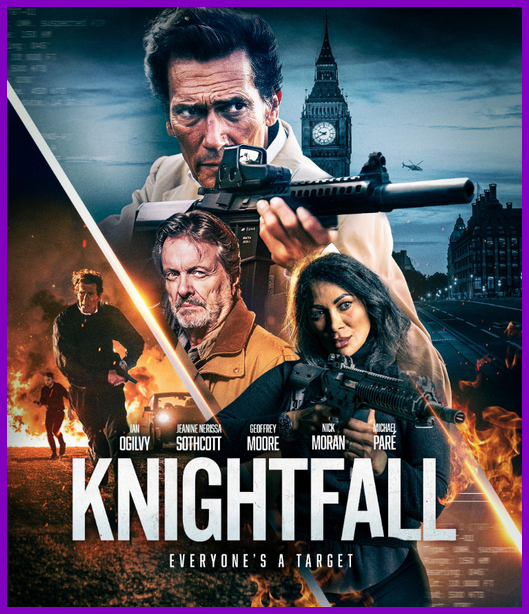
There is something wonderfully refreshing about an espionage thriller that remembers the most important weapon in a spy’s arsenal is his brain.
Lean, character-driven, and refreshingly free of gadgetry and bombast, KNIGHTFALL puts intelligence before action and then makes that action count. Director Ben Fortune and writers Robert Dunn, James Smy, and Bob Schultz deliver a grounded British spy thriller in which moves and countermoves matter, relationships carry consequences, and a chessboard proves every bit as important to understanding the film as a gun.
At the center of it all is Ros, played by Jeanine Nerissa Sothcott.

A scientist holding the only key to a stolen briefcase containing a deadly man-made biological weapon, Ros is much more than the familiar endangered daughter whose predicament pulls a retired operative back into action. She is the lynchpin of the entire story. The weapon makes her essential to the plot, but her relationships make her essential to the film.
On one side is her father, Charles Knight (Ian Ogilvy), a former MI5 spy catcher whose retirement is interrupted when Ros becomes a target. On the other is Ros’s boyfriend Hugh (Geoffrey Moore), a younger, cooler MI5 agent very much of the contemporary intelligence world. Ros stands between the two men personally and generationally, giving KNIGHTFALL an emotional dimension beyond simply stopping the bad guys before they get the deadly contents of that briefcase.
Sothcott proves more than capable of carrying that responsibility. There is a grounded maturity to Ros that immediately works in the film’s favor. She is intelligent without the screenplay having to keep announcing her intelligence, vulnerable when circumstance warrants it, yet never helpless. And when the situation turns physical, the film doesn’t suddenly transform her into an implausible superwoman.
That restraint is particularly evident in the action direction of Darren LeFevre.
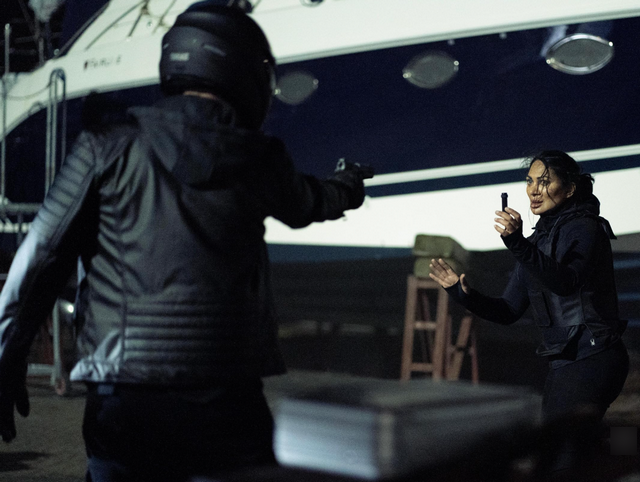
Rather than choreographing fights simply for visual flash, LeFevre works with the physicality and abilities of the performers. Ros is a petite woman frequently facing considerably larger opponents, and the action acknowledges that. She fights accordingly, using movement, leverage, circumstance, and sheer determination rather than magically acquiring the ability to overpower men twice her size.
The result is action that feels tactile and believable, particularly during a terrific safe-house confrontation involving Ros and Michael Paré. It’s hard-hitting, tightly constructed, and beautifully integrated with the camera rather than staged simply to showcase choreography. A rain-soaked marina sequence similarly makes excellent use of environment, darkness, and physical vulnerability.
But KNIGHTFALL’s greatest strength may be that Fortune knows action is only one piece on the board.
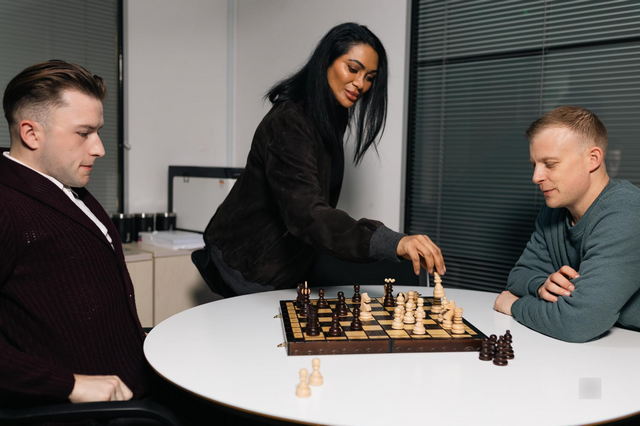
That board becomes literal in one of the film’s best scenes as Charles and Ros sit opposite each other over a game of chess. What could easily have become a static exposition dump instead crystallizes the film’s entire approach. This is a story about thinking ahead, anticipating another person’s moves, knowing when to advance and when to hold position.
KNIGHTFALL itself is a chess game.
And Ian Ogilvy is exactly the man you want sitting at the board.
Ogilvy brings Charles an effortless old-school refinement that never slips into caricature. There is history in his manner, confidence in his silences, and the unmistakable sense that retirement may have removed Knight from active service but hasn’t dulled the instincts that made him formidable in the first place.
The production design reinforces that beautifully.
KNIGHTFALL develops an increasingly rich visual and tonal bandwidth through the environments inhabited by its principal characters. Ros’s safe-house apartment is clean, sparse, almost clinical. Hugh’s home is hipper and more contemporary, with greater texture and a spectacular showy glass fireplace commanding the center of the room. Then we arrive at Charles’s manor, and the visual world expands into wood, staircases, fireplaces, artwork, shadow, and history.
Charles is old school not only in his manor, but in his manner.
But don’t mistake old school for obsolete.
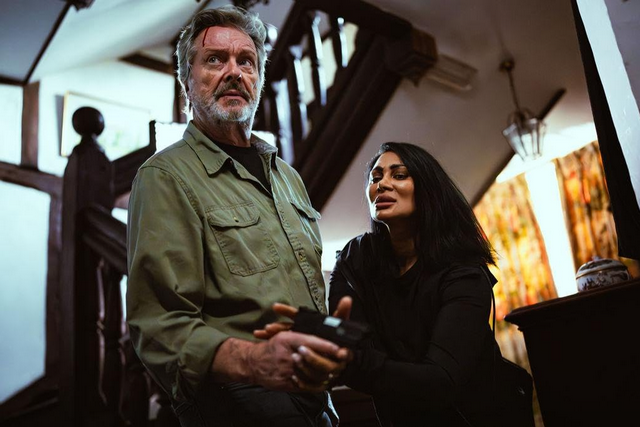
Embedded within all that history is an impressive security and surveillance system, complete with ever-present black-and-white monitors ready to announce unwelcome visitors. Charles may surround himself with the trappings of another era, but he has kept pace with the modern intelligence world.
And sometimes even an excellent security system can’t prevent an exploding front door.
That melding of generations becomes one of KNIGHTFALL’s most enjoyable undercurrents. Hugh’s sleek modernity and Charles’s old-school refinement aren’t presented as mutually exclusive approaches but as different generations of the same clandestine world—with poor Ros caught squarely between her father and her boyfriend.
Casting Geoffrey Moore as Hugh adds another delightful dimension.
Moore has charisma to burn, with a vocal timbre and cadence that can be startlingly evocative of his father, Sir Roger Moore. Yet Geoffrey possesses his own distinctly contemporary screen presence, making Hugh feel entirely at home as the younger MI5 man.
Putting Moore opposite Ogilvy also gives the film a lovely bit of cinematic history without ever turning it into a stunt. Ogilvy famously succeeded Roger Moore as Simon Templar, starring in Return of the Saint after Moore’s tenure in The Saint. Now Ogilvy and Moore’s son inhabit two generations of the British intelligence world together.
The Saint and the son of a Saint.
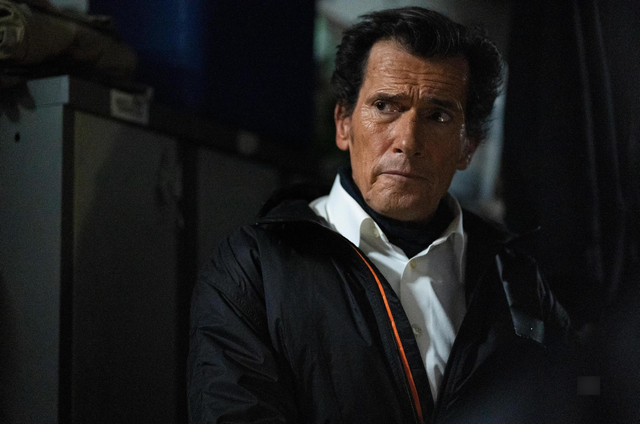
Fortune wisely doesn’t beat us over the head with it. There are no winking Bond gags, no desperate attempts at pastiche, no gadgetry inserted merely to capitalize on the Moore name. KNIGHTFALL respects that heritage and then gets on with telling its own story.
And Moore is allowed to get on with playing Hugh.
James Westlake’s cinematography is instrumental in establishing the film’s shifting visual personality. Particularly effective are the night-for-night shoots, with Westlake leaning into rich, inky blue-blacks that immediately fuel KNIGHTFALL’s cloak-and-dagger tone as action kicks off the film. That nocturnal palette returns during later nights as Ros seeks the help of her father, visually reconnecting us with the danger already set in motion. Interiors develop increasing warmth, depth, and texture as the story moves through its various worlds, while the rain-soaked marina sequence takes full advantage of darkness, reflections, and the cold night air to heighten both tension and physical vulnerability. Westlake also makes strong use of Charles’s manor, allowing its architecture to become part of the action rather than merely serving as an attractive backdrop.
Mike Myshko’s editing keeps everything moving with similar economy. KNIGHTFALL doesn’t overstay its welcome, nor does it inflate sequences merely to make the movie feel bigger than it is. Logan Jones’s score complements rather than overwhelms, allowing tension and performance room to breathe.
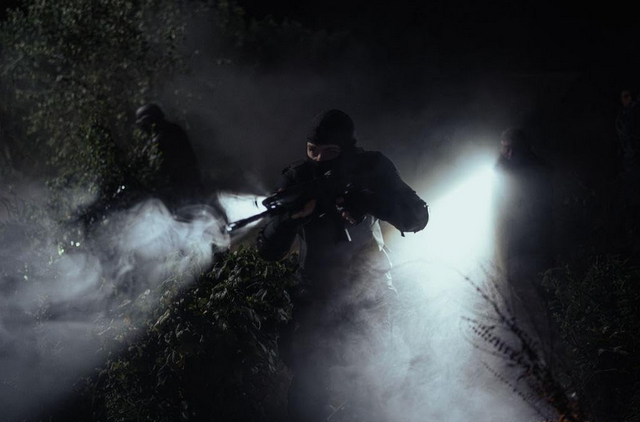
That economy is important because KNIGHTFALL knows exactly what kind of movie it wants to be.
This isn’t globe-hopping superspy spectacle. It doesn’t need exploding volcano lairs, fleets of exotic cars, or a quarter-billion-dollar budget. Its pleasures are smaller and more intimate: watching experienced performers inhabit well-defined characters; seeing a seemingly innocuous conversation acquire greater significance; letting intelligence create suspense before violence releases it; and using locations, action, and production design intelligently rather than wastefully.
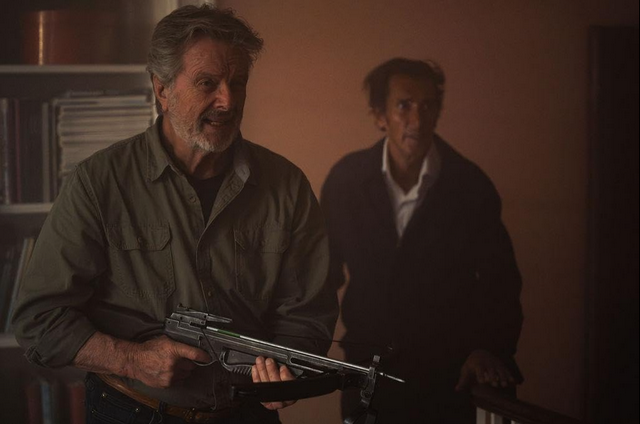
Even the film’s opening makes its intentions clear. A military installation, a covert operation, Geoffrey Moore—and a crossbow—give us an immediate taste of danger before the story settles into the character work that will ultimately drive it.
And drive it Ros does.
For all the pleasures of watching Ogilvy’s old-school spy catcher return to action and Moore’s younger MI5 operative move through his contemporary world, Ros remains the connective tissue. Without her, Charles has no personal reason to return. Without her scientific knowledge, the biological threat cannot be resolved. And without her relationship to both Charles and Hugh, the film loses the human triangle that gives its espionage mechanics emotional stakes.
Jeanine Nerissa Sothcott makes certain we never forget it.
Most importantly, KNIGHTFALL leaves you wanting more.
Not because it feels incomplete. Quite the opposite. Fortune delivers a satisfying, economical espionage thriller that understands the value of leaving a little unexplored territory on the map. Charles Knight feels like a character with more history than one film can contain, and the world around him feels capable of generating another mission without simply repeating this one.
KNIGHTFALL understands that the best spy games aren’t played with gadgets. They’re played with people.
And like any good chess player, it knows that sometimes the smartest move is the one that leaves your opponent—and your audience—wondering what comes next.
Here’s hoping Charles Knight has another move left on the board.
Directed by Ben Fortune
Written by Robert Dunn, James Smy, Bob Schultz, and Simon Cluett
Producer: Jonathan Sothcott
Cast: Ian Ogilvy, Jeanine Nerissa Sothcott, Geoffrey Moore, Robert Cavanah, Rupert Holliday Evans, Nick Moran, and Michael Paré
by debbie elias, 09/05/2026
KNIGHTFALL is available on Digital and On Demand on September 11th