GRIPPING.
That’s the word.
Not “action-packed.”
Not “pulse-pounding.”
Not “high-octane.”
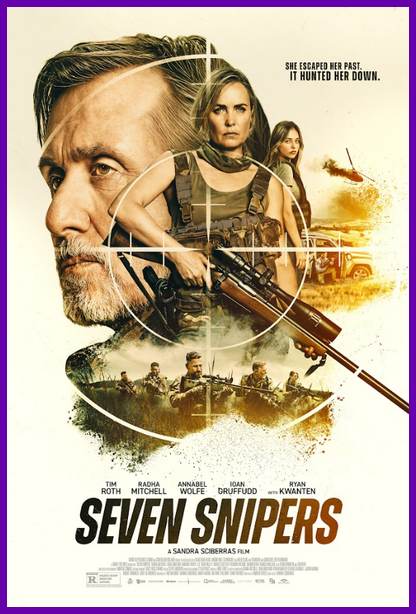
SEVEN SNIPERS is gripping because director Sandra Sciberras understands that sustained tension is not created through nonstop movement or endless gunfire. It is built through silence, restraint, uncertainty, spatial orientation, concealment, and hyper-awareness.
Every creative discipline in the film feeds that singular objective: sustained and escalating tension.
This is not a tactical thriller interested in spectacle for spectacle’s sake. It is a film that weaponizes:
environmental sound,
fragmented perspective,
withheld exposition,
visual isolation,
and emotional suppression.
And that’s why it works so well.
Set against the harsh, bug-infested isolation of the Australian countryside, SEVEN SNIPERS follows former elite sniper Kris (Radha Mitchell), whose secluded existence with daughter Anja (Annabel Wolfe) erupts into a deadly siege when the terrifying Dragon (Tim Roth) resurfaces from her past. But Sciberras wisely avoids drowning the narrative in exposition-heavy mythology or overexplained backstory. Instead, the film reveals itself in fragments — behavioral clues, facial tension, clipped dialogue, tactical movement, and brief flashes of memory that hint at years of buried trauma without ever fully spelling everything out.
That restraint becomes one of the film’s greatest strengths.
Like the snipers themselves, the film understands the value of concealment.
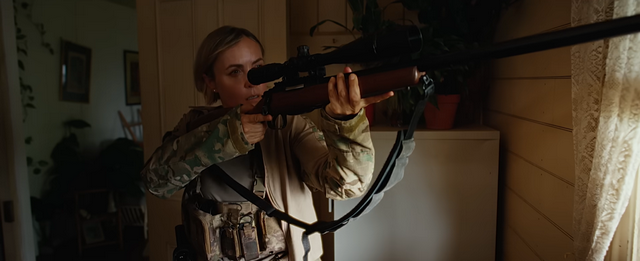
Characters survive by remaining quiet, still, and unreadable. Emotionally and tactically, exposure becomes dangerous. As a result, SEVEN SNIPERS communicates through physicality as much as dialogue. Sweat gathering on Kris’s face. Controlled breathing. Slight shifts in posture. Eyes scanning terrain. Bodies remaining unnaturally motionless while danger quietly closes in.
The audience is forced to observe the same way the characters observe.
And that observational tension is amplified enormously through the work of editor Stephanie Liquorish and supervising sound editor/re-recording mixer Dylan Barfield. Silence in SEVEN SNIPERS is never empty. Wind through grass, insects humming, distant movement, fabric brushing against terrain, the subtle intake of breath — every sound becomes a possible threat.
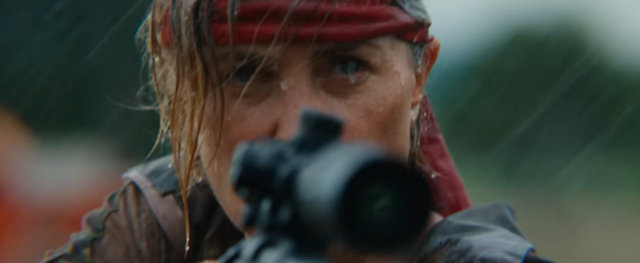
Silence itself becomes suspense.
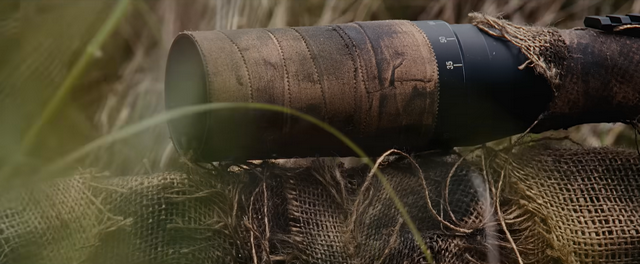
Liquorish’s editorial rhythms further heighten the tension through a carefully orchestrated interplay of sniper-scope POVs, wider environmental shots, and abrupt visual interruptions. Particularly effective is the film’s use of individualized scope designs, allowing audiences to instantly recognize whose perspective they are inhabiting while simultaneously emphasizing the terrifying limitations of tunnel vision.
You can see 1000 yards ahead. But not 2 feet beside you.
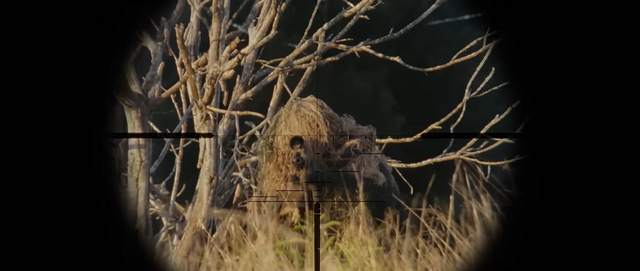
That vulnerability drives nearly every sequence.
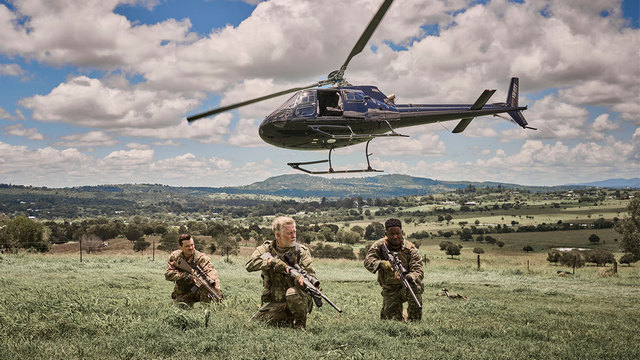
Visually, cinematographer Andrew Condor leans heavily into environmental realism while simultaneously constructing a clear tactical visual grammar for the audience. Condor delivers striking panoramic and aerial photography of Kris’s isolated property, carefully establishing the geography of the terrain and the escalating dangers hidden within it.
Those sweeping overhead and wide-frame compositions do far more than simply showcase the rugged Australian landscape. They orient the audience spatially, allowing viewers to understand sightlines, exposure points, escape routes, sniper positioning, and the enormous challenge of both locating and evading Dragon within the vast terrain surrounding the farmhouse.
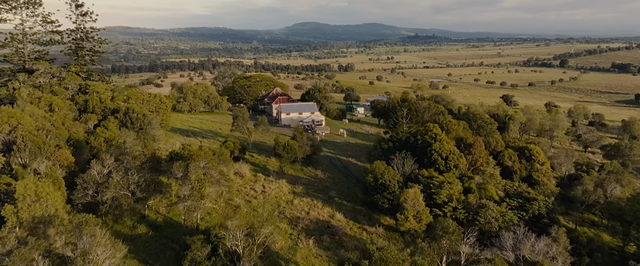
That spatial clarity becomes essential to the film’s suspense mechanics. Audiences always understand the physical vulnerability of the characters even when they cannot see the threat itself.
At the same time, Condor balances those expansive environmental compositions with intensely claustrophobic sniper POV imagery and tightly framed close-ups emphasizing sweat, breath, eye movement, and minute physical reactions. The result is a visual language constantly oscillating between tactical overview and suffocating immediacy.
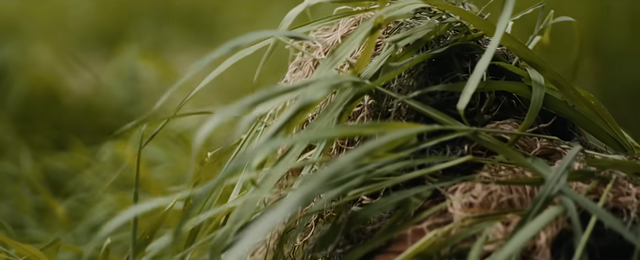
The Australian landscape itself becomes oppressive and alive — dry grass, insects, weathered structures, rusted textures, and dense terrain all reinforcing the emotional exhaustion and hyper-vigilance of the characters trapped within it. Kris’s isolated farmhouse tells its own story before a word is spoken; deteriorating, unpainted, overgrown, and emotionally guarded against the outside world.
Importantly, SEVEN SNIPERS also understands that suspense only works if audiences care about the people in danger. Sciberras smartly anchors the film in character first, particularly in the emotional push-and-pull surrounding Anja and the competing desires of Kris and Dragon. Both want her. Both believe they are justified. That emotional complexity gives the film dramatic weight beneath the sniper mechanics and tactical cat-and-mouse structure.
Radha Mitchell delivers one of her strongest performances in years, conveying exhaustion, fury, trauma, intelligence, and maternal protectiveness largely through controlled restraint rather than overt emotional display. As Kris, Mitchell feels forged in steel — a woman whose emotional armor has been built through years of survival, tactical precision, and buried pain.
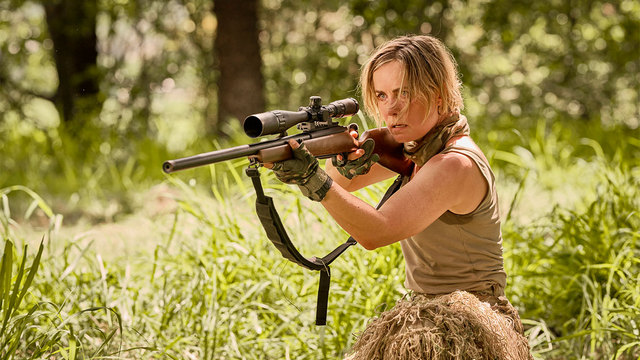
Equally impressive is Annabel Wolfe as sixteen-year-old Anja. Wolfe brings remarkable emotional balance to the role, moving seamlessly between teenage defiance, vulnerability, fear, and lingering childlike warmth. Particularly affecting are Anja’s quieter moments recalling childhood memories with Milk, moments that briefly soften the film’s otherwise sustained tension and reveal the emotional life Kris has struggled to preserve for her daughter.
For this reviewer, Wolfe’s performance carries an additional layer of significance. More than a decade after first appearing in My Pet Dinosaur, Wolfe now demonstrates striking emotional maturity as a performer, confidently going steel toe-to-steel toe with Mitchell scene for scene while still preserving Anja’s youthful emotional fragility.
Ioan Gruffudd brings warmth and humanity as Milk, functioning as an emotional bridge between Kris and Anja, while Tim Roth becomes one of the film’s most effective instruments of sustained unease as Dragon.
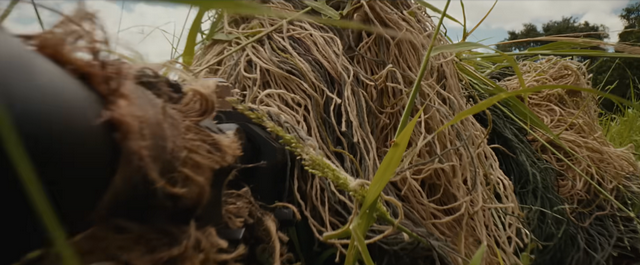
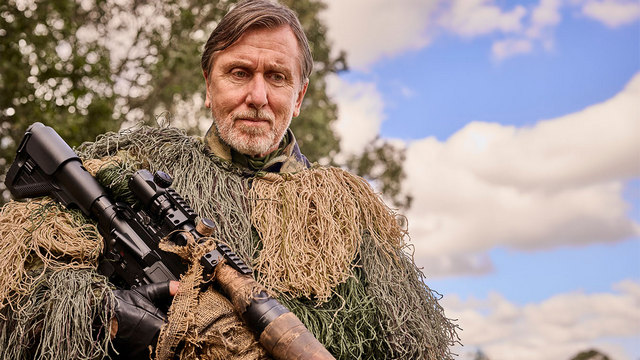
Importantly, Sciberras resists the temptation to overexpose the character simply because Roth is playing him. For more than two-thirds of the film, Dragon remains largely concealed beneath camouflage and shadow — his ghillie suit obscuring nearly his entire body and face, sometimes revealing little more than a single eye staring through a sniper scope.
Knowing Roth inhabits the role naturally creates audience anticipation to see more of him. Yet Sciberras smartly weaponizes that withholding.
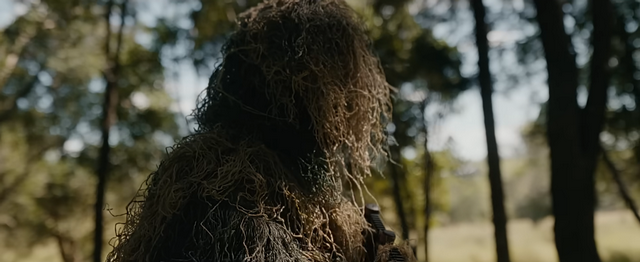
By denying Dragon extended screen presence, the film transforms him into something far more unsettling than a traditional visible villain. He becomes an unseen predator fused with the terrain itself — a lurking psychological threat capable of emerging from anywhere at any moment.
That scarcity of visibility feeds directly into the film’s larger tension architecture. Like the limited exposition, fragmented backstory, sniper POVs, and carefully controlled soundscape, Dragon’s concealment reinforces the constant uncertainty driving the narrative.
You never fully see him. And therefore, you never stop searching for him.
A particular standout among the sniper ensemble is Pacharo Mzembe as Nico. Mzembe is outstanding, physically disappearing into the terrain with such effectiveness that his sudden reappearances repeatedly jolt both the characters and audience alike. His ability to seemingly merge into the environment before unexpectedly emerging from the landscape perfectly reinforces the film’s overarching themes of concealment, hyper-awareness, and unseen danger.
And that restraint once again proves key.
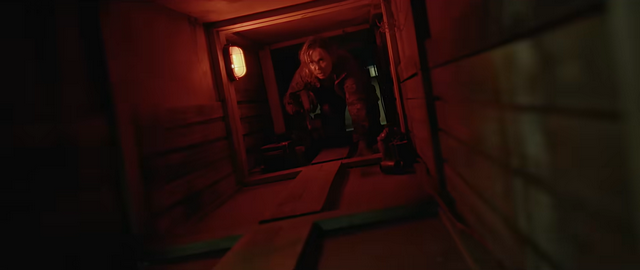
Sciberras never loses sight of the emotional core beneath the tactical tension. The result is a thriller where every sound matters, every movement matters, every silence matters.
By grounding its action in atmosphere, sonic immersion, emotional withholding, spatial precision, and deeply sustained suspense, SEVEN SNIPERS emerges as one of the year’s most gripping action thrillers — a film that understands tension is not something you simply create. It is something you carefully control.
Directed by Sandra Sciberra
Written by Andrew O’Keefe
Cast: Radha Mitchell, Tim Roth, Ioan Gruffudd, Charles Cottier, Pacharo Mzembe, Annabel Wolfe
by debbie elias, 05/15/2026
SEVEN SNIPERS is available On Digital on June 5, 2026.