“And it’s all just been fucking destroyed.”
The words appear on a green computer screen as THE BEAST quietly comes to life, accompanied by little more than the soft tapping of keyboard keys. And then Renny Harlin destroys everything.
With a hard visual and sonic cut, silence explodes into carnage and Harlin puts his foot on the accelerator, rarely letting up for the next 90 minutes. It’s a deceptively simple opening, but one that tells us almost everything we need to know about what lies ahead. Sound and image will work in tandem. Violence will arrive without warning. And respite will be fleeting.
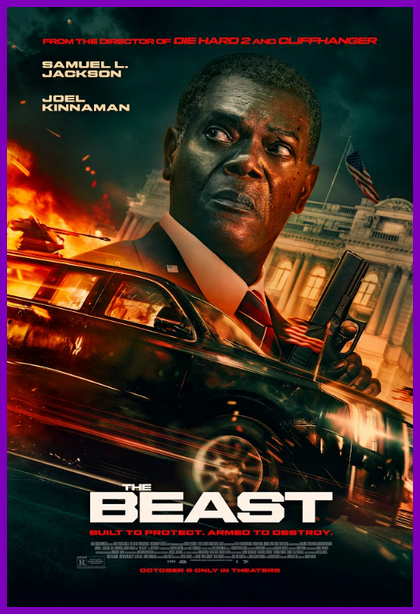
But THE BEAST is more than Harlin once again proving he knows how to blow things up—and blow them up well. Beneath the gunfire, rockets, helicopters, explosions and vehicular mayhem is one of the most character-driven films of his career, anchored by Samuel L. Jackson and Joel Kinnaman as two men trapped together inside the armored Presidential limousine known as the Beast while a coordinated attack aimed at staging a global coup plunges the world around them into chaos.
And what a ride it is! This is one of the best, if not the best, film of Renny Harlin’s career.
Working with cinematographer Jacques Jouffret, Harlin turns what could easily have become a visually monotonous exercise in confinement into a master class in finding the frame. There seemingly isn’t an inch of the Beast they don’t explore with the camera. Angles and framing are in constant flux, moving from wider two-shots of the President and Secret Service Agent Taft to increasingly intimate close-ups and ECUs, while reflections, windows, screens, weaponry and the physical architecture of the limousine continually reshape the frame.
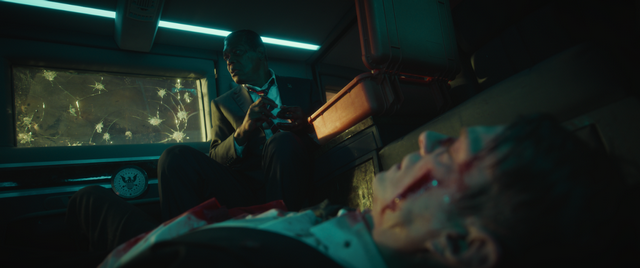
The result is not merely visual variety. The Beast becomes a character unto itself—protector, prison, weapon and, occasionally, adversary. It can withstand bullets, rockets and seemingly everything else being hurled at it, but the President’s command of this technological marvel is another matter entirely. Unable to remember his identification number when THE BEAST demands it, an increasingly irritated President starts offering up everything from his favorite ice cream flavor to his favorite loafers and the book sitting beside his bed. It’s a wonderfully humanizing beat and exactly the kind of humor Samuel L Jackson can toss off without ever breaking the tension.
And then there’s the Presidential playlist. Kenny G, anyone? So much for that as heavy metal takes over and THE BEAST’s Gatling guns come to life, transforming what we’ve previously seen only as a schematic into glorious action-movie reality.
Editor Alex Rodriguez takes everything Harlin and Jouffret throw at him and finds a rhythm that is propulsive without becoming exhausting. THE BEAST gives us precious few opportunities to catch our breath, but Rodriguez knows exactly when we need one. The film pauses; it never stops. Even quieter exchanges between the President and Taft carry the sensation that something outside those armored walls is still moving toward them.
And then there is the sound.
The first thing Renny Harlin destroys is silence, and from that opening detonation forward, the sound editing and mix are nothing short of superb. Gunfire doesn’t merely sound like gunfire; different weapons have different voices. Explosions have size, distance and character. Bullets and projectiles striking the Beast have a physicality all their own. Planes, helicopters and rockets occupy the world outside while Command, SATCOM, radio chatter and static invade the world within.
And underneath it all is the engine.
Listen to it.
Acceleration and deceleration, power and weight, strain and speed are communicated aurally as much as visually. The Beast doesn’t simply transport the President and Taft through the action. It growls its way through it. The vehicle has a presence, a personality and ultimately a voice of its own.
Of course, no Samuel L performance would be complete without a certain twelve-letter expletive, and THE BEAST knows exactly who it has behind the wheel. When Taft tells the President, “I love how you say Mutha Fucker,” what follows is essentially a Presidential master class in proper pronunciation courtesy of Samuel L himself. It’s hilarious, perfectly timed and another welcome pressure release before Harlin tightens the screws again.
But beneath the President’s humor and command is something darker.
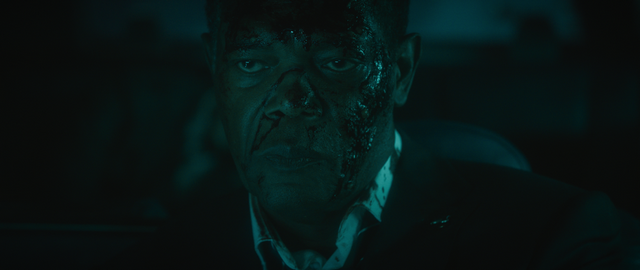
His fingers move through a peculiar exercise. Images of Vietnam intrude without explanation. Faces from decades earlier appear in the back seat. Harlin doesn’t immediately tell us what any of it means. He lets the fragments accumulate, visually separating those memories and hallucinations from the present through blackish greens and a markedly different tonal texture. In fact, the color palette and tonal bandwidth throughout THE BEAST are striking, moving from the suffocating blacks and greens of night and memory to the dramatically different visual world that awaits with morning.
Even the name of the President’s old unit—the Vampire Squad—feels tailor-made for a film unfolding almost entirely in darkness. These were men trained to move and fight through the night, and decades later the President once again finds himself doing precisely that.
Then comes one of Jackson’s finest moments in the film.
The President talks about war. Not its politics or strategy, but its psychology; what happens to a human being who has witnessed horror and nevertheless has to keep moving. You keep going because you have to. You keep going until you can’t.
And then you crumble.
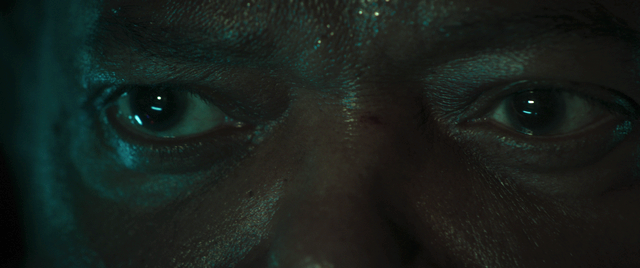
Harlin and Jouffret move increasingly close on Samuel L, into ECUs of his eyes that flirt with macro territory, stripping away virtually everything else in the frame. For a film filled with spectacular action, it’s one of its most chilling images. There is nowhere for Jackson to hide and nothing for the audience to look at except the memories living behind those eyes.
And Harlin has just quietly told us where THE BEAST is going.
For all the firepower surrounding them, however, the real heart of THE BEAST isn’t the armored machine. It’s the two men inside it.
At first, Taft is essentially defined by his job. He’s a Secret Service agent. His responsibility is the President. Protect him. Keep him moving. Keep him alive. But as the night wears on and Taft’s injuries become increasingly grave, titles and protocol begin falling away. An agent becomes a companion, then a confidant, and ultimately something closer to a brother-in-arms.
Even “Mr. President” eventually disappears.
“Stop with the sir shit. It’s Oscar.”
It’s a small line with enormous significance. The office hasn’t disappeared and neither has Oscar’s responsibility to it, but inside the Beast there are increasingly just two men trying to keep one another alive.
Samuel L. Jackson and Joel Kinnaman are superb together, finding an easy rhythm between humor, pain and vulnerability without ever forcing the relationship. The quieter exchanges prove as important as the action, whether Oscar is talking about something as seemingly inconsequential as bread crusts or Taft is listening as the President reveals pieces of a life that exists beyond the office. These moments aren’t pauses from the story. They are the story.
And once Taft is badly wounded, we discover precisely what kind of man Oscar is.
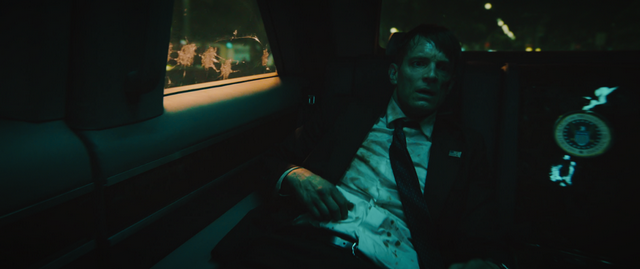
He could concentrate solely on his own survival. Instead, he’s trying to save Taft while simultaneously keeping the Beast moving, stitching him up as the vehicle’s self-driving system warns that human hands must return to the wheel. Command is in his ear. The Beast is demanding his attention. The clock is ticking. Taft is bleeding. And Oscar refuses to leave him behind.
It’s as if Taft represents the entire country that the President is fighting to save.
Oscar’s concern continually extends beyond the armored walls protecting him. He wants to know how many people have been lost. He wants desperately to reach his wife. And at a moment when the meaning and responsibilities of leadership seem to be debated daily, there is something unexpectedly refreshing about watching a Commander-in-Chief whose instinct is not merely self-preservation.
He leads, but he also cares.
THE BEAST gives us a President who is neither infallible nor superhuman, but recognizably human—and Samuel L Jackson makes every bit of that humanity count.
Even the President’s Secret Service code name, Paladin, immediately calls to mind Richard Boone’s HAVE GUN – WILL TRAVEL character—smart, sophisticated, impeccably composed and more than capable of lethal force when necessary. It’s an association that fits Jackson’s Oscar remarkably well.
But Oscar isn’t invulnerable.
Harlin has been reminding us of that all night.
Those fingers. Vietnam. The men who didn’t come home. Rosa. And that word: Crumble.
As the night reaches its breaking point, the lesson Oscar gave us about the psychology of war becomes prophecy. The man who has spent the night telling everyone else what must be done finally reaches the point he described earlier. Oscar crumbles.
Battered physically and emotionally beyond endurance, with everything he has fought through seemingly collapsing around him, Oscar activates the Beast’s self-destruct. The machine that has protected him throughout the night has reached the end of its usefulness, and so, seemingly, has the man inside it.
And then he hears Rosa.
What matters at this moment is beautifully simple: her voice reaches Oscar when nothing else can.
She tells him to stay alive. To come home.
And Oscar comes back. And so does the world.
After spending virtually the entire film immersed in night—blacks, blackish greens, artificial light, fire, smoke and the armored confines of the Beast—Harlin and Jouffret suddenly give us the beautiful light of a clear blue morning.
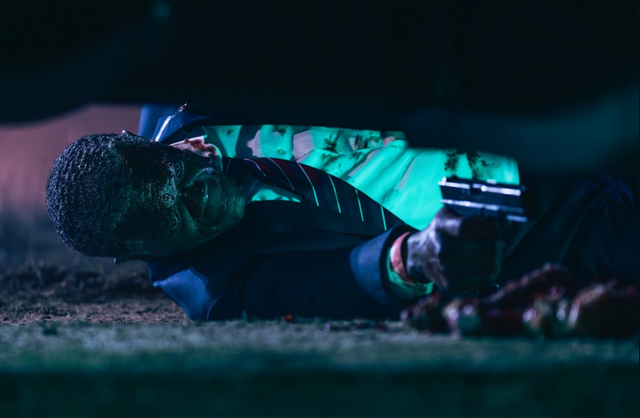
Marine One is waiting. Rosa is waiting. Oscar just has to get there.
Harlin wrings every last drop of suspense out of the journey. For a moment, it appears Oscar may have died with the Beast. Intellect tells us otherwise, but that doesn’t stop the heart from momentarily lodging somewhere around the throat.
And then— the gas mask.
Oscar’s face appears and THE BEAST delivers one of those unabashed, fist-pumping action-movie hero reveals that should have an audience cheering.
And Paladin still has work to do.
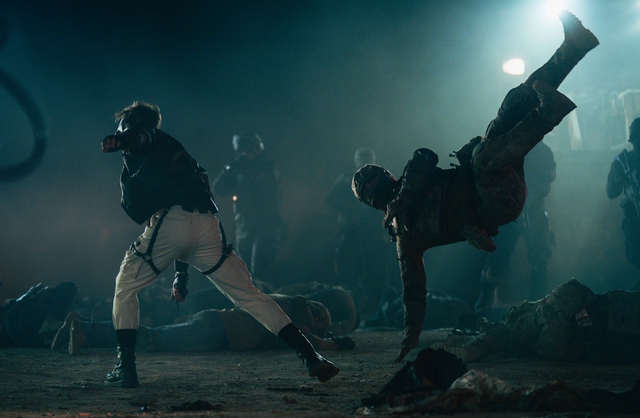
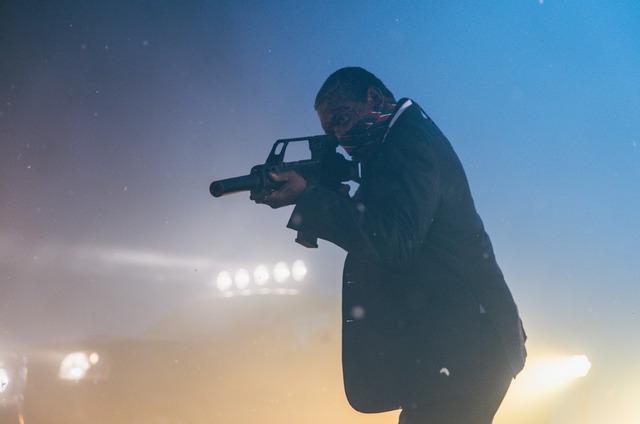
With the technological fortress that protected him now gone, Oscar falls back on something much older: the soldier he once was. The Vietnam fragments that have haunted the film cease being memories and become muscle memory. Knives. Guns. Guns wielded like baseball bats. Hand-to-hand combat. Everything we’ve learned about Oscar over the course of the night converges in a brutally physical fight for survival.
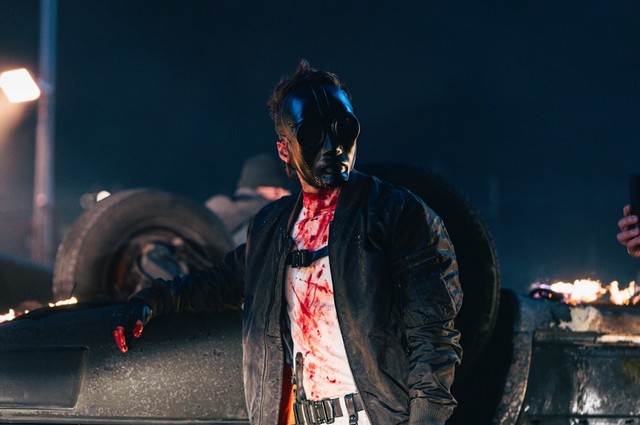
Harlin lets the sequence become visceral, savage and gloriously unrestrained, reminding us that beneath the suit, the tie and the office of the Presidency is a man who once learned how to survive by fighting through the black of night.
Yet one of the most affecting moments in THE BEAST comes after the fighting is done.
Oscar finds an old car. Marine One is ahead. Rosa is waiting.
And before he goes to her, he ties his tie. That’s it.
No speech explaining what the gesture means. None is necessary. Perhaps he’s once again assuming the mantle of the President. Perhaps he’s a husband making himself presentable before seeing his wife. Perhaps it’s both.
After a night spent stripping Oscar down to the man beneath the office, that tiny gesture puts the pieces back together. President. Oscar. Man.
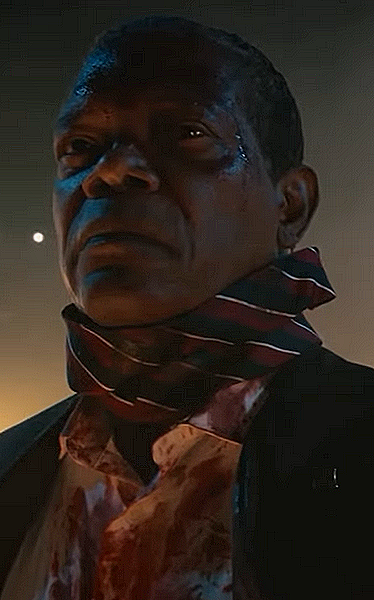
And it is Samuel L. Jackson who makes every stage of that transformation believable. Harlin knows precisely what audiences expect from Jackson and isn’t above giving us the pleasures that come with that expectation—the humor, the attitude, the authority and, yes, a properly enunciated “Mutha Fucker.” But he also gives his longtime collaborator room to dig deeper. Jackson’s Oscar carries age, memory, regret, fear and loss alongside all that swagger, delivering some of his finest character work in years.
Kinnaman is equally important to that equation. Taft isn’t simply there to give Oscar someone to save or someone with whom to exchange dialogue inside the Beast. Kinnaman gives him an understated humanity that beautifully counterbalances Jackson’s larger presence. Their relationship develops without fanfare, gradually and believably, until the President and the Secret Service agent have become two wounded men who need each other to survive.
And by the time morning comes, every breadcrumb Harlin has scattered through the night has found its place. The fingers. Vietnam. The Vampire Squad. Oscar’s explanation of what it means to crumble. Rosa. Taft. Even the President’s uneasy relationship with the technology surrounding him. Nothing feels arbitrarily planted simply to manufacture a third-act payoff. What initially appeared to be fragments become pieces of the man.
That’s where Harlin excels with THE BEAST. He checks every box an action fan could want —explosions, gunfire, rockets, helicopters, vehicular mayhem, Gatling guns, hand-to-hand combat and knives—but never allows the spectacle to become the whole movie.
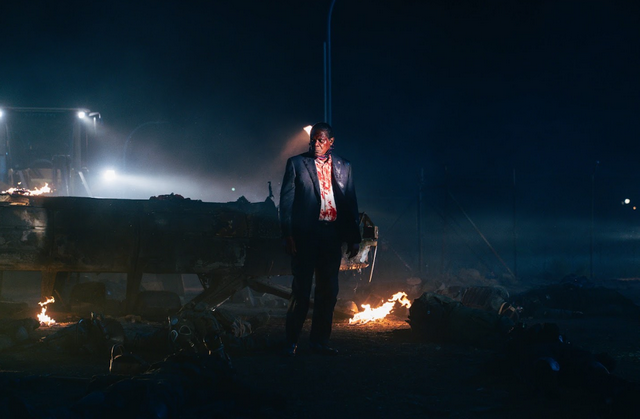
Working with Jouffret, Rodriguez and an impeccable sound team, Harlin reaches into every compartment of the cinematic toolbox and uses what he finds with purpose. Cinematography turns confinement into visual possibility. Editing makes 90 minutes feel like a headlong sprint. Sound gives dimension to a world we frequently cannot see. VFX and practical action work hand-in-hand rather than competing for attention. And through it all, character remains firmly in the driver’s seat.
Renny Harlin and Samuel L. Jackson have always been a winning collaboration, and THE BEAST only reinforces why. Harlin knows how to harness Samuel L’s formidable screen presence without being overwhelmed by it, while Jackson understands exactly how to inhabit the heightened cinematic world Harlin builds around him. This time, however, both bring something more to the equation. There is age here. History. Mortality. And heart.
THE BEAST begins by telling us that everything has been fucking destroyed. Ninety minutes later, Renny Harlin has blown up damn near everything that wasn’t.
And somehow, the thing that hits hardest is a man tying his tie.
Director – Renny Harlin
Writer – Umair Aleem
CAST – Samuel L. Jackson and Joel Kinnaman
by debbie elias, 10/03/2026
THE BEAST is in theatres on October 9, 2026.