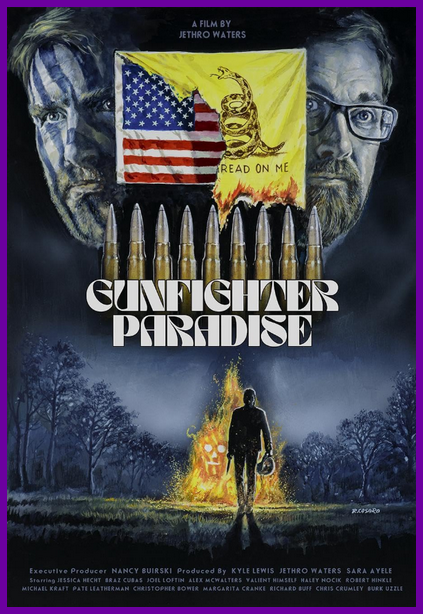
There are films that announce themselves with polish, and there are films that arrive with something more valuable: a voice. GUNFIGHTER PARADISE, the debut narrative feature from writer/director/cinematographer/editor/star Jethro Waters, has that voice in abundance.
Darkly funny, visually arresting, and richly original, GUNFIGHTER PARADISE announces Jethro Waters as a singular new visual stylist. Steeped in a distinctly Southern sense of place and contradiction, this is a film that does not simply tell a story so much as immerse us in a mind, a mood, and a culture in quiet collapse.
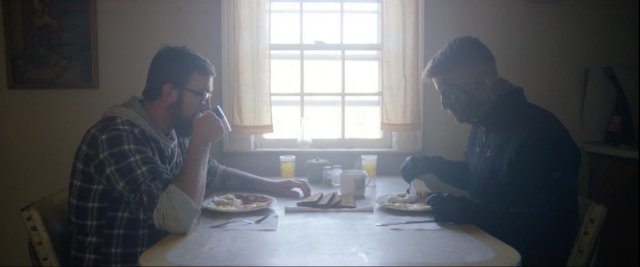
A hunter named Stoner returns home to North Carolina carrying a mysterious green case. His mother has died. The family house sits heavy with memory. Reality begins to fray. There are handwritten riddles, divine whispers, unholy visions, strange visitors, a cable man, zealous neighbors, and, yes, a mummified cat with jewels in its eyes. From that premise, Waters constructs a darkly comedic, hallucinogenic fantasia that wrestles with patriotism, religion, fatherhood, masculinity, gun culture, and Southern identity without ever reducing itself to a simplistic thesis statement.
That refusal to preach is one of the film’s greatest strengths.

Waters is clearly interested in asking difficult questions about faith, fear, violence, and the psychic fractures running through contemporary American life, but GUNFIGHTER PARADISE never bludgeons the audience with answers. Instead, it invites interpretation. The film functions as a kind of puzzle box, not in a gimmicky way, but in the sense that every scene, image, and tonal shift feels designed to be explored rather than merely consumed. There are arguments to be made from multiple vantage points. Waters trusts viewers to sit in ambiguity, and in doing so, he creates a work that is more engaging than any tidy polemic could ever be.
What makes that ambiguity work is the rigor of the filmmaking.
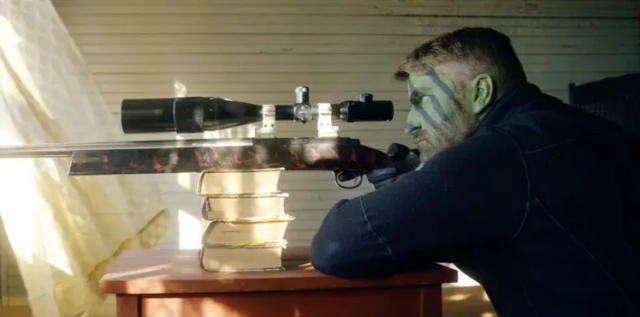
As a visual stylist, Waters proves himself to be remarkably assured. This is a film built on detail — not decorative detail, but expressive detail. He understands how to create a distinctive visual grammar and, more importantly, a visual tonal bandwidth that meshes seamlessly with the emotional tonal bandwidth of the film. Extreme close-ups, macro shots, textured inserts, wide shots of barren winter landscapes, lyrical montage, and abrupt surrealist ruptures all work together in service of Stoner’s deteriorating mental and spiritual state.
Waters knows that cinema often speaks loudest in fragments. A pine-tree air freshener. Frankincense. Bacon turned with vice grips. The grain of weathered wood. The slow emergence of a bolt cutter through the gaps of a rotted barn wall. A gun in pieces, studied in close-up. These are not throwaway cutaways. They are emotional and thematic building blocks. The details matter here, and Waters makes them matter.
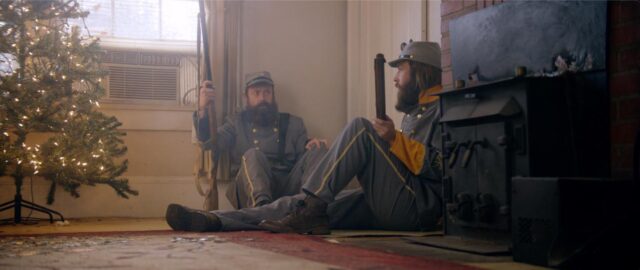
The result is a film that feels tactile and sensory. One can almost smell Maurice’s ever-present air fresheners and the frankincense his mother used to burn. One can feel the dampness of the pond, the roughness of old wood, the cold bite of the open landscape. This is not visual excess for its own sake. It is visual storytelling with intention.
The chaptered structure and voiceover are equally effective tools. Voiceover can often become a crutch in lesser hands, but here it is an architectural necessity. Because GUNFIGHTER PARADISE is rooted in Stoner’s fractured interiority, the voiceover gives the audience a guide rope without over-explaining the terrain. Waters smartly avoids exposition-heavy scenes and instead allows voice and image to work in tension with one another. We hear one thing, while the visuals may suggest another. That dissonance deepens the ambiguity and sharpens the psychology.
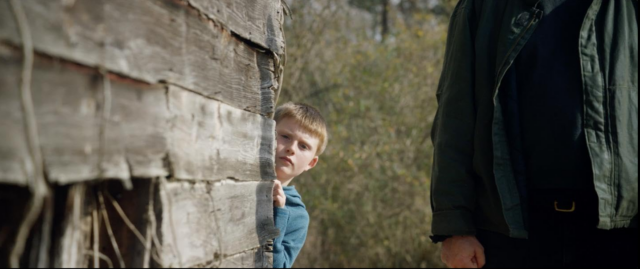
The film’s most memorable flourishes often come from its willingness to embrace the absurd and let that absurdity curdle into something revealing. The mummified cat, Eugene, is a perfect example. What begins as an almost laugh-out-loud visual gag gradually becomes unsettling, pathetic, and weirdly incisive, a reflection of Stoner’s unraveling psyche and the film’s broader tonal dexterity. Waters has the nerve to push a ridiculous image further and further — closer, tighter, stranger — until it stops being merely funny and becomes disturbing. That is not an easy balancing act, but he pulls it off.
And tone, ultimately, is where GUNFIGHTER PARADISE distinguishes itself most.

This is a dark comedy, yes, but not one interested in easy punchlines or ironic detachment. Its humor is knottier than that, emerging from character specificity, cultural contradictions, and the absurdity of human behavior under pressure. Some viewers may not immediately connect with its off-kilter rhythms or its surreal detours, but Waters remains admirably committed to the film’s internal logic. He is not chasing broad approval. He is building a world. That confidence gives the film its identity.
The score, crafted by Waters and Bryan Black, deserves particular mention. Drawing on hints of spaghetti western tradition while shifting into eerie, sinister passages when needed, the music becomes another storytelling instrument in the film’s tonal orchestration. It evokes both frontier myth and Southern Gothic dread, often in the same breath. Combined with the live gospel and spiritual elements that appear in the film, the soundscape deepens the push-pull between sincerity and satire, faith and fear.
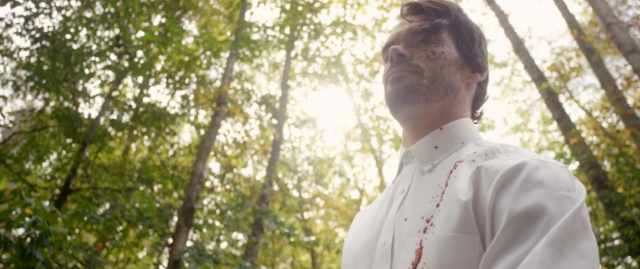
Performance-wise, the film has a rough-hewn authenticity that works to its advantage. Many of the cast members are first-time actors, yet Waters wisely leans into lived-in rhythms rather than polished theatricality. The result is a world populated by eccentrics, believers, oddballs, and damaged souls who feel as though they belong to this place. Waters himself, stepping in front of the camera as Stoner, gives the film a central figure who is both grounded and ghostly, a man moving through grief, confusion, and inherited cultural baggage with a deliberateness that is often as unnerving as it is sad.
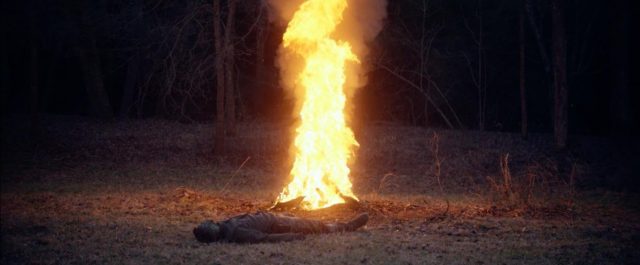
If the film has a weakness, it is perhaps the same quality that gives it its distinctive power: its refusal to simplify itself. GUNFIGHTER PARADISE asks the audience to lean in, to accept tonal instability as part of its design, and to sit with images and ideas that do not always resolve neatly. For some, that may prove frustrating. But for those willing to meet Waters where he is operating, the rewards are considerable.
Because this is not just a promising first narrative feature. It is the work of a filmmaker with a point of view.

With GUNFIGHTER PARADISE, Jethro Waters proves himself to be a storyteller of depth and skill, one who understands not only how to compose a striking image, but how to make image, rhythm, sound, and tone work in concert. The film is funny, unsettling, thematically alive, and visually committed in ways that feel increasingly rare. It does not play it safe, and it does not beg for consensus. It simply commits — fully, weirdly, vividly — to its own singular vision.
And in a cinematic landscape too often content to blur the background and spell everything out, that kind of bold, handmade originality feels like a little slice of paradise.
Written and Directed by Jethro Waters
Cast: Braz Cubas (aka Jethro Waters), Joel Loftin, Alex McWaters, Christopher Bower, and Margarita Cranke
by debbie elias, 04/15/2026
GUNFIGHTER PARADISE will be touring US theatres this summer.