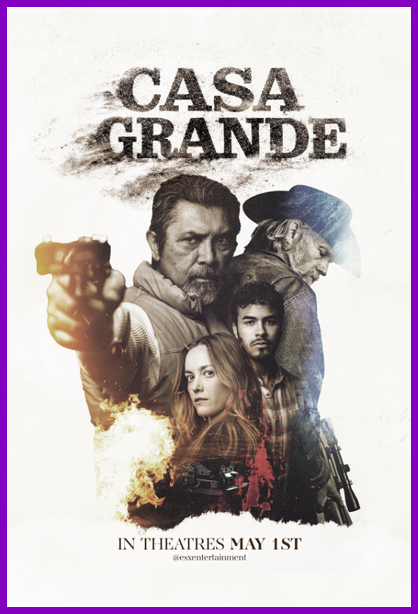
At its core, every great Western is about land.
Who owns it.
Who works it.
Who profits from it.
Who protects it.
And ultimately, who has the right to claim it as home.
With CASA GRANDE, director Juan Pablo Arias Munoz takes those foundational themes of the classic American Western and reshapes them into something contemporary, emotionally layered, and culturally resonant. Expanding upon the television series of the same name, Arias Munoz transforms the story into a sweeping modern Western where generational conflict, mineral rights, environmental tension, family legacy, and cultural identity collide beneath the breathtaking beauty of the Sierra Nevadas.
What makes CASA GRANDE particularly compelling is its refusal to simplify any side of the conflict.
.
This is not a film about heroes and villains.
It is a film about competing definitions of stewardship.
When a prodigal daughter returns home to her family ranch amid her father’s declining health and mounting external pressures, old wounds quickly resurface. But the emotional tensions within the Clarkman family soon expand into something much larger as wealthy businessman Roy Reyes, played with commanding complexity by Lou Diamond Phillips, pushes aggressively toward lithium extraction and land acquisition that could permanently alter the region’s future.
Thematically, the film operates in territory reminiscent of contemporary neo-Westerns like Yellowstone, Landman, or Hell or High Water, but Arias Munoz smartly reframes the familiar genre dynamics through Latino perspectives rarely centered in mainstream Western storytelling. Rather than positioning Latino characters within stereotypical supporting or criminal roles, CASA GRANDE places them at the very center of the ideological conflict itself.
Roy Reyes is not a cartel caricature or one-dimensional corporate villain. He is educated, ambitious, charismatic, and deeply convinced that progress is necessary for survival. His vision for the future — driven by lithium extraction, economic development, and modernization — is rooted not simply in greed, but in generational trauma and a desperate desire to secure power and stability for his family moving forward.
And that moral complexity is where CASA GRANDE finds much of its strength.
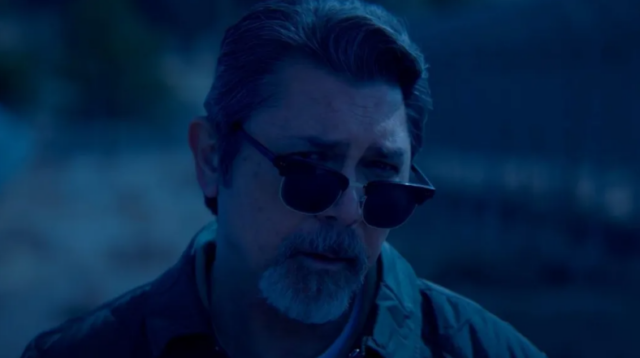
Arias Munoz wisely avoids painting any character as entirely right or entirely wrong. Instead, the film explores the painful reality that progress often arrives carrying both opportunity and destruction simultaneously. The Clarkmans fight to preserve tradition, land, and identity. Reyes fights to secure influence, economic growth, and a future he believes his family deserves. Both sides operate from love, fear, loyalty, and deeply personal histories.
Human beings, as the film repeatedly reminds us, are complicated.
That emotional nuance extends throughout the ensemble. Family tensions simmer beneath nearly every interaction as characters wrestle with loyalty, morality, generational expectation, and the burden of legacy. Particularly compelling is the dynamic between Roy and his son Leon, whose growing discomfort with his father’s increasingly ruthless methods creates one of the film’s strongest internal conflicts. Leon’s moral hesitation serves as an important counterbalance to Roy’s uncompromising ambition, reinforcing the film’s recurring question: how much should one sacrifice in the name of protecting the future?
Visually, CASA GRANDE is stunning.
Cinematographer Reuben Steinberg captures the Sierra Nevadas with breathtaking scope while never losing sight of the intimacy at the story’s emotional center. Sweeping mountain vistas, snow-covered ranchlands, violent winds, and expansive skies contrast beautifully against the warmth and closeness of family interiors. Arias Munoz smartly uses that visual duality to mirror the film’s thematic tensions — the harsh, exposed beauty of the land against the emotional protection and history contained within homes, kitchens, barns, and family spaces.
The natural environment itself becomes an active participant in the storytelling.
Weather conditions shift unpredictably throughout the film, with snow, rain, wind, and changing light often adding unexpected emotional texture to scenes. Rather than fighting against nature, Arias Munoz embraces it, allowing the landscape to shape the emotional atmosphere in ways that feel organic and deeply immersive.
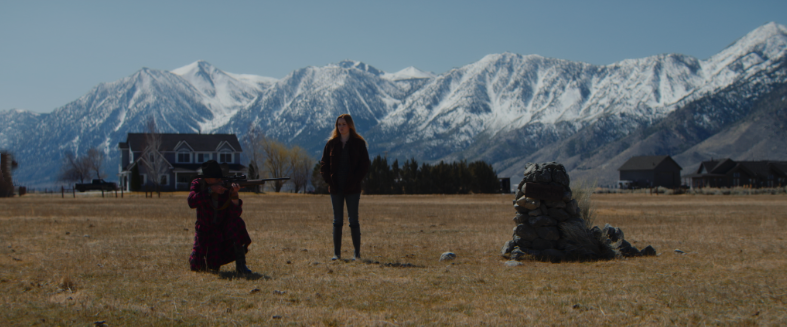
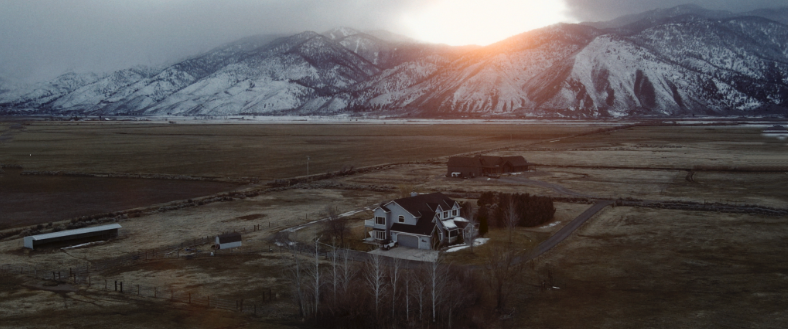
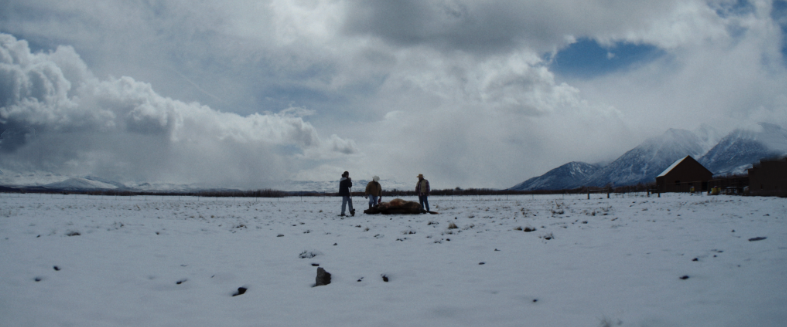
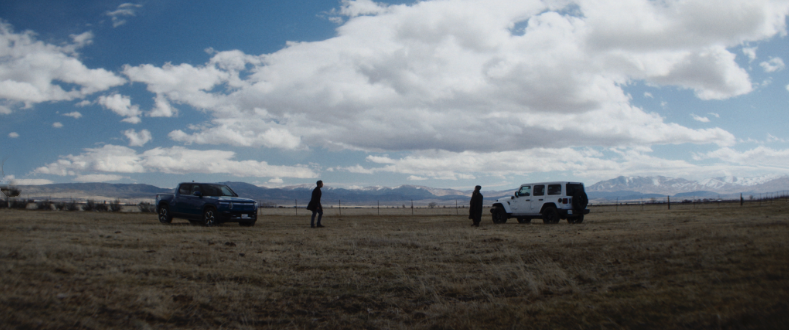
Importantly, the film never allows its visual grandeur to overwhelm its characters. Arias Munoz consistently balances large-scale imagery with emotional intimacy, ensuring the audience remains invested in the people inhabiting these spaces rather than simply admiring the scenery around them.
That balance becomes especially impressive in the editing by Brett Hudland, who skillfully manages a sprawling ensemble narrative filled with overlapping emotional threads. The film breathes patiently when necessary, allowing moments of reflection and family connection to land naturally, but it also develops a strong emotional momentum by weaving together parallel storylines and family dynamics into unified emotional beats.
The editing frequently uses visual storytelling in place of exposition-heavy dialogue, trusting the audience to absorb emotional information through juxtaposition, rhythm, silence, and imagery. That confidence gives the film a maturity that elevates it beyond many contemporary streaming-style dramas that often over-explain their themes.
Performance-wise, the cast delivers across the board.
Lou Diamond Phillips is excellent as Roy Reyes, bringing both charm and danger to a man whose love for his family coexists alongside a willingness to permanently reshape an entire community to achieve his goals. Phillips wisely avoids playing Roy as a traditional antagonist. Instead, he allows the audience to understand the emotional logic driving the character, even when his decisions become increasingly difficult to defend.
Meanwhile, the Clarkman family dynamics ground the film emotionally, giving weight to the larger land conflict by constantly reminding viewers what is actually at stake beyond property lines and mineral rights: memory, identity, belonging, and generational continuity.
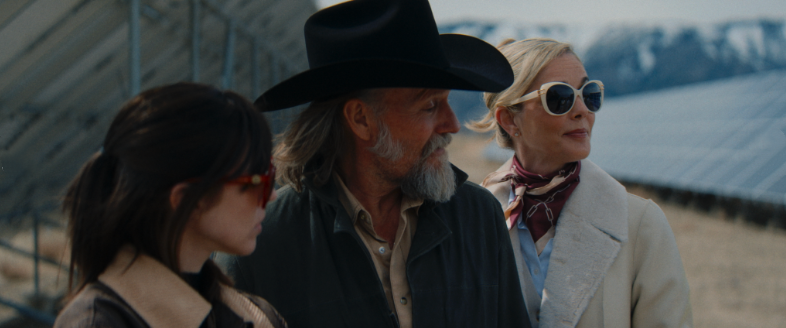
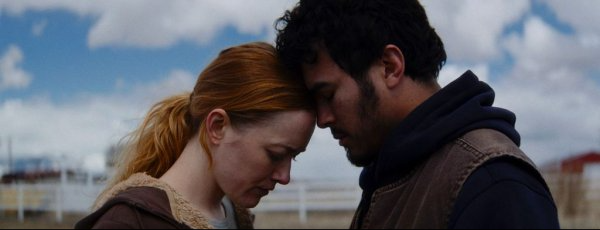
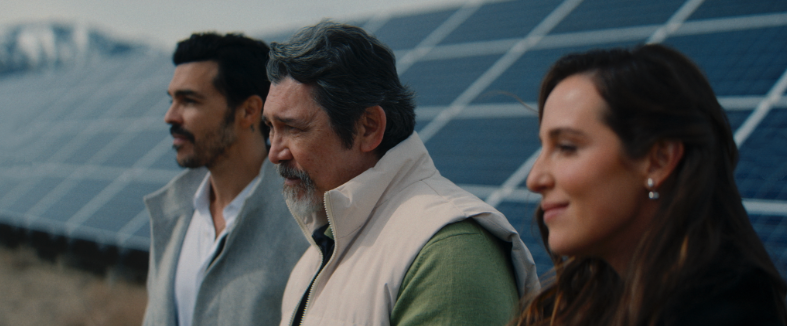
Particularly noteworthy is Kate Mansi as Hunter Clarkman, who brings a fierce emotional volatility and unapologetic defiance that rivals Yellowstone’s Beth Dutton. While audiences may recognize Mansi from her tough-edged turn as a mobster’s daughter on General Hospital, her work here elevates her into something even more commanding. As Hunter, Mansi delivers a performance rooted equally in strength, vulnerability, loyalty, and simmering rage, becoming one of the film’s most emotionally forceful presences.
There is also something quietly refreshing about the film’s portrayal of masculinity and power. Much like the classic Westerns that inspired it, CASA GRANDE understands that emotional restraint often reveals more than performative bravado. The tensions between fathers and children, tradition and ambition, heritage and reinvention all unfold through layered conversations, lingering silences, and unresolved emotional wounds rather than simplistic melodrama.
For Arias Munoz, the modern Western becomes less about gunslingers and frontier mythology than about survival within rapidly changing social and economic landscapes.
And that is precisely why the film feels timely.
As debates surrounding land use, resource extraction, environmental stewardship, labor, economic inequality, and cultural identity continue to intensify across the country, CASA GRANDE taps into anxieties that feel both deeply personal and universally relevant.
Most importantly, the film never loses sight of the emotional humanity beneath those larger thematic questions. Because beneath the land disputes, political tensions, and economic battles lies a much more intimate question haunting every character in the film:
What does it truly mean to protect a home when the world around it is changing faster than anyone can stop?
Directed by Juan Pablo Arias Munoz
Written by Juan Pablo Arias Munoz and Sherell Jackson
Cast: Lou Diamond Phillips, John Pyper-Ferguson, Madison Lawlor, Christina Moore, Javier Bolaños, Kate Mansi, Lauren Swickard, Daniel Edward Mora, Loren Escandon, Bruce Davison, Shalim Ortiz and Charley Debenedetti
by debbie elias, 05/01/2026
CASA GRANDE is currently in theatres.