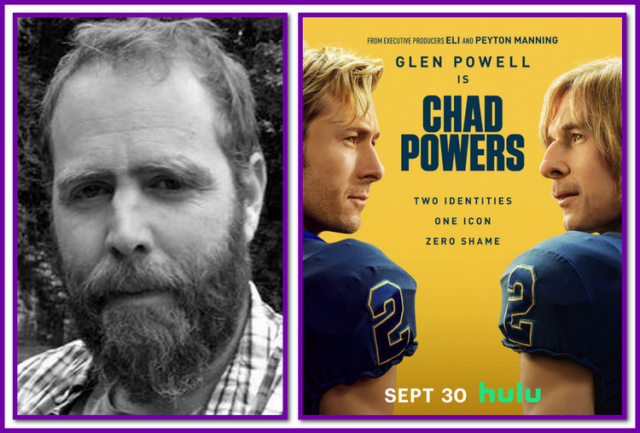
There’s a very fine line between sincerity and absurdity. And in CHAD POWERS, cinematographer MARK SCHWARTZBARD walks it with remarkable precision.
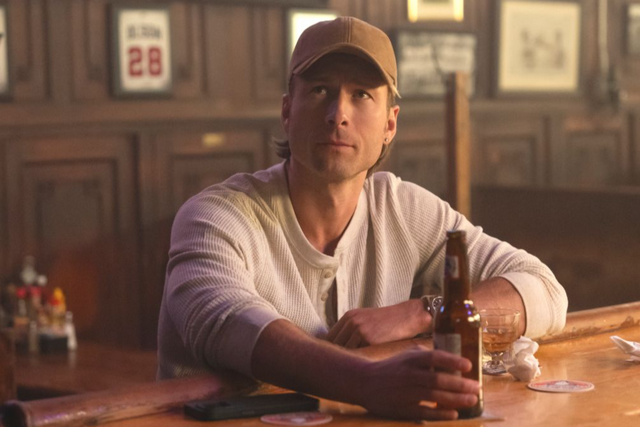
On paper, the premise sounds completely ridiculous. Disgraced former college quarterback Russ Holliday (Glen Powell), disguises himself with prosthetics and fake credentials to infiltrate another football program as an entirely new person, Chad Powers. Yet under the guidance of directors Tony Yacenda, Payman Benz, and Michael Waldron (co-creator and co-writer with Glen Powell), and through Schwartzbard’s lensing, the series never treats its world like a joke. Instead, it embraces the emotional sincerity and mythic iconography of classic football cinema while gleefully undercutting it with outrageous comedy, emotional vulnerability, and just enough chaos to keep audiences perpetually off-balance.
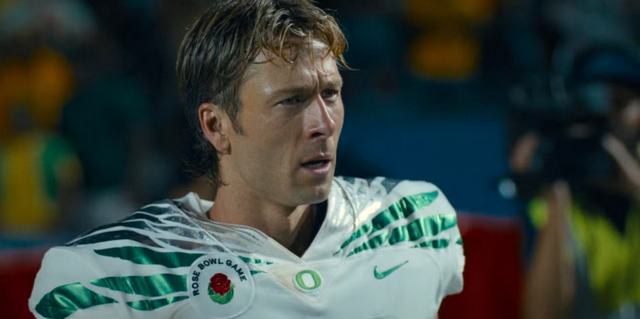
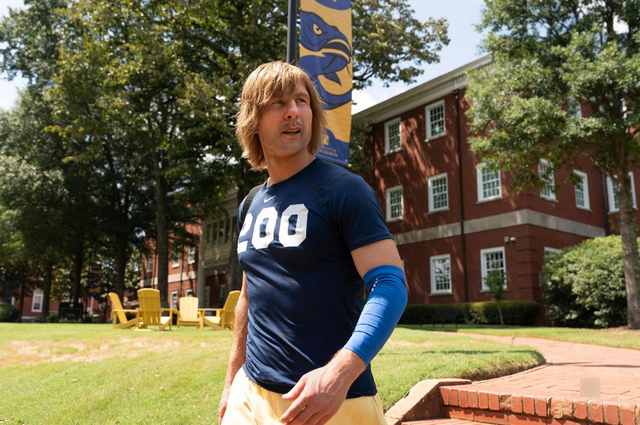
Schwartzbard, who served as cinematographer on Episodes 1, 2, 5, and 6, effectively opened and closed Season One with a distinct visual grammar that grounded the series’ tonal balancing act. Shooting with ARRI Alexa 35 cameras and Panavision PVintage lenses built from rehoused ‘60s and ‘70s Super Speeds, Schwartzbard and the creative team leaned into a textured, nostalgic aesthetic inspired by everything from Moneyball to the original Top Gun and late-90s NFL Films broadcasts.
“The conceit is so ridiculous,” Schwartzbard explained, “that the best way for me to be able to play this is if I’m surrounded by a very kind of serious world.” That philosophy permeates every frame of the series.
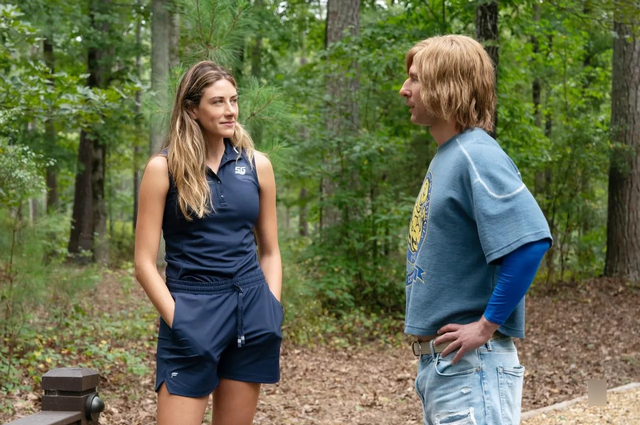
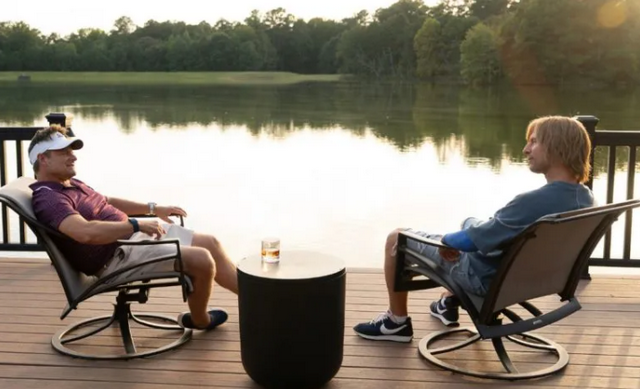
From sweat-soaked Georgia football practices beneath punishing summer sun to emotionally intimate dockside conversations between Chad and Coach Jake Hudson (Steve Zahn), the cinematography constantly oscillates between operatic sports grandeur and deeply human vulnerability. Long lenses dominate the visual language, echoing traditional football coverage while simultaneously creating a documentary-like immediacy that keeps the audience emotionally tethered to the characters rather than merely the spectacle.
And what spectacle it is.
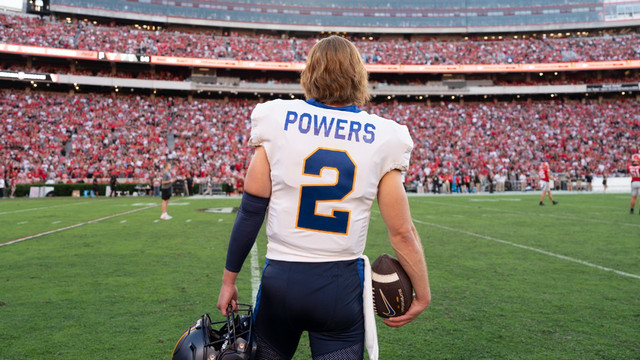
One of the season’s most ambitious sequences came during filming at a live University of Georgia football game, where the production had only three minutes during halftime to capture the climactic stadium moment concluding Episode 6. With thousands of screaming fans drowning out communication systems, Assistant Director Kris Krengle devised a semaphore-style flag system to coordinate the elaborate Steadicam choreography led by operator Joe Hernandez.
“We had the three minutes,” Schwartzbard recalled. “No second takes. If that shot had failed, no one had a plan for what would happen to finish the series.”
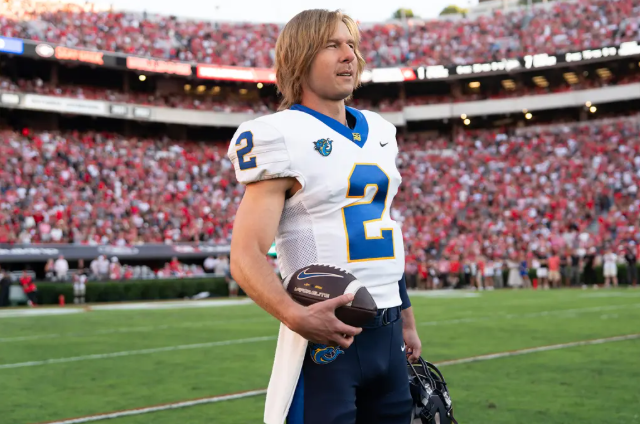
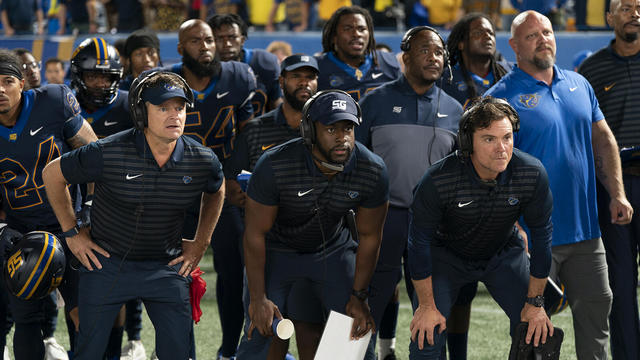
The resulting sequence is breathtaking. Hernandez’s camera races alongside the team before sweeping around Chad Powers as he absorbs the roar of the crowd — visually bookending the opening Rose Bowl sequence from Episode 1 in which Russ Holliday’s life implodes under similarly thunderous adulation. The symmetry is elegant, emotional, and visually triumphant.
Hernandez’s Steadicam work becomes one of the series’ secret weapons, whether gliding through football practices, dancing through musical-theater-infused domestic scenes with Chad’s friend and school mascot Danny Cruz (Frankie Rodriguez), or navigating emotionally volatile confrontations. Schwartzbard repeatedly praised Hernandez’s athleticism and intuitive collaboration with Powell, noting that the pair developed an almost choreographic rhythm together throughout production.
“Joe used to play football,” Schwartzbard explained. “He was a college football player, so he was right at home here. All this stuff is like, okay, we’re gonna run 50 yards, then swivel around him, and the two of them would just kind of work it out together. They were good dance partners.”
That sense of movement-as-performance is woven throughout the series. Whether following Chad Powers sprinting through Georgia pine forests, weaving through chaotic football practices, or moving through Danny’s exuberant Broadway-infused choreography inside the players’ house, the camera rarely feels imposed upon the actors. Instead, it moves with them — responsive, fluid, and emotionally connected.
Schwartzbard even joked about his own role amid the athletic choreography unfolding around him. “I just sit back and watch TV,” he laughed. “I point to things.”
That collaborative fluidity extended to Schwartzbard’s work with directors and cast alike. While Yacenda approached episodes with extensive preparation and carefully mapped visual planning, Waldron’s responsibilities as showrunner often required a more improvisational energy on set as scripts continued evolving during production.
“With Tony, we made more decisions in pre-production because we had a longer pre-production period,” Schwartzbard explained. “With Michael, a lot of things we were jumping into last minute, figuring things out pretty quickly, but in both cases they’re both open to collaboration.”
For Schwartzbard, the process ultimately became less about rigid shot design and more about discovering visual solutions organically with the directors and cast in real time.
“They both know the things they feel are important about the scene,” he said, “and then we kind of bat around ideas of how to make that work with the camera, and where the blocking is, and figure that out with the cast, and then how to shoot it.”
Authenticity also proved critical to the football action itself.
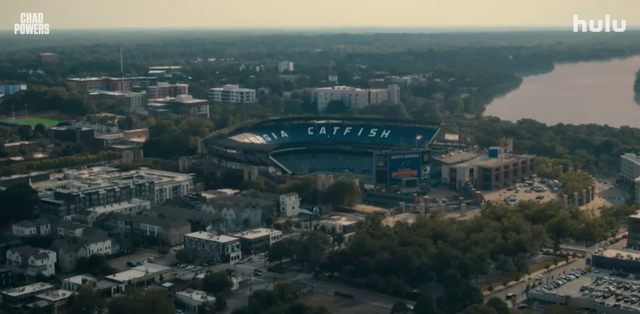
Schwartzbard credits veteran football cinematographer Steve Andrich — whom he laughingly called one of the production’s “secret weapons” — with helping shape the show’s authentic sports coverage. A longtime NFL Films veteran and second-unit specialist on major football productions, Andrich brought decades of institutional football-photography knowledge to the series.
“The trick to shooting football is hire Steve,” Schwartzbard joked. But Andrich was only part of the equation.
Schwartzbard also pointed to football coordinator Mike Sheldon and his company Game Changing Sports as instrumental in transforming the series’s football sequences into something immersive, cinematic, and emotionally coherent.
“He basically assembled the team,” Schwartzbard explained. “He was the coach. He was the real coach.”
According to Schwartzbard, Sheldon recruited dozens of athletes with genuine collegiate and professional football experience — including former college players, XFL talent, and athletes with NFL experience — to populate both sides of the on-screen teams. More importantly, Sheldon helped bridge the gap between athletic realism and cinematic execution.
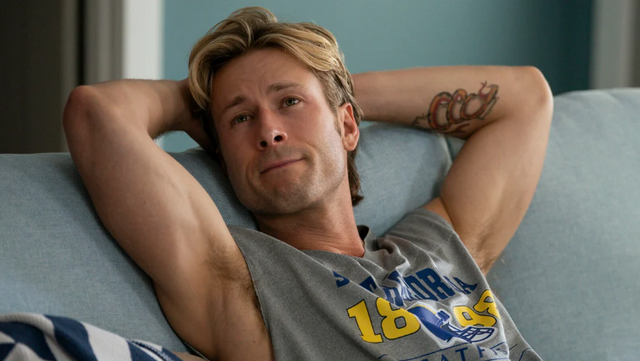
“Mike would set up all the plays,” Schwartzbard said. “And it turns out football players — I didn’t realize this because I’m not a big football fan — football players follow a play. The play is the plan of what’s going to happen.”
That highly structured methodology proved invaluable for camera choreography.
“These guys are experts at integrating the information, learning how to hit their marks, and then improvising when it goes wrong,” Schwartzbard explained. “So it’s kind of like working with dancers.”
For a cinematography team navigating multiple cameras, long lenses, complex blocking, and live-action football movement, that precision became indispensable.
“It was a very camera-friendly group of people,” Schwartzbard said. “You could kind of organize action to happen in very, very precise ways, and it would happen repeatedly and precisely, which is just what a camera crew needs.”
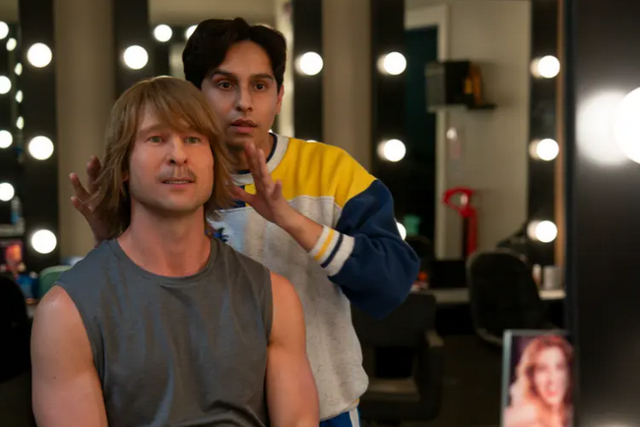
Remarkably, Powell’s elaborate prosthetic transformation required far less photographic manipulation than Schwartzbard initially feared.
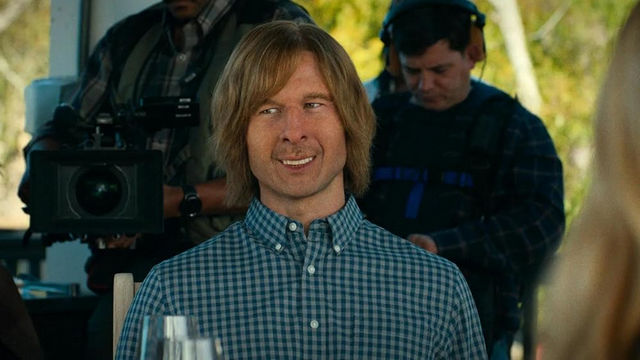
Prior to production, the cinematographer admitted he had become increasingly anxious after hearing repeated warnings about the challenges of photographing prosthetics convincingly on camera.
“I had gotten calls in the past about shooting things with prosthetics,” Schwartzbard recalled. “People would ask, ‘Have you shot prosthetics before? Do you know the tricks to light prosthetics?’ And I got really nervous that there’s like a whole thing about prosthetics.”
For Schwartzbard, the concern wasn’t simply aesthetic. It was technical. What details would the camera expose? Would harsh lighting reveal seams, texture inconsistencies, or flaws in the makeup design? Would he need to alter his lighting philosophy to protect the illusion?
“What am I going to see?” he remembered wondering.
The answer came quickly during the production’s first camera test.
“Glen went into the trailer, got the prosthetics, came out, we put the camera on him, and it just looked amazing,” Schwartzbard said. “There was nothing.”
Rather than cautiously avoiding difficult lighting conditions, Schwartzbard deliberately pushed the makeup to its limits.
“I just took a handheld camera and started running around, getting right up in his space, looking for pores,” he explained. “I took him out into the hard, brutal sun with no fill light, looking for things, just trying to see what was going to fall apart.” Nothing did.
“It all was fine,” Schwartzbard said. “There were no flaws. Nothing I had to hide with the camera.”
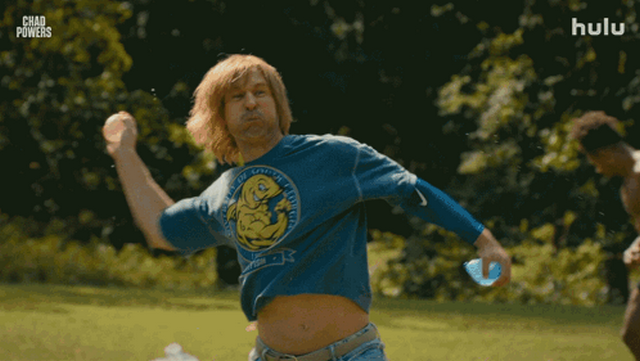
That freedom ultimately became essential to the visual philosophy of CHAD POWERS. Because the prosthetics could withstand harsh daylight, long lenses, close-ups, and aggressive naturalistic photography, Schwartzbard never had to compromise the show’s grounded visual realism in order to protect the illusion.
Instead, the production fully embraced Georgia’s unforgiving sunlight, sweaty football practices, and documentary-style immediacy — allowing Chad Powers’ increasingly absurd deception to exist inside a world photographed with complete sincerity.
For all of the large-scale football spectacle and elaborate production logistics, Schwartzbard insists the defining visual philosophy behind it was actually simplicity.
“I feel like the lighting was as simple as anything I’ve ever done,” he said. That simplicity, however, was anything but accidental.
Working alongside gaffer Mitch Mcdandallad, key grip Luis Pagans, and their crews, Schwartzbard deliberately avoided overly glossy or hyper-stylized lighting setups in favor of something more grounded and immediate — an aesthetic rooted in the gritty realism of NFL Films and the emotional authenticity of classic sports dramas.
“We weren’t doing such complicated glossy lighting,” Schwartzbard explained. “We were really trying to be as simple as we could.”
That philosophy extended across every environment in the series, from Danny Cruz’s cramped apartment to sprawling stadium exteriors under brutal Georgia heat.
Danny’s apartment, with its soft twinkle lights and intimate warmth, relied on remarkably minimal augmentation.
“We had to black it out because we were shooting day-for-night,” Schwartzbard said, “but I think it was a couple of LED tubes taped to the wall in strategic places.”
Even the stadium sequences embraced practicality over excessive manipulation.
“When we were in a stadium at night, we had too many other problems,” Schwartzbard laughed. “So we just turned on the stadium lights.”
Additional lighting would only be introduced when necessary for closer coverage, allowing the large football environments to retain their authentic atmosphere and documentary immediacy.
For Schwartzbard, the objective was never visual perfection. It was emotional believability.
“It was really trying to be as simple as possible and trying to go for a kind of naturalism,” he explained. “And somehow, as we went along, it developed into something good.”
Of course, having a cast led by Powell certainly helped.
“There’s many reasons Glen Powell is Glen Powell,” Schwartzbard joked. “One of them, I think, is it turns out you point a camera at him in any light, he looks amazing.”
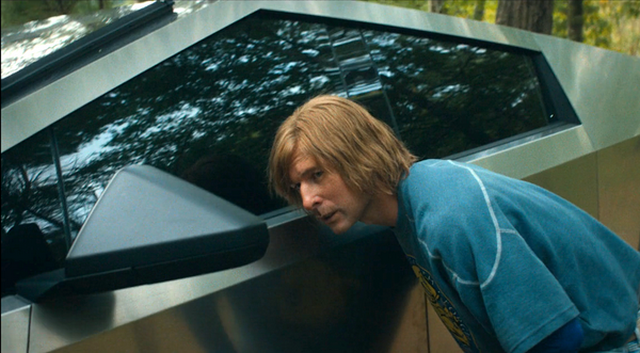
That commitment to grounded realism extended even to one of the series’s more unexpected recurring environments: Chad Powers’ Cyber Truck.
Despite the vehicle’s futuristic appearance, Schwartzbard approached the interiors with the same stripped-down naturalism that defined the rest of the series. And while the Cyber Truck presented fewer logistical headaches than one might expect, it still created specific photographic challenges.
“I don’t want to go on record as an apologist for the Cyber Truck in general,” Schwartzbard laughed, “but it’s actually a pretty big vehicle, and it’s not terrible to film in.”
The real issue, according to Schwartzbard, was visibility and depth. “The worst thing about filming it is the rear window,” he explained. “This is something that bugs me about all modern cars. The rear windows get smaller and smaller.”
For cinematographers, those design choices create significant compositional limitations during dialogue scenes.
“If you’re shooting a two-shot from the hood, there’s just kind of no depth,” Schwartzbard said. “You’re just looking into a dark cave.”
To create the illusion of movement and environmental realism inside the vehicle, Schwartzbard and the crew frequently relied on practical blue-screen and green-screen techniques combined with carefully motivated lighting.
“Most of that stuff was blue screen or green screen,” he explained. “The truck was rarely moving during those dialogue scenes.”
Rather than relying on elaborate virtual-production techniques, the crew often staged the vehicle outdoors or onstage while carefully simulating shifting natural light and environmental movement.
“We would maybe block out the real sun and have a 4K up on a lift to be a fake sun,” Schwartzbard said. “And kind of have a branch on a stand that we’d spin in front of the light to emulate the shadow of passing trees.”
The approach perfectly reflects the production’s overall visual philosophy: practical, restrained, and rooted in illusion through simplicity rather than technological excess. “In other words,” Schwartzbard joked, “just your general blue screen, green screen stuff.”
One particularly stunning sequence in Episode 6 unfolds inside a darkened auditorium after the truth about Chad Powers’ identity begins unraveling. Rendered largely in silhouette with minimal illumination pouring through distant open doors, the scene strips away visual certainty and emotional safety alike as Danny confronts Chad/Russ in the aftermath of the revelation.
For Schwartzbard, the sequence evolved out of both logistical necessity and thematic discovery.
“We had a lot of back and forth about where to stage that,” he explained. “Some of which had to do with scheduling realities and where we were going to be and where we had to fit that in.”
Originally, the production explored smaller, more practical locations inside the school, including hallways and side rooms connected to the nearby cheer rehearsal sequence. But the more the filmmakers explored the geography, the more the auditorium itself began speaking to the emotional subtext of the scene.
“There’s a big auditorium right here,” Schwartzbard recalled. “It’s a little crazy that they would have that very private conversation somewhere they could be heard by someone waiting out there, but we figured it was visually interesting enough that we would overlook that reality.”
What ultimately sold the location was its thematic resonance with the character of Danny himself.
“Because Danny is a theater guy, this is a place that he’s comfortable and familiar with. It’s his natural place,” Schwartzbard said. “And the content of the scene is again about the deception and the identity and all that stuff, and that all seems to fit somehow with the idea of theater.”
As the production team began photographing the darkened space with only natural spill light filtering through the open doors, the visual concept suddenly clicked into place.
“We kind of put our reservations aside,” Schwartzbard said. “We started looking in there and taking some pictures on our phones. We were like, ‘Yeah, this is great. We gotta do it here.’”
The result is arguably the emotional apex of the season — a haunting meditation on performance, shame, identity, and reinvention staged within a literal theatrical space. By withholding full visibility of the actors’ faces and embracing silhouette, the cinematography forces the audience to focus less on disguise and more on emotional truth.
And while the series delivers elaborate football spectacle and outrageous comedy, Schwartzbard admits his favorite sequence is far quieter and emotionally devastating.
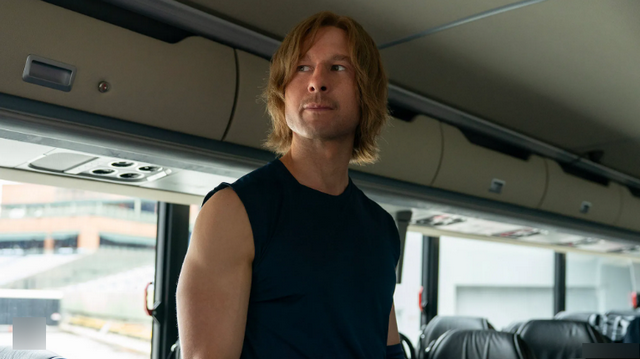
“You know, I’m torn,” he said when asked about his favorite scene from the series. “Part of me wants to say the opening scenes is our big fancy football scene, but I think maybe my real favorite was the scene on the bus at the end of Episode 6, towards the end, where Ricky (Perry Mattfeld) comes and confronts Glenn on the bus.”
What makes the moment particularly striking is its restraint. Set largely within the confined space of the team bus, the sequence relies less on technical flourish and more on emotional honesty and performance.
“It’s a pretty simple scene, camera-wise,” Schwartzbard explained, “but it was a very emotional scene, and I think the cast did amazingly with it. We were able to shoot this confined thing on a bus. I don’t know… it just felt like the moment where this series is starting to turn into something darker and more interesting.”
That emphasis on simplicity — allowing performance, framing, and emotional tension to drive the sequence rather than overt visual embellishment — mirrors the same grounded naturalism Schwartzbard brought to The Lowdown. Even amid the heightened absurdity of CHAD POWERS, the cinematography consistently remains anchored in emotional truth.
And while Schwartzbard won’t return for Season Two due to scheduling conflicts, his visual fingerprints remain permanently embedded in the DNA of the series.
By grounding outrageous comedy within the visual sincerity of classic football cinema, Schwartzbard helped it transform into something unexpectedly heartfelt, visually dynamic, and emotionally authentic — proving that even the most absurd premise can resonate deeply when photographed with honesty, restraint, and soul.
By debbie elias, exclusive interview 04/22/2026
All episodes of Season One of CHAD POWERS are now streaming on Hulu and Disney+.