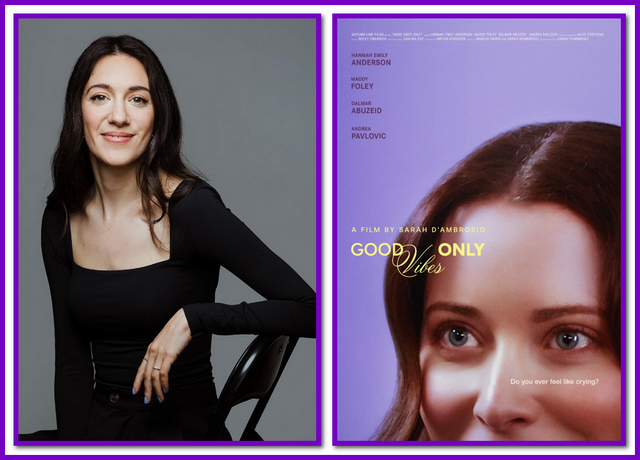
From its opening moments, GOOD VIBES ONLY announces itself as something more than another AI cautionary tale. It’s sly, funny, and just a little bit unnerving – a short that understands both the seductive pull of technology and the very human anxieties underneath it.
For entertainment lawyer turned writer/director/producer, SARAH D’AMBROSIO, GOOD VIBES ONLY the film is not just a calling card. It’s a statement of intent. Though this is her freshman outing as a writer/director, the work carries the confidence of a seasoned storyteller with clean, unfussy compositions, a sharply controlled tone, and a precise understanding of how color, pacing, and performance can turn a 13-minute short into a complete emotional experience, or a perfectly composed trial brief.
When D’Ambrosio first conceived GOOD VIBES ONLY, AI was nowhere near the omnipresence it is today. The film now plays like a piece of speculative fiction that accidentally caught up with reality.
“At the time that I wrote it, the way that we are using AI today was not the reality,”
Sarah explains. “A lot of the conversations that we were having on set early on were actually like, what is AI? What could it look like in our lives? So it was really kind of a thought experiment on what place it could have in our lives.”
The seed came from something incredibly mundane – lunch with friends.
“There was like a natural lull in the conversation. And as we do in the modern world, everyone grabbed for their phones because they were uncomfortable with silence… I was just very curious about that modern reality, that pull that we have to fill discomfort with something. And I was just as curious about how AI could play into all of that”.
That simple, recognizable moment – the need to fill silence, to mute discomfort – becomes the emotional backbone of GOOD VIBES ONLY. The film’s AI assistant, Margaret, doesn’t feel like sci-fi so much as a logical next step from meditation apps, wellness platforms, and algorithmic self optimization.
Coming from a background as a producer, D’Ambrosio approached directing with both reverence and fear.
“In terms of directing, I was truly terrified to do it,” she admits. “I have such reverence for actors, the emotional spaces that they go to, and I was really… nervous about what that would look like.”
Her solution was to lead not with authority, but with vulnerability:
“I really just led with vulnerability.” Open to her cast and crew about this being her first time directing, and writing, she “kind of tried to create a space.”
That actor-centric approach shows in the film’s central performance. As Eva, Hannah Emily Anderson navigates confusion, panic, and dependence with a face that feels like its own special effect. You can see every moment of doubt, every tiny panic spiral, every desperate reliance on her umbilically tethered smartphone AI conscience, Margaret.
Eva’s relationship with her phone – and with Margaret – becomes almost physical, something D’Ambrosio and her team leaned into visually.
“We spend so much of our modern life looking at our phones. But for a film, a lot of the conversations that we had were like, how do we make it still interesting to be looking at the screen? It informs so much of these characters’ lives and our own lives.”
Visually, GOOD VIBES ONLY is striking in its restraint. The frames are clean and unfettered. The blocking is precise. There’s a confidence in the work of cinematographer Alice Stephens and the way the camera moves – or doesn’t – that feels entirely intentional.
D’Ambrosio knew what she wanted to see, but she also knew she wanted collaborators who could push it further.
“I was more confident, certainly, about what I was visually inspired by. I felt quite secure in that. I reached out to people that I really admired”, describing production designer Shauna Eve and cinematographer Alice Stephens as “ insanely talented. Relaying her vision to them, “they kind of just took it to new heights.”
Color became one of the key storytelling tools. The film’s palette is cool, alluring, and deliberately contradictory. “The color aspect was really important to me. I wanted the world to feel like this sort of calming, meditative space that’s quite beautiful and alluring, but also to feel very cold at the same time, which is why we went for these really cool tones”.
That creates a purposeful visual dissonance. Everything looks designed to soothe you, yet something in the temperature of the image keeps you on edge. The infamous purple suit worn by Eva because Margaret told her that “purple is a power color”, becomes part of that commodified, packaged “wellness” aesthetic.
“I’m just so interested in the way that things are commodified for women, packaged. Things that are completely random, like purple powering, doesn’t mean anything, but when it’s sold in a specific way, it’s targeted towards women. So I was really curious about that culturally.”
The contrast extends into the spaces Eva inhabits. The cooler, paler interior worlds, the office with its sharp green pops, and then the warm return to nature when she lands on a park bench. The outside world isn’t idyllic, but it is palpably more alive – a subtle reminder that the “good vibes” we’re being sold inside might be anything but.
One of the film’s most effective choices is treating Margaret – the AI in Eva’s phone – as a full character. The phone is photographed as if it were a scene partner. Tilted in nervous, almsot sweaty hands, left alone on a counter, clutched like an umbilical cord that can’t be cut.
That choice came with a practical challenge. How do you make a screen and a disembodied voice cinematic?
“A lot of the conversations that we had were like, ‘How do we make it still interesting to belooking at the screen?’, because it’s just not as interesting as the rest of the world. But it informs so much of these characters’ lives. The color piece was kind of the big discussion and how to make it look sort of like these meditative apps that are really alluring and pretty in some ways and unsuspecting.”
The other half of Margaret is vocal – a perfectly modulated voice performance by Maddie Foley, who sounds almost too much like an AI system.
“Maddie is actually one of my very good friends, and I was very familiar with her voice acting, so I knew from the start when I wrote it that I really wanted her to play that part”.
To keep Eva and Margaret’s dialog organic on set, Maddie wasn’t just a post-production element. She was physically there, hidden on location. “We had Maddie on set with us to help keep the dialog organic between Eva and Margaret. So Maddie was sort of in the spaces, but she was hiding behind a door, underneath a desk, just so you would just hear the voice and to aid Hannah’s performance.”
Laughingly, Sarah recalls “When we first started shooting, everyone in the crew was looking around being like, ‘Is that an AI recording?’. It was so creepy how much it sounded like a robot. But she’s phenomenal.”
The result is two fully realized characters – one on-screen, one only heard – locked in an intimate, increasingly fraught relationship that feels all too recognizable.
For a film that runs roughly 13 minutes, GOOD VIBES ONLY covers a surprising amount of tonal ground. Satire, unease, genuine emotional breakdown. That balancing act was forged in the edit with editor Becky Swanick.
“Becky is incredible. She has such a great comedic instinct, and I really trusted her to kind of guide, especially in that realm when there are these sort of satirical jokes.
The challenge was pacing – not just comedy, but the fusion of dark satire and sci fi. “I was trying to find the right pacing for a dark satire with a sci-fi mix. So that was, I think, the biggest challenge.”
It may have been the most challenging, but also the most rewarding. “I feel like I learned so much as a director through the edit because the story can change so much and you don’t realize that when you’re on the page with it.”
On set, the film stayed close to the script, especially in the AI inflected dialog that borrows from online “cringe” and social media speech.
“The dialog was pretty close to the script because so much of the dialog was inspired by kind of the internet cringe, things that we see on social media that don’t really mean anything outside of what the internet tells us they mean”.
But when it mattered, D’Ambrosio allowed the film to breathe. The key breakdown between Eva and Margaret became a space for improvisation and emotional risk.
“The biggest moment of improvisation was really Hannah’s scene, a final breakdown with Margaret near the end. We really operated like a closed set. It really was Alice tracking Hannah and where she wanted to go with it. And then also in that case, we had Maddie in that room.”
For all of its big ideas, GOOD VIBES ONLY is anchored in small, specific, human details. Chief among them, oat bars, a chuckle inducing running bit that becomes unexpectedly emotional connective tissue between characters.
The way Eva spirals into a nervous, rapid fire monologue about oat bars, an ex-boyfriend, and the impossibility of reclaiming a shared space is one of the short’s comedic high points. It’s the kind of scene that feels discovered rather than manufactured, sprung from the character’s own anxiety and need to connect over something, anything.
D’Ambrosio clearly delights in how those little, almost throwaway details can come to define us – and, in this case, expose just how much we’re grasping for simple human connection in a world of carefully packaged “good vibes.”
Behind the camera, GOOD VIBES ONLY is driven by women at almost every level. The heads of department – from cinematography and production design to editing, casting, art direction, and sound – are predominantly female. “It was predominantly female, and all of the production heads of department were women,” Sarah confirms.
For her, this wasn’t an incidental outcome; it was a deliberate response to ongoing imbalance.
“I feel that representation in our industry is really lagging for women, and I know so many female artists in my life that are so incredibly talented.”
As writer and director of GOOD VIBES ONLY, D’Ambrosio was able to help shift the tide with not only the female-centric gaze of a story and her directorial vision, but through every level of production, “particularly for a story where we’re talking about and looking at female rage and ways in which women feel that they don’t [or] can’t express themselves. . .I really just wanted a forum to celebrate the talents of all of these different women.
That ethos comes through in the film’s focus on female experience and in its refusal to reduce Eva’s journey to a simple “tech is bad” parable. Instead, it’s about a woman navigating pressure, expectation, commodified wellness, and the lure of something that promises to manage it all for her – at a cost.
If GOOD VIBES ONLY feels like a calling card, that’s because it is – and an impressively polished one at that. D’Ambrosio’s command of performance, visual language, and tonal balance points toward a career that’s just getting started.
She already has her eyes on what comes next.
“I’m certainly working on writing a few pieces. I do have a feature that I’m writing, co-writing with a friend. It’s a horror feature, and I am hoping to shoot another short film this year. But I have been playing around with ways to kind of extend GOOD VIBES ONLY, so hopefully that’ll be in the future as well.”
Whatever form it takes, be it an expanded version of GOOD VIBES ONLY or something entirely new, the voice on display here is clear, confident, and deeply attuned to the way we live now – tethered to devices, chasing calm, and aching for something real underneath all the “good vibes.”
by debbie elias, exclusive interview 07/14/2026
GOOD VIBES ONLY is currently on the festival circuit.