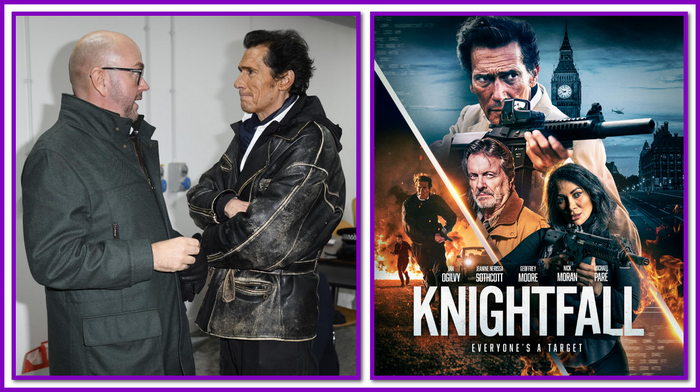
There is a moment midway through a conversation with producer JONATHAN SOTHCOTT when, almost casually, he provides the key to understanding not only how he made KNIGHTFALL, but how he approaches filmmaking itself.
“I come from the Roger Corman School of Filmmaking, which is if you find an asset, you find a way of incorporating it into the movie.”
It is a deceptively simple philosophy. In Sothcott’s hands, however, an asset can be almost anything: a location he knows he can secure, a marina accessible through an executive producer, an actor already working on another of his films, an office that can double as MI5 headquarters—or even a crossbow that happens to be lying around when a movie needs a stronger opening.
“The story is great,” Sothcott continues, “but you can bend the story around any kind of production value that makes it more interesting and more exciting.”
And that, in many respects, is KNIGHTFALL.
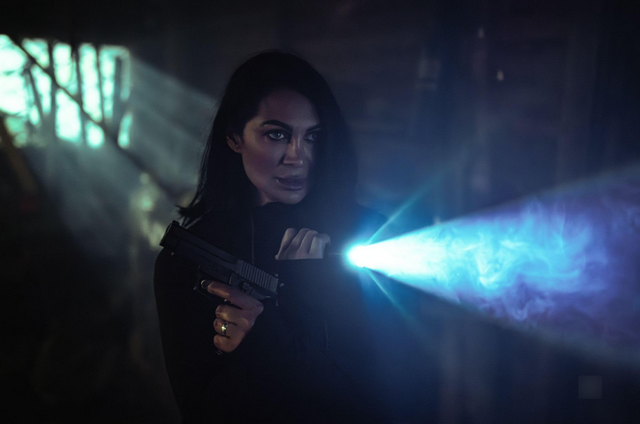
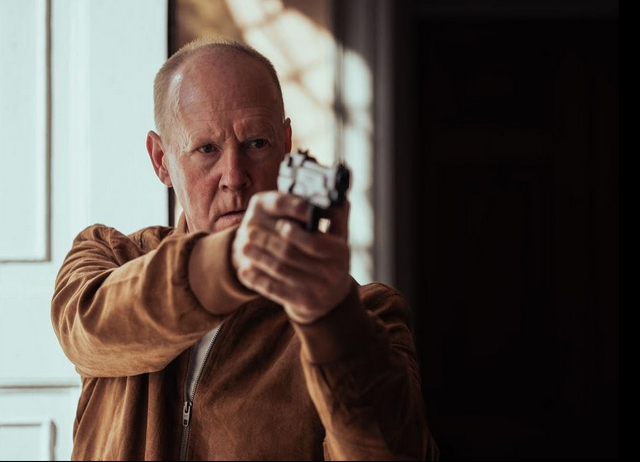
A lean, intelligent British espionage thriller starring Ian Ogilvy, Jeanine Nerissa Sothcott, Geoffrey Moore, Robert Cavanah, Rupert Holliday Evans, Nick Moran, and Michael Paré, KNIGHTFALL centers on former spy catcher Charles Knight (Ogilvy), who is pulled out of retirement when his scientist daughter Ros (Sothcott) becomes the target of killers seeking a stolen briefcase containing a man-made biological weapon.
But this is no gadget-laden attempt to imitate Bond. Directed by Ben Fortune, KNIGHTFALL is grounded in character, intelligence, and performance, with action growing organically from story and, just as importantly, from the physical capabilities of the actors performing it.
For Sothcott, that was essential.
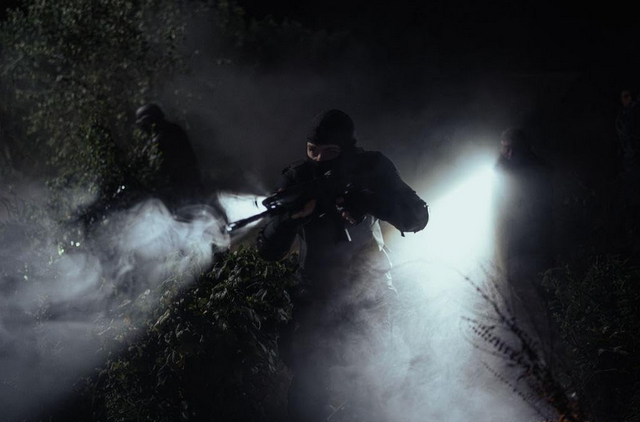
Working with Action Director Darren LeFevre, whom Sothcott calls “the best coordinator I’ve ever worked with,” the filmmakers deliberately avoided asking the actors to perform action that would undermine the film’s credibility.
“We talked at great length about how we have to try and make this sort of realistic,” says Sothcott. Jeanine Nerissa Sothcott is petite; LeFevre and Paré are considerably larger men. Simply having her trade blows indiscriminately with opponents twice her size would not ring true.
Instead, LeFevre tailored the choreography to character, performer, and circumstance.
“The thing with Darren is, I’ll say to him, ‘This is what we’re going to do, Darren. Go away and think about the best way to do it.’ And if he comes to me with a better idea than what’s in the script, obviously that’s what we’ll do. And invariably he does.”
That trust extends throughout Sothcott’s filmmaking family.
One of KNIGHTFALL’s standout sequences—a brutal confrontation between Jeanine Nerissa Sothcott and Michael Paré—wasn’t even part of the original production plan. Sothcott was shooting his horror film HELLOWEEN in late 2023 with Paré and Jeanine and realized he had an opportunity.
“I said to him, look, while you’re here doing this horror movie, is there any chance we could do one day, a sort of one-day cameo for this? And he said, ‘Yeah, sure, that sounds great. Send me the script.’ I said, ‘Michael, I don’t have a script, but I’ll have a script for your bit.’”
They created the sequence. Paré, Jeanine, and LeFevre rehearsed it one afternoon on the HELLOWEEN set, and the following night they shot it.
The only problem?
“It set the bar very high for the rest of the movie because it’s such a great scene.”
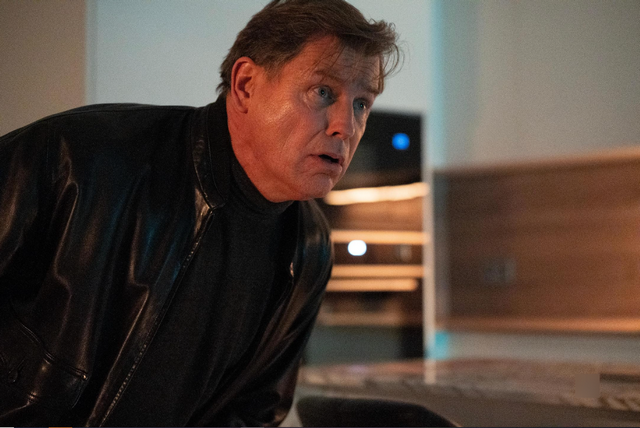
For Sothcott, Paré represents precisely the kind of actor he believes independent genre filmmaking should be embracing.
“There is nothing that Paré can’t do,” he says, calling him one of the most underrated leading men working today. “I always say to people, I’m very, very lucky that he is in this B-movie milieu at the minute, but I hope for him it doesn’t last forever.”
Sothcott believes Paré is “just a Yellowstone away from a resurgence.”
That philosophy—giving accomplished performers a platform rather than chasing youth for youth’s sake—runs throughout KNIGHTFALL.
“It is a very important part of what we do at our company,” Sothcott explains. “The obsession with youth that Hollywood and the streamers have isn’t something that I share. There are so many amazingly talented actors out there, and so we try really hard to give them platforms as well.”
Few casting choices embody that better than Ian Ogilvy and Geoffrey Moore.
Ogilvy, of course, played Simon Templar in Return of the Saint, following Roger Moore’s iconic turn as Templar in The Saint before Moore became James Bond. Geoffrey Moore, Roger’s son, had been Sothcott’s friend for years.
“When Geoffrey walks into the room, people don’t know who he is, but they know he’s someone,” Sothcott says. “He just lights up the room. He’s sort of like a very tall light bulb.”
Sothcott had wanted to find the right project for Moore. A horror film or gangster picture, he felt, would squander what Moore naturally brought to the screen. Then an espionage project arrived.
Suddenly, Sothcott could put the Saint and the son of a Saint together.
“It was just a perfect storm and all too good to be true.”
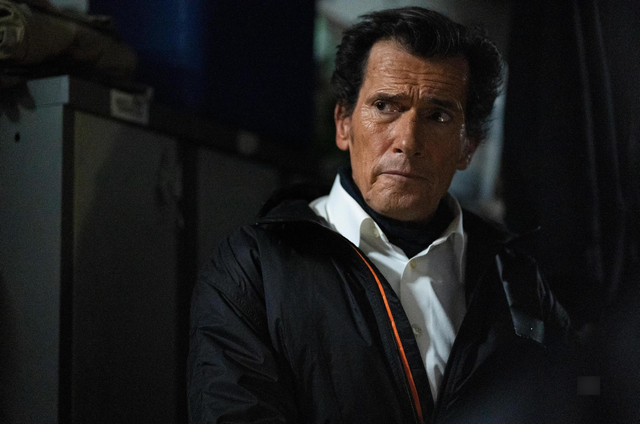
Yet Sothcott was equally determined that the casting never become a gimmick.
Geoffrey may evoke his father in appearance and especially in vocal timbre and cadence, but Sothcott sees a distinctly different, more modern screen presence.
“Roger, even at his peak, was a very kind of old-fashioned star,” he says. “He was kind of the last of the gentleman heroes, really. He was in that line of Cary Grant and people like that, whereas Geoffrey is a very modern screen presence.”
The temptation to lean harder into Bond nostalgia was there. At one point Sothcott considered Stephen Berkoff and Julian Glover for roles eventually consolidated around Nick Moran’s Carmichael. Both had appeared opposite Roger Moore during his Bond years.
Sothcott and Geoffrey discussed it.
“I said, ‘I’m just worried that if we put Berkoff and Glover in a scene with you, it’s going to look like we’re trying a bit too hard with the Bond stuff.’”
They backed away.
It was precisely the right instinct. KNIGHTFALL benefits from its cinematic lineage without becoming beholden to it. There is familiarity in its DNA, but never parody or pastiche.
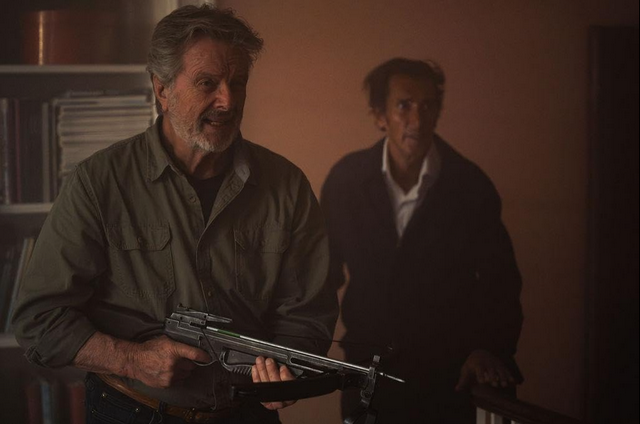
Production design becomes another means of maximizing what is available while allowing the environments themselves to define character. And KNIGHTFALL creates a particularly effective visual progression through its principal living spaces.
First comes Ros’s safe-house apartment: clean, sparse, and clinical, reflecting both her scientific world and the stripped-down urgency of her situation. Then we move into Hugh’s home, where greater texture and personality begin creeping into the frame, capped by that wonderfully showy glass fireplace planted squarely in the middle of the living room.
And with Hugh (Geoffrey Moore), another visual idea begins to emerge—the generational melding of the world of British intelligence.
Hugh is the hipper, cooler, younger MI5 agent, and his surroundings reflect that contemporary sensibility. Charles Knight belongs to the old school, something evident not only in his manor, but in his manner. By the time we arrive at Charles’s home, the visual bandwidth has opened completely—wood, staircases, fireplaces, artwork, shadow, and history enveloping a man whose own history is now being called back into service.
But Charles may be old school; he is hardly antiquated. Embedded within all that history is a first-rate security and surveillance system, its ever-present black-and-white monitors announcing intruders and reminding us that beneath the traditional trappings, Knight remains very much a spy catcher. And should the monitors prove insufficient, there are always exploding front doors.
Hugh’s sleek modernity and Charles’s old-school refinement coexist within the film just as the younger and older generations of intelligence operatives do—with poor Ros caught quite literally between them as daughter to one and girlfriend to the other.
It’s character definition—and generational definition—without wasteful exposition.
And for Sothcott, even something as seemingly innocuous as the color of a wall becomes a producorial consideration.
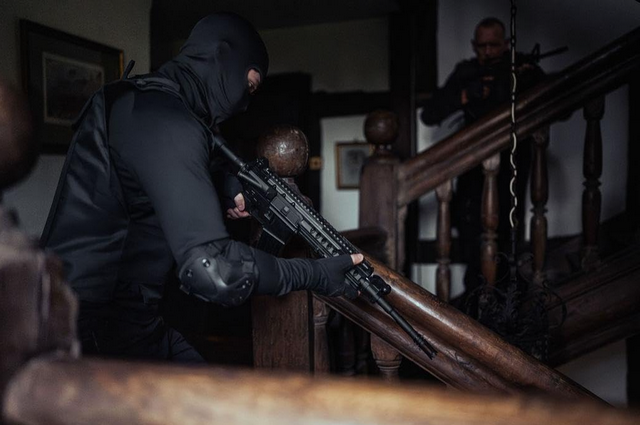
He laughs about the recurring battle over white walls. UK distributors don’t want them, viewing them as a telltale sign of low-budget filmmaking. There is just one inconvenient problem.
British people actually have white walls.
“The first question I always say when we’re location scouting: ‘Has it got white walls?’ ‘Yes.’ Right. Forget it. No good.”
When white walls can’t be avoided, texture becomes invaluable—architecture, furnishings, reflections, anything that can give the frame dimension and keep an inexpensive location from looking inexpensive. Hugh’s glass fireplace is a perfect example.
By the time KNIGHTFALL reaches Charles’s manor, however, the filmmakers have an embarrassment of visual riches for cinematographer James Westlake to exploit.
Except even that sprawling world contains a bit of Sothcott sleight of hand.
In the story, Charles speaks of moving from the cottage to the big house.
There weren’t two houses.
“Actually, it was one big house, and we just shot it from different angles to make it look like two.”
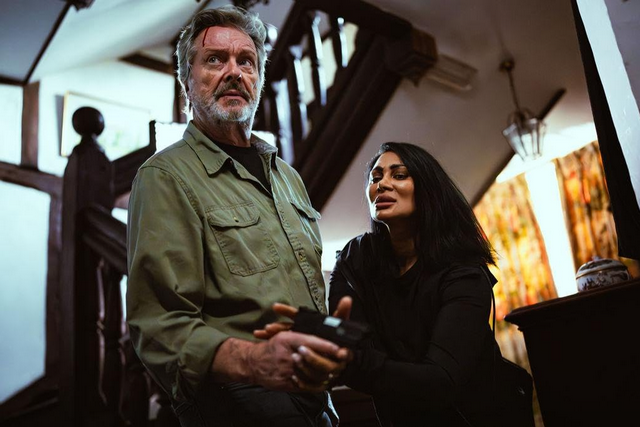
That is not simply budgetary necessity. It is knowing what the camera can give you and refusing to waste what is already there.
The marina came courtesy of an executive producer who had a boat there. Carmichael’s MI5 scene? Sothcott’s own London office.
Asset. Opportunity. Production value.
And then there was the crossbow.
KNIGHTFALL originally began quietly, with Ros receiving a telephone call and getting into her car. Once Sothcott saw the assembly, he realized that in an AVOD marketplace increasingly governed by the need to grab viewers immediately, the movie needed something more.
Working with writer Simon Clewett, he devised a new opening introducing Geoffrey Moore’s Hugh taking down opponents at a military installation.
Then LeFevre supplied one more useful bit of information.
“Oh well, I’ve got a crossbow, Governor.”
Sothcott’s response was essentially inevitable.
“Great. Well, he can shoot someone with a crossbow. That sounds terrific.”
Roger Corman would undoubtedly understand.
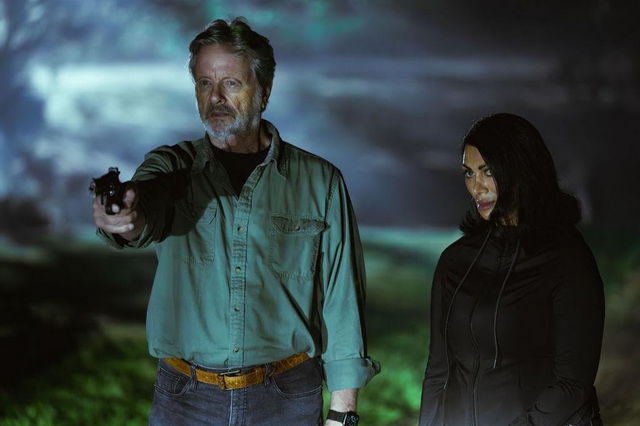
But Sothcott’s producing doesn’t end when the camera stops rolling.
“The movie doesn’t stop when it’s finished.”
He casts his films himself. He remains involved throughout development and production. And he stays involved through distribution and marketing because, ultimately, the responsibility is his.
“The buck stops with me because the financiers have high expectations of everything, and I have to fulfill them because I’m playing with other people’s money, really.”
That same clear-eyed assessment of assets extends to distribution.
For KNIGHTFALL, Sothcott had Saban in mind for North American distribution well before completion. He knew the film he was making, knew the audience for it, and knew the distributor equipped to reach that audience. There was no fantasy of making one kind of film and hoping someone could somehow sell it as another.
“We always saw this as a Saban movie in North America.”
Sothcott had worked successfully with Saban on RENEGADES and knew what the company could bring to an independent action film. More importantly, he understood the difference between merely getting a film onto a platform and having a distributor capable of getting eyes on it.
And when sales agents came bearing grander promises, Sothcott remained characteristically pragmatic.
“They come in with all these great promises of, ‘Oh, you know, we’re going to get whoever to pick it—get a big studio to pick it up…Paramount’s going to buy it.’ And I go, ‘Yeah, yeah, yeah, yeah. Just phone Steve Break at Saban. Let’s get it done.’”
That may sound obvious. It isn’t.
Particularly in an independent marketplace in which Sothcott sees the distinction between some smaller distributors and simple aggregators becoming increasingly blurred, getting a movie onto a platform isn’t enough. Positioning, publicity, and the ability to get eyes on that movie matter.
So does knowing exactly where you belong.
“We are making a certain type of movie for digital platforms,” Sothcott says. There is no pretense otherwise. Instead, he and his company, Shogun Films, are building a community around viewers who enjoy the same action and horror movies they enjoy making—and who want to see familiar, accomplished faces inhabiting them.
That relationship with audiences has become increasingly important as the economics surrounding independent film have changed.
Sothcott misses DVD.
A lot.
A staunch advocate for physical media who still buys Blu-rays himself, he laments not only the loss of something tangible, but the business infrastructure that once surrounded it.
“It was a lot easier then,” he says. “You had an eye on how your film was doing. It was a tangible product that you could sell to people.”
The disappearance of the traditional $20-to-$50 million theatrical film has had consequences far beyond that sector, he believes. Those movies once generated cash flow that helped support distributors’ marketing operations across their slates. Today, much of that filmmaking has migrated into the streaming-original world, while smaller independent pictures have lost the marketing machinery that once accompanied physical-media releases.
“If I made KNIGHTFALL 15 years ago, and it had been a DVD movie in the UK, a UK distributor would have thought nothing of spending half a million dollars marketing that film.”
Today, Sothcott says, much of that burden has shifted directly onto filmmakers.
“We are in a brave new world of guerrilla marketing for indie movies, and we do have to do it ourselves now.”
He isn’t complaining. He is adapting.
And perhaps that is where Sothcott’s Roger Corman School of Filmmaking ultimately extends beyond filmmaking itself. Finding the asset is only part of the equation. You also have to recognize when the equation has changed.
“I’m a big believer that to adapt is to survive.”
Sothcott knows his place in the filmmaking ecosystem and has no apparent desire to pretend he’s making something else. He has worked at larger budgets. He is comfortable now in the microbudget space, telling genre stories with actors he admires, collaborators he trusts, and a keen understanding of the audience waiting at the other end.
More money doesn’t necessarily make the problems disappear.
“I did a $3 million movie 15 years ago. We built sets at Elstree Studios. We did all this kind of stuff, and to be honest with you, it was exactly the same problems. They were just bigger and more expensive.”
Which may explain another wonderfully pragmatic Sothcott production maxim: “The less money, the smaller the problem.”
And as long as audiences continue wanting the movies he makes, Sothcott intends to keep making them.
“People keep telling me that they like these stories, and as long as they keep wanting them, then I will keep wanting to make them.”
For a producer whose career is built on recognizing the value of what is already within reach, that may be the most valuable asset of all: An audience that wants another one.
by debbie elias, exclusive interview 09/08/2026
KNIGHTFALL is available on Digital and On Demand on September 11th