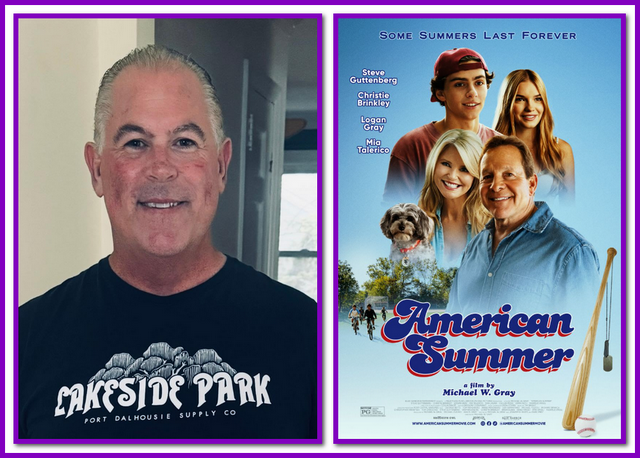
Michael W. Gray didn’t set out to make AMERICAN SUMMER because he wanted to recreate a simpler time. He set out to make the kind of movie his father wished still existed.
Some 15 years ago, when Gray’s four children were young, his parents would often pick up the kids and give Mom and Dad a little time to themselves. There would be ice cream, perhaps a movie, and eventually the grandparents would bring everyone home.
Gray’s mother, whom he describes as bubbly and someone who loved the arts, delighted in those movie outings. His father was different. A veteran who had grown up during the Great Depression, he was a more stoic man, and contemporary family entertainment could leave him more bewildered than entertained.
“I’d say, ‘Dad, how’d you like the movie with the kids?’ And he said, ‘Oh, there was a fish flying around, colors and sounds, and I couldn’t even look at it. I was getting dizzy.’”
Then came the challenge.
“He said, ‘They don’t make something I can watch with the kids and enjoy.’ And I said, ‘Challenge accepted, Dad.’”
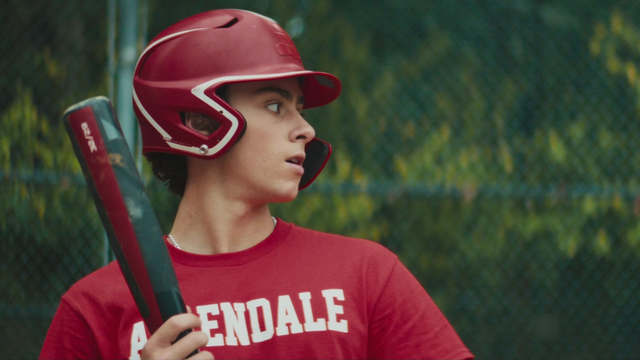
That challenge became the seed for AMERICAN SUMMER, a warmhearted coming-of-age story about one seemingly ordinary childhood summer that becomes anything but ordinary for young Mikey (Logan Gray). There’s baseball. Friendship. A first love. A puppy. Life lessons. And looming over it all, the uncertainty surrounding Mikey’s Army father, who has gone missing overseas.
Steve Guttenberg plays Mikey decades later, looking back on the summer that left an indelible mark on his life. For Gray, the film would ultimately become equally rooted in memory.
“That was sort of the beginning in 2012 of my sketching out a family multi-generational movie, which ultimately became sort of loosely based on a summer I had personally had.”
And suddenly it becomes easy to understand why AMERICAN SUMMER feels less like a manufactured exercise in nostalgia than someone opening an old box of photographs and remembering what happened just beyond the edges of the frame.
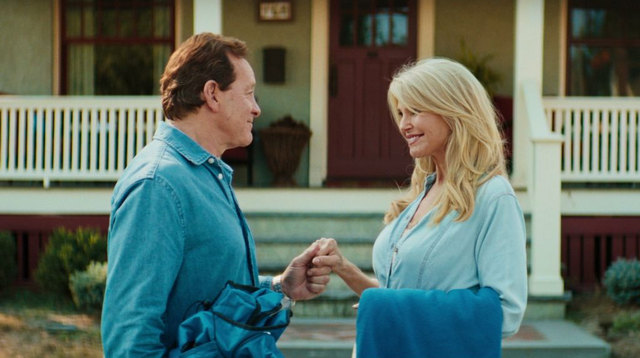
FROM TEN PAGES TO THE DIRECTOR’S CHAIR
Gray initially approached AMERICAN SUMMER not as a writer-director but as a producer.
In 2012, he began free-writing what amounted to a ten-page treatment. Then work intervened. Gray was busy producing films and traveling the festival circuit, and AMERICAN SUMMER went onto the back burner. Years passed. In 2018, Gray turned the treatment into a screenplay and brought in Jennifer B. White, whom he credits as instrumental in helping him through a substantial rewrite.
“She was so crucial in that process and gave me confidence and helped me through, and we got a great draft out of that together.”
Writer Marc Pray subsequently came aboard to take another look at the material, and by 2019 Gray had what he considered a working screenplay. Initially, the ambitions were considerably larger.
“We started to look at this as a bigger project. Like, hey, maybe we can get Paramount Pictures or Universal to make this. It’s a big family movie.”
Gray wasn’t necessarily going to direct. A larger production might bring in a more established director.
And then came 2020.
The ensuing years brought changing circumstances, changing budgets and repeated rewrites. Every new financial iteration required Gray to revisit what was on the page and determine what could realistically be put in front of the camera. Eventually, something changed beyond the budget. Gray changed.
“You know what? We’re going to go indie on this. I’m going to direct it.”
By 2024, with another budget and new people involved, Gray was rewriting yet again. He estimates the screenplay went through perhaps a dozen iterations, with additional changes sometimes being made on the morning of a shoot.
The producer who had first sketched ten pages in 2012 had become the writer-director responsible for finally bringing them to life.
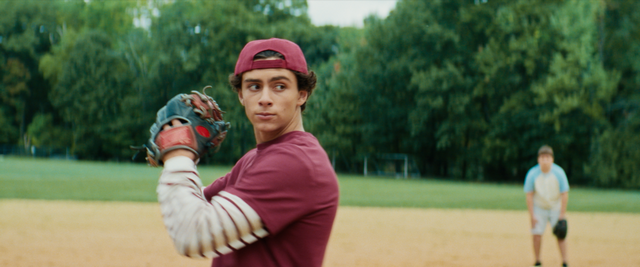
THE POSITIVITY OF LIGHT
For all the years AMERICAN SUMMER spent in development, Gray didn’t want the finished film to feel labored. Its visual simplicity is part of its charm.
Working with cinematographer Collin Brazie, Gray avoids flashy camera work or self-conscious visual flourishes. The photography instead reflects the remembered ease of childhood summers: open spaces, greenery, baseball fields, homes, diners and abundant natural light. That light was particularly important to Gray.
“We’re talking about a summer season movie and something light and hopeful and bringing people together. I wanted it to be open and natural light.”
In fact, darkness was something he deliberately avoided. “We never shot in the dark, ever. There was always daylight. Even if it was end of day, it was still daylight, and we wanted that positivity from the light to come through. That’s part of the theme of the movie.”
Gray personally scouted the New Jersey locations and became familiar with how the light behaved at different times of day before bringing Brazie through them.
“I knew what I wanted, and I knew what the light looked like at different times of day.”
Rather than meticulously shot-listing the film, Gray relied upon that advance familiarity with the locations and Brazie’s technical expertise to determine how best to capture them.
“He knew how to set up his camera and how to use his lenses. I don’t know that stuff as well. But it was a really good collaboration.”
The result is a visual grammar that feels refreshingly unforced. Even interiors maintain a connection with the outside world. Sunlight pours through windows. Family conversations unfold around a kitchen table. Problems large and small are addressed in the spaces where families actually live.
“You solve problems in your kitchen for a lot of people. That’s where you talk about life and death and problems and baseball practices and stuff like that. That’s where a lot of our lives exist.”
It’s an observation that gets to the heart of AMERICAN SUMMER.
Gray isn’t trying to make ordinary life extraordinary. He’s remembering why the ordinary eventually becomes extraordinary to us.
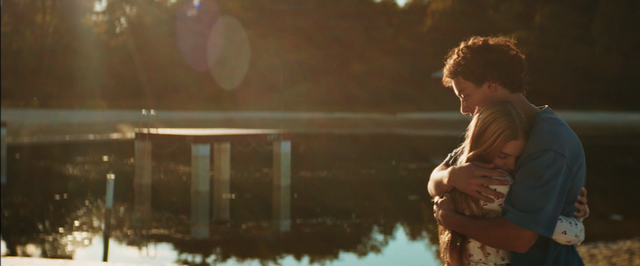
COACH GRAY TAKES THE FIELD
If AMERICAN SUMMER was going to succeed, however, all the natural light and nostalgic imagery in New Jersey wouldn’t matter if its young cast didn’t convince us they had been friends long before the camera arrived.
Here Gray discovered that another part of his life had unexpectedly prepared him to direct.
He is a longtime volunteer youth sports coach.
“I’ve been around literally thousands of children,” he says. “Getting kids to work together and socialize and be a cohesive team has been something I’ve been really good at over the years.” So the director brought Coach Gray onto the set.
Rather than relying solely upon rehearsals to manufacture chemistry, Gray encouraged the young actors to spend time together away from the work itself. “We ate together, we joked around, we told stories.”
The objective was the same one a coach might have with a newly assembled team: create camaraderie first and trust that the results will become visible when it counts. “It’s a way to build camaraderie and teamwork so that when you’re performing, there’s a chemistry.”
Central to everything was finding young Mikey.
With Guttenberg already attached as the adult version of the character, Gray needed a young actor who could credibly become the boy whose memories Guttenberg is sharing with us.
After seeing numerous candidates, Gray found Logan Gray. “The universe brought us Logan Gray. He was the perfect guy.”
The resemblance to Guttenberg helped, but it was Logan’s performance that sealed it.
“He looks like Steve. He’s a great actor, this kid, and he nailed it.”
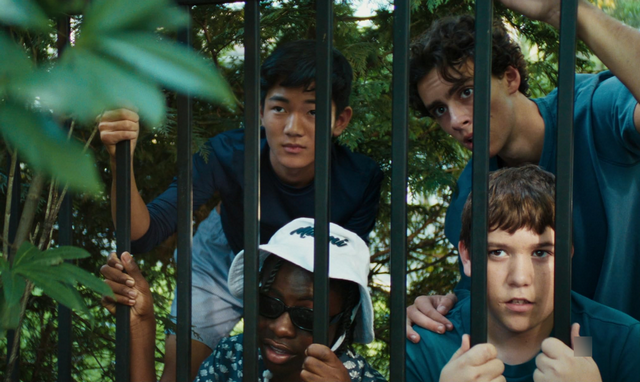
From there, Gray built the young ensemble around Logan, deliberately seeking contrasting personalities that would create a believable group of friends. The result is one of the film’s strongest assets. These kids don’t merely occupy scenes together. They feel as if they have a shared history.
And then there was one cast member who required an entirely different coaching technique.
ENTER ONE TAKE NOODLE
There is an old warning in Hollywood about never working with children or animals. Gray did both. At the same time. And lived to tell the tale.
The puppy who appears in AMERICAN SUMMER wasn’t even the production’s original canine choice. When that dog fell through, Gray was introduced to Noodle, the puppy belonging to composer Timothy Bright.
Gray asked to see a video. “Let’s cast Noodle right away. Boom!”
There was, however, a slight problem.
The dog in the screenplay was named Monty. Noodle had apparently not read the screenplay.
On her first day of shooting, producer Michael Cuomo approached Gray with the news that their new cast member simply wasn’t responding to her character’s name.
“Hey, man, this dog’s not replying to Monty. I think we have to change the name to Noodle.” Cuomo apparently expected resistance from his writer-director. There was none.
“Great. Noodle it is.”
Noodle proved so camera-ready that she soon acquired another name around the production: “One Take Noodle.”
Never underestimate the value of an actor who knows her name, hits her mark and doesn’t ask for another take.
FINDING THE FILM IN THE EDIT
Gray’s advance planning continued into post-production with editor and eventual co-producer Gregory Cusumano.
The montages that punctuate AMERICAN SUMMER—baseball, family, young love, memories accumulating almost faster than Mikey can appreciate them—weren’t solutions devised after photography. Gray had scripted them point by point.
“I knew exactly in my head how I wanted them to look, and then it was a matter of getting the shots and having the footage.” Budget again imposed discipline.
There wasn’t an enormous volume of coverage from which Gray and Cusumano could construct countless alternatives. They had the footage they had, and Gray knew what he had intended when shooting it.
“We had a couple shots, and that’s all we could do. We had limited footage to work with, and I knew what I had, and I knew what I wanted.”
But Cusumano brought another set of eyes to the material. “His input was so valuable to me.”
The two spent the winter together in what Gray remembers as a tight, lonely editing room—albeit one fortified with snacks—with Gray beside Cusumano throughout the process.
What emerges is an edit that never calls attention to itself. The montages function as storytelling rather than decoration, allowing experience and emotion to accumulate without unnecessary exposition. Much like the summer itself, one moment simply flows into the next.

LETTING THE MUSIC BREATHE
Composer Timothy Bright faced a similar challenge.
A story this unabashedly nostalgic could easily be smothered by a score determined to instruct the audience when to feel sentimental. Gray and Bright instead sought something lighter.
After watching the film, Bright sat down with Gray and Cuomo for a creative session in Bright’s studio—Noodle, naturally, was also in attendance. Gray and Cusumano had already placed temporary music against scenes to establish tone, giving Bright a starting point for their conversations.
“We went through it scene by scene.” The desired palette could change with the moment.
“We wanted a little bit of heart and a little bit of rock and roll in certain scenes, and a little bit of jazz in certain feelings.”
The resulting score complements rather than competes with the images. It allows baseball to be baseball, young love to be young love, and childhood adventure to retain its innocence without musically announcing the significance of every moment.
Because Mikey doesn’t yet know which moments will matter most. That understanding comes later.
ONE SUMMER LATER
That is ultimately where AMERICAN SUMMER finds its emotional footing. For young Mikey, this is simply summer. He wants to play baseball. He falls for a girl. He spends time with his friends. He learns lessons about sportsmanship, friendship and growing up. He worries about his father. He shares time with family.
Only the older Mikey can look backward and understand what those days became.
And perhaps that is also true for Michael W. Gray.
What began as a challenge from his father became a project spanning more than a decade, moving Gray from producer to screenwriter to director and eventually forcing him to reconsider something about himself.
Asked what directing his first feature taught him, Gray doesn’t point to a camera technique, an editing trick or some hard-won secret of production.
“The one thing I learned is that I don’t know everything.”
It is a simple admission from someone who arrived at the director’s chair after years in the industry.
“We all think we know everything. I have a lot of experience and a lot of knowledge. But you do learn something new every day, and I’m open to learning and collaborating and having great people around me to help me be able to do what I need to do.”
He intends to direct again, taking what he learned on AMERICAN SUMMER and making the next production, as he puts it, “tighter and better and smoother and more efficient.”
But there’s something fitting about the fact that his first feature as a director began with something his father taught him without intending to. Make something people can share. Parents with children. Grandparents with grandchildren.
And somewhere between baseball games, first love, kitchen-table conversations, Fourth of July gatherings, a scene-stealing puppy and the long summer daylight, Gray found the movie he promised his father he would try to make.
Challenge accepted, Dad. Challenge met.
by debbie elias, exclusive interview 09/03/2026
AMERICAN SUMMER is exclusively in theatres on September 4th.