WHAT IS REAL?
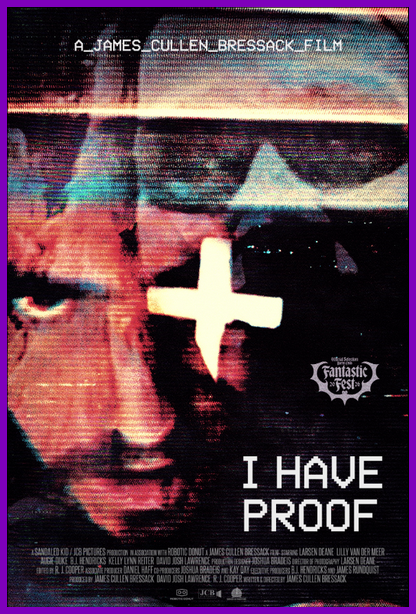
It is a question scribbled among my notes while watching writer/director James Cullen Bressack’s I HAVE PROOF, and by the time the film ends, it is no longer merely a question about what we’re seeing on screen. It’s a question about Alex. About evidence. About perception. About obsession. And perhaps most unsettlingly, about our own willingness to believe what someone places before our eyes and calls proof.
In 44+ years as a film critic, I have never seen anything quite like I HAVE PROOF.
I’ve seen found-footage films. I’ve seen faux documentaries. I’ve seen stories built around unreliable narrators, conspiracy theories, paranoia and psychological deterioration. But Bressack takes pieces of those familiar cinematic languages and creates something uniquely his own, constructing a narrative through six VHS-C “evidence tapes” recorded by Alex (Larsen Deane), a man desperately attempting to document and prove something that no one else believes.
What is he trying to prove? I’m not telling you.
Is what we’re seeing real? I’m not telling you that, either.
Because that uncertainty is the delicious conceit at the heart of I HAVE PROOF. Bressack doesn’t simply ask us to watch Alex. He makes us examine Alex’s evidence. Every image becomes potentially significant. Every object demands inspection. Every sound makes us listen more closely. And as the tapes accumulate, so do the questions.
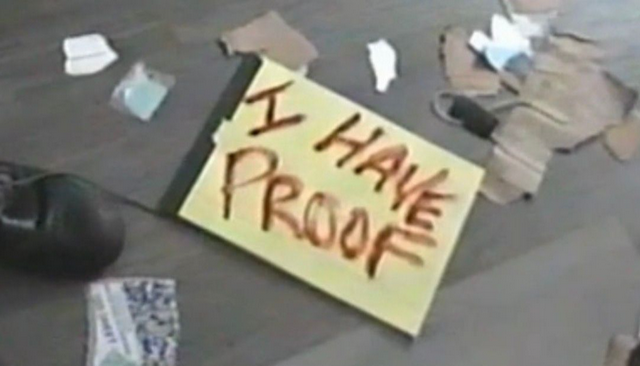
Static. Color bars. Timecodes. Polaroids. Bloody fingerprints. White envelopes slipped beneath a door. Messages written in blood across yellow legal pads. A knife. Rope. Oversized black silicone gloves. A vial of holy water. Rosary beads. A cross. An old analog standard-cassette tape recorder. Objects appear, reappear and take on increasing significance as Alex meticulously builds his case.
Bressack understands that the power of this construct lies in restraint. There is virtually no dialogue for much of the film, nor does he rely on exposition to tell us what Alex is thinking. Instead, we watch. We listen. We study.
And we start connecting dots. But are those dots actually connected?
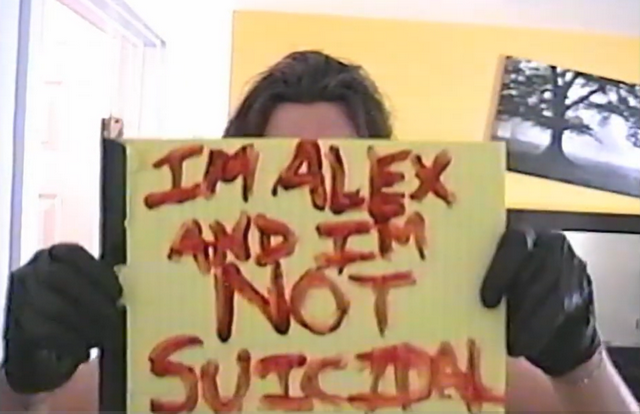
That is where Bressack begins playing a particularly effective psychological game with us. Once he conditions us to search for meaning, we begin doing exactly what Alex is doing. A seemingly innocuous detail suddenly feels important. Something glimpsed in one tape causes us to reconsider something seen earlier. We begin looking into corners, studying photographs, examining the arrangement of objects and listening to noises that ordinarily might be dismissed.
Before long, we aren’t merely watching Alex search for proof. We’re helping him look for it.
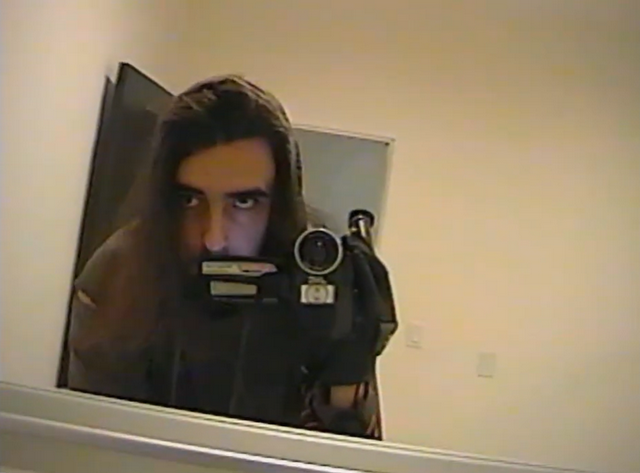
Larsen Deane is riveting as Alex, delivering a largely physical performance in which posture, movement, stillness, facial expression and breathing become his dialogue. There is a haunting intensity to his increasingly internalized behavior, particularly during an extended stare into a mirror that feels less like a man looking at his reflection than one searching it for answers.
Adding another fascinating layer to Deane’s performance is the fact that he also serves as cinematographer and camera operator. The camera therefore becomes an extension of Alex himself. Slow sweeps of the hotel room don’t always show us everything we want to see. Pans search rather than merely reveal. Movement becomes increasingly reflective of Alex’s mental and emotional state.
It’s an inspired marriage of performance and cinematography because we aren’t watching Alex through someone else’s observational lens.
We are frequently seeing through his.
That subjective quality is reinforced beautifully by Joshua Bradeis’s production design. Alex’s hotel room becomes an evolving physical manifestation of the man inhabiting it. What begins as a functional space increasingly fills with equipment, papers, trash and the detritus of obsession. Bressack and Bradeis understand the value of tactile objects within an analog world, and almost everything Alex touches has weight and texture.
That tactility is critical because I HAVE PROOF exists almost defiantly outside our sleek digital age.
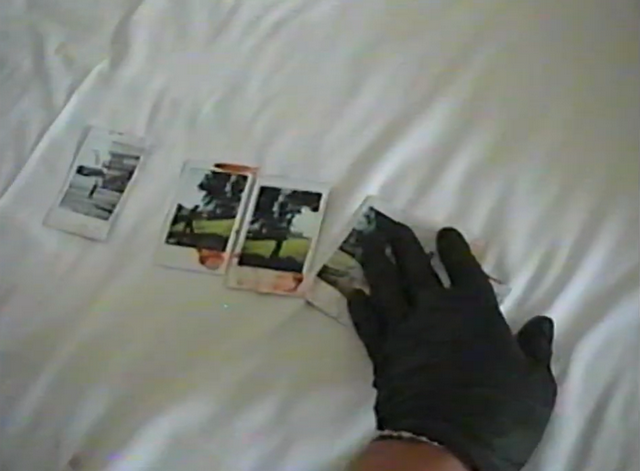
Bressack shoots on VHS-C, and the imperfections of the format are integral to the film’s effectiveness. Images bleed. Resolution softens. Static intrudes. Color behaves imperfectly. Darkness doesn’t surrender information easily. Rather than diminishing the experience, those limitations make us lean into it. We have become so accustomed to pristine digital imagery that the degraded analog image paradoxically feels more immediate—and perhaps even more trustworthy.
Or is that merely another assumption Bressack wants us to make?
Equally important is editor R.J. Cooper, whose work is nothing short of superb. Cooper establishes the individual rhythm of the evidence tapes while simultaneously creating an overarching rhythm across all six. Repetition never becomes redundancy because details mutate, interruptions gain meaning and the relationship between what we’ve already seen and what we’re seeing now is continually shifting.
One of the film’s most inspired devices comes through fleeting images from Alex’s childhood birthday party.
Initially these fragments feel almost anomalous, pieces of another life intruding upon the evidence. But watch what happens to them. As the film progresses, the birthday images become increasingly abbreviated. Memories that once had some duration shrink into flashes and eventually into mere blips, as if Alex himself is slowly being erased beneath the weight of whatever truth he is pursuing.
It’s haunting.
And Cooper knows precisely how long—or how briefly—to let us see them.
But if the images are what draw us into Alex’s world, Brian Berger’s sound design may be what traps us there.
There is no traditional score telegraphing fear, no musical hand reaching through the screen to tell us when we’re supposed to become uneasy. Instead, Berger turns the environment into the score. Wind. Distant voices. Indistinct low frequencies. Room tone. Mechanical noises. Alex’s breathing. Pounding on the hotel room door. The unmistakable sound of the door handle jiggling from the other side. The soundscape becomes increasingly oppressive without ever announcing itself as such.
And those sounds have consequences. Alex wedges a chair beneath the door handle, another small detail that speaks to his mounting vigilance. Then, on one occasion, the pounding and rattling send him leaping up, pulling away the chair and throwing open the door.
No one is there.
Is someone tormenting him? Did someone get away before he opened the door? Is Alex hearing what he believes he’s hearing? Bressack doesn’t tell us. But Berger makes certain we hear it, too.
And then there are tiny sounds.
At one point, the squeak of a gloved finger dragging across the window pane is as chilling as fingernails scraping across a chalkboard. It sent a shiver through me.
That’s how attuned Bressack and Berger have made us by then. Something that would be incidental in another film becomes almost unbearably noticeable because I HAVE PROOF has taught us that everything might matter.
This attention to detail extends to Cheryl Holtzman and Eric Fox’s practical makeup and effects work. Without venturing anywhere near spoiler territory, suffice it to say that when their contributions become increasingly important, the degraded VHS-C image works beautifully in their favor. Practical effects possess an inherent physicality, and here the analog format gives them an additional layer of immediacy that pristine digital photography might actually have diminished.
And then Bressack reaches approximately the 1-hour-and-8-minute mark.
And this thing explodes.
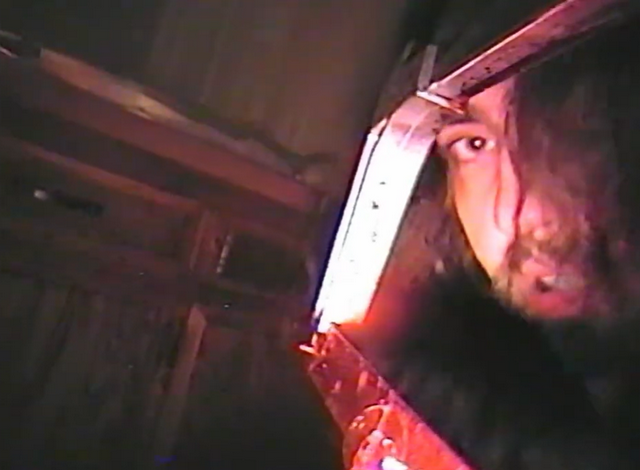
Everything he has been methodically accumulating—every visual clue, sonic disturbance, repeated image, physical object, increasingly desperate breath and unanswered question—suddenly seems to accelerate. The restraint of the preceding hour becomes essential because Bressack has been tightening the spring all along.
When he finally releases it, I HAVE PROOF becomes almost breathless.
Yet even amid that acceleration, he doesn’t betray the fundamental conceit. He never abandons the evidentiary structure simply because the film has reached its climax. The camera remains important. The physical tapes remain important. What Alex records remains important.
And, most importantly, what we believe remains important.
There is something wonderfully audacious about Bressack making this particular film now. We live at a moment when images can be manipulated effortlessly, artificial images can be generated in seconds, misinformation can travel around the world before anyone thinks to question it, and almost every person carries a sophisticated recording device in a pocket.
Bressack responds by going backward.
A VHS-C camera. Physical tapes. Battery-powered equipment. Handmade props. Practical effects. A tiny crew. A man desperately attempting to capture something tangible and place it before us as proof.
The irony is irresistible.
Because the more physical Alex’s evidence becomes, the more I HAVE PROOF forces us to confront an uncomfortable question: Does seeing something make it true?
Bressack doesn’t answer that for us.
Nor should he.
In my many years of knowing and interviewing James Cullen Bressack, I’ve watched him move among horror, action and thrillers of vastly different scales, budgets and styles. I HAVE PROOF feels unlike anything he has done before. It’s inventive, handmade filmmaking built not around spectacle but around an idea—and the confidence to trust an audience enough to let that idea breathe.
Not everyone will surrender to its unusual rhythm or deliberately fragmented construction. This is decidedly not mainstream filmmaking, nor is it trying to be. But for audiences willing to watch closely, listen carefully and engage with the evidence rather than wait for a film to explain itself, I HAVE PROOF is riveting, unsettling and increasingly immersive.
Six tapes.
One man’s evidence.
And one final question left for each of us to answer: Do you believe him?
Written and Directed by James Cullen Bressack
Cast: Larsen Deane, Lilly Van Der Meer, Augie Duke, and Kelly Lynn Reiter
by debbie elias, 09/11/2026
I HAVE PROOF makes its World Premiere at Fantastic Fest on September 21, 2026, and then screens at additional festivals thereafter.