By debbie lynn elias
What is truth? What is memory? How much of what we see, hear, and believe is shaped by perception, assumption, or the limitations of our own understanding? And perhaps most importantly, can we trust the information being presented to us?
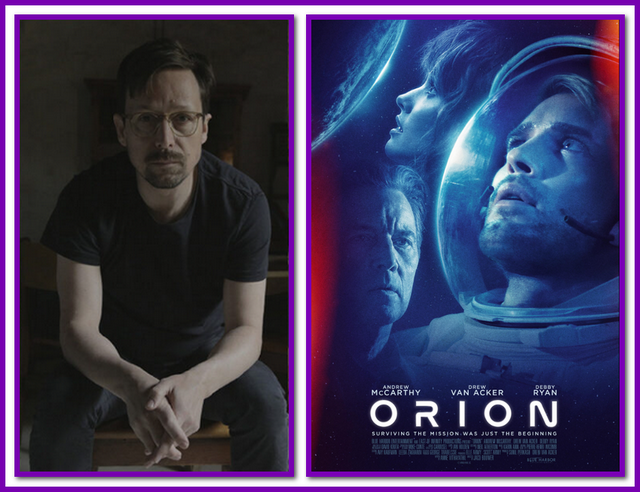
These are the questions at the heart of ORION, an extraordinary science-fiction mystery directed by JACO BOUWER that challenges audiences to look beyond the obvious, listen to the silence, and question everything. With a deceptively contained setting, a small ensemble led by Drew Van Acker, Andrew McCarthy, and Debby Ryan, and a remarkable integration of cinematography, production design, sound, score, performance, and editing, Bouwer has crafted a film in which every creative choice has purpose.
Bouwer possesses that rare combination of creative vision and thoughtful intention. His images are striking, but never merely decorative. His silences are deliberate. His camera movements have meaning. And even the physical limitations of the production become instruments of storytelling.
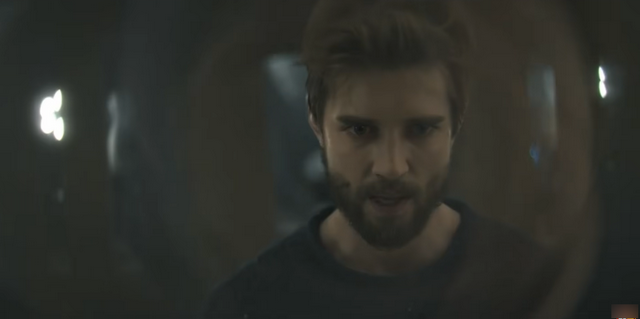
Written by Anne Vithayathil, ORION follows Apollo (Van Acker), the sole surviving astronaut of a disastrous mission, who awakens with no memory of what happened to his crew. As an interrogator attempts to unlock those memories, the question of what Apollo knows becomes inseparable from what he believes—and what the audience is willing to accept as truth.
For Bouwer, the attraction began with the screenplay’s exploration of unreliable narration.
“There was something about Anne’s script that kind of drew me in. This idea of sort of unreliable narrator, you know, this thing about truth, memory, and to just not put too much other stuff on it, but just to sit within those kind of thematic elements. There was enough for me to excite me and to kind of draw me into the project.” It is a deceptively simple foundation for a remarkably complex piece of filmmaking.
Producer Sunil Perkash, who had considered numerous filmmakers for the project, recalls that Bouwer immediately distinguished himself. “We had many directors wanting to direct this but Jaco was a real cut above and he came in and made this his film!”
Perkash also describes Bouwer as “VERY humble,” an observation borne out in conversation with the filmmaker. Despite the extraordinary precision of ORION’s execution, Bouwer remains willing to question his choices, consider alternatives, and acknowledge the collaborative discoveries that shaped the finished film.
And perhaps nowhere is that combination of creative conviction and humility more evident than in Bouwer’s approach to performance.
THE TRUTH OF THE MOMENT
ORION is a film constructed in layers. Like the Russian nesting dolls placed within its central interrogation environment, each apparent revelation suggests another reality waiting beneath it. Bouwer embraces the metaphor.
“It’s like these onion skin of layers, and you think you have found a revelation, but then there’s another layer underneath.”
But how does a director guide actors through a story in which deception, uncertainty, and shifting perception are essential to the narrative without allowing those layers to overwhelm the performances?
For Bouwer, the answer lies in playing the truth of each individual moment.
“How do you play a lie? We talked a lot about it in the beginning. I think it was something that Drew [Van Acker] was like, in the beginning, ‘But how do I show all these layers?’ And then I just think you have to choose in that moment what is the truth.” Attempting to signal every hidden motivation would risk muddying the emotional clarity of the scene. “If you’re trying to play all those layers, it could easily become really fuzzy or kind of murky. And I think it was almost like you have to, for this moment, you are amnesiac. You can’t remember.”
That philosophy extends to the relationships between Apollo, Jim (Andrew McCarthy), and Mary (Debby Ryan). Each performance must remain authentic to the circumstances as the characters understand them, even when the audience may be receiving incomplete information. “It was almost like you have to really, really delve into the truth of the moment and play the truth for that moment.”
The complexity of that approach becomes particularly evident in Bouwer’s direction of Debby Ryan as Mary, a character whose apparent identity conceals a far more troubling reality.
While Apollo and Jim operate within their respective versions of the truth, Mary’s situation introduces an additional dimension: the possibility that she is not merely participating in a deception, but has herself been manipulated into becoming part of it. Bouwer and Ryan explored the disturbing implications of Mary’s circumstances, including the possibility that she had been abducted, held against her will, and physically altered to assume an identity that was never hers.
“I think it was maybe a bit different for Debby because Mary, or her role, we were really talking about where does she come from? Why would she do that?” Rather than playing Mary as an entirely convincing participant in the deception, Ryan deliberately allows moments of discomfort and emotional fracture to emerge. “For her, she was there against her will. So if you look at her performance, there’s moments where you can see through, you can see the real character breaking through, and that was a conscious choice.” It is a subtle but crucial distinction.
What might initially appear to be inconsistencies in Mary’s behavior become, upon reconsideration, evidence of an entirely different psychological reality. Bouwer even recalls encountering a review suggesting that Mary was simply a more convincing liar than the other characters. But that interpretation misses the deliberate vulnerability embedded within Ryan’s performance.
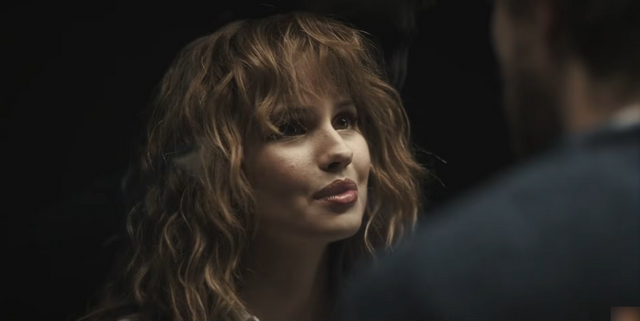
“That was a conscious choice to show those layers, that she is not in her comfort zone. That was intended.”
And suddenly the Russian nesting dolls become more than an elegant visual metaphor. They become a representation of the characters themselves, each constructed identity concealing another layer of truth, coercion, or uncertainty.
Bouwer’s background in theater becomes particularly important here. ORION is a dialogue-driven film, with extended exchanges, precisely motivated blocking, and carefully calibrated shifts in emotional power. Rather than disguising those theatrical qualities, Bouwer embraces them. He also discovered that his principal actors approached preparation quite differently.
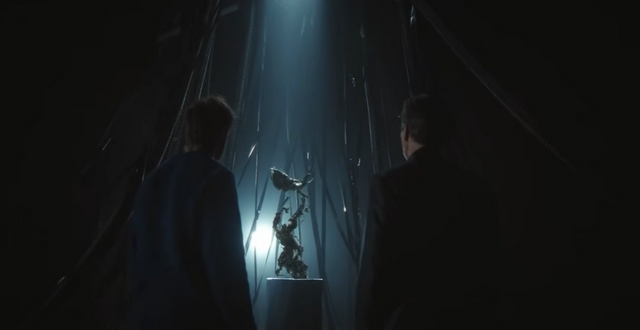
Van Acker welcomed extensive rehearsal. Bouwer and the actor blocked out the central room and experimented with the physical operation of the mysterious instrument that figures so prominently in Apollo’s experience.
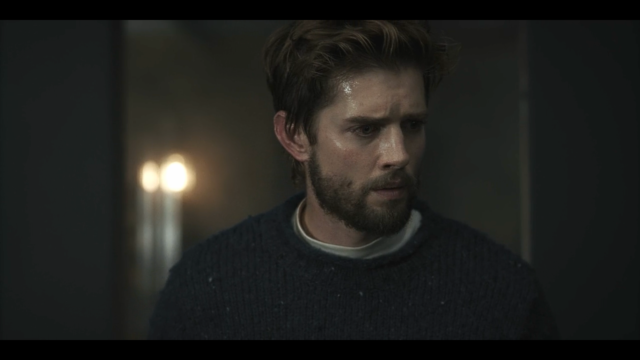
Producer Perkash reveals that the instrument’s distinctive sign-language-inspired movements originated with Bouwer, who rehearsed them with Van Acker for hours until the gestures felt right. This was not movement for movement’s sake. The gestures became another language within a film fundamentally concerned with communication.
McCarthy, meanwhile, preferred a different approach.
“Andrew works differently. He doesn’t really want to know too much. He just comes in and wants to do the work. And for him, it’s all about, does it make sense to move on this line, or motivation?” Bouwer understood that instinct immediately. “There shouldn’t be a movement that is not motivated, and that comes from my theater. Everything has to have meaning.”
McCarthy also wanted to preserve the spontaneity of his reactions. Rehearsing an exchange too extensively could diminish the uncertainty and immediacy of hearing another actor’s delivery for the first time.
For Bouwer, these contrasting methods ultimately served the same purpose: maintaining the integrity of the performance. And that performance, he insists, must remain paramount, regardless of how elaborate the surrounding filmmaking becomes.
LIGHT, DARKNESS, AND THE POWER OF NEGATIVE SPACE
Working with cinematographer David Kruta, Bouwer developed a visual language in which the absence of information becomes as important as its presence.
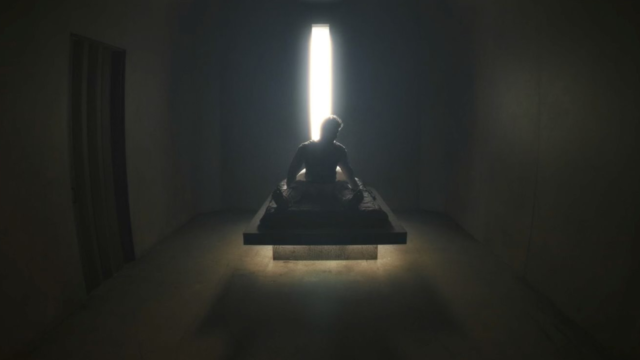
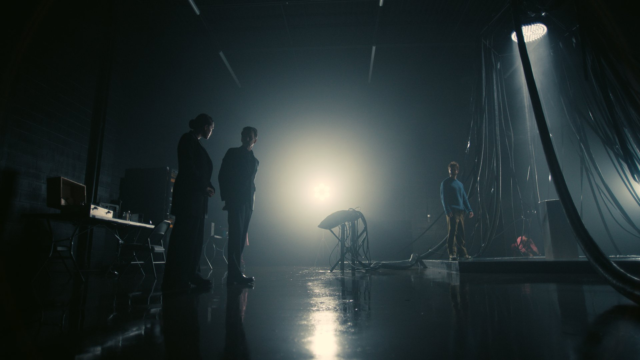
Consider the extraordinary sequences involving Mary and Apollo, in which a carefully defined area of illumination appears suspended within an expanse of impenetrable blackness. There is no comforting blue-black gradation, no discernible background, no visible architecture to establish spatial relationships. The darkness is absolute. For Bouwer, that void was essential.
“We always wanted that kind of negative space, this void almost, to really kind of not know or give away at that time. Because if you give too much away, you as an audience start kind of building your world. You can’t help it.” The result is both visually arresting and psychologically unsettling.
“We both, me and Kruta, saw this kind of square of light floating in this void, and that made it more mysterious. What is behind her? What is there?” The darkness suggests possibilities without confirming them. Something may exist beyond the illuminated space, or nothing may exist there at all. Either possibility creates tension. “Out of the darkness something might come. So you never know. It’s got this almost unconscious kind of tension that is there, which I really like.”
The collaboration between Bouwer and Kruta began well before principal photography. Sharing visual references and creative instincts, they quickly discovered a common understanding of the film’s aesthetic requirements. “Me and David, we just kind of gelled from the beginning. Even before I went over, we had the same references, we talked about the same stuff. It was really great working with him. Such a gentle giant.” That creative rapport is evident throughout ORION.
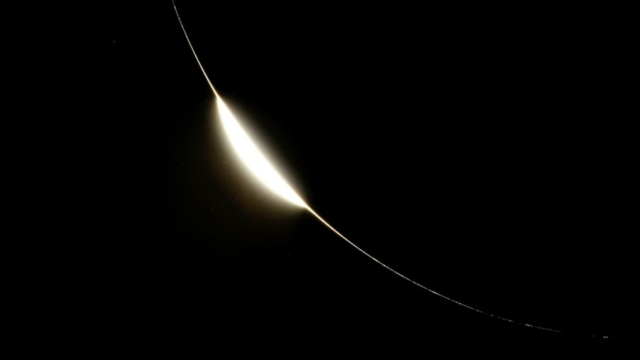
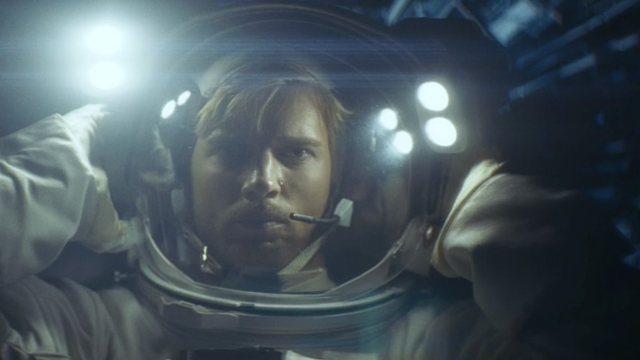
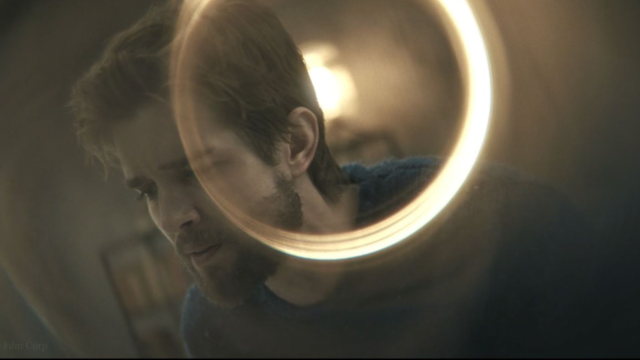
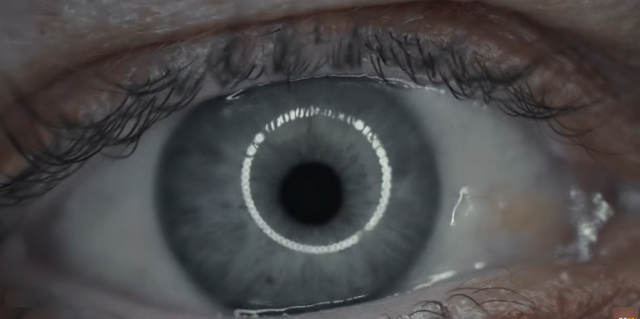
The camera rotates. Frames become inverted. Angles tilt in ways that resist conventional Dutch-angle compositions. Extreme close-ups and macro imagery fragment the human body into abstract landscapes of texture, color, and movement. Most significantly, Bouwer begins with an extreme close-up of an eye. It is an image he had envisioned from the earliest stages of development.
“Even in my treatment, there was this image I can remember of this extreme close-up of an eye. And that is kind of symbolic in a way that you want people to say, ‘Don’t trust what you see.'” The eye, traditionally understood as an instrument of observation and verification, becomes a warning against accepting appearances. “Don’t trust all that is in front of you. I think that was just an attempt to go right, almost in the beginning, into that idea of truth and what you see.”
From Apollo’s first moments of consciousness, the audience shares his disorientation. Camera movement is slow and deliberate. Images withhold context. Pierre-Henri Wicomb’s score introduces isolated piano notes rather than an immediately explanatory musical theme. Bouwer refuses to rush the audience toward certainty.
BUILDING A WORLD FROM CONCRETE AND SHADOW
The film’s extraordinary visual atmosphere also depends on production designer Mike Conti, whose central interrogation environment—the Madeline Room—provides a physical foundation for Bouwer’s aesthetic. Its surfaces are dominated by concrete and gray, with carefully selected objects and restrained accents of color. The environment is spare but never empty of meaning.
The Russian dolls, in particular, become a tangible representation of the film’s layered narrative structure.
Rather than creating a sleek, futuristic science-fiction facility, Bouwer and his collaborators favored something more tactile, austere, and deliberately difficult to place in time.
“Me and Kruta both felt like it’s more like an old-school world, that they’re slightly out of time. You’re immediately a bit confused, not knowing where you are and what is the context, which I really like.” The brutalist architecture was a conscious departure from the familiar science-fiction vocabulary of pristine white surfaces and polished steel. “It’s more tangible, warmer than your typical clinical white and steel. So that was a conscious decision.” Bouwer imagined the space as part of an institutional complex with a history stretching back decades, perhaps to the 1950s, 1960s, or 1970s.
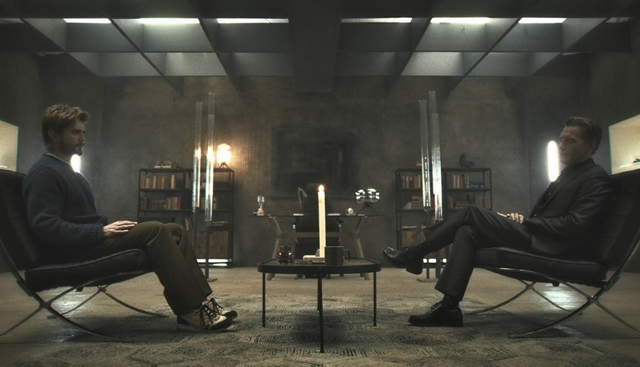
A serendipitous discovery in Syracuse, where the film was shot, reinforced that vision. Bouwer encountered a striking brutalist art gallery whose architecture so closely resembled the world he had imagined that he briefly considered shooting the entire film there. Although that was not possible, the building’s presence influenced the production, and one of the locations ultimately used in the film carried that architectural language into the larger world beyond the interrogation room. The challenge was to make the audience feel that a much larger environment existed outside the limited spaces on screen. “I was always conscious of this thing of being watched, being watched. And then there was the idea that these people in the room always had to feel that there is a bigger world outside of this room.”
Sound, lighting, architecture, and carefully controlled glimpses of the surrounding environment create that impression. The result is a film that feels simultaneously confined and expansive.
Perkash compares its construction to Hitchcock’s REAR WINDOW, observing that once viewers recognize how much of ORION unfolds within only a few rooms, the pleasure becomes solving the increasingly tense jigsaw puzzle. Indeed, the physical confinement encourages heightened attention. Every gesture, sound, shadow, and object becomes potentially significant.
And Bouwer uses that attention to his advantage.
THE SOUND OF SILENCE
If ORION’s visual language challenges the reliability of sight, its sonic landscape asks equally provocative questions about hearing.
The film’s sound design, developed through the work of supervising sound editor Thomas James, re-recording mixer Ronald Prent, and their collaborators, is inseparable from Wicomb’s score and Bouwer’s dramatic intentions. There are passages of low-frequency drones, unsettling textures, rhythmic pulses, and the distinctive qualities of the theremin. Yet some of the most powerful moments occur when the sound abruptly disappears. Silence becomes an event.
Bouwer describes an almost subliminal sonic presence within the central environment. “It’s almost like you have this office in this huge brutalist building. So it’s almost got its own kind of tone that’s there constantly. And sometimes you take it away.” That removal transforms the audience’s perception of the space.
A sound barely noticed while present becomes conspicuous through its absence. The resulting quiet heightens awareness and creates anticipation.
For Bouwer, however, the guiding principle remained the same as with the cinematography. “For me, it was again, what do you do that doesn’t upstage the actors?” The soundscape needed to support the performances rather than compete with them.
One particularly fascinating decision involved the mysterious instrument and its communication system. Rather than assigning those sounds exclusively to the sound-design team, Bouwer wanted Wicomb himself to create them.
“The machine or the instrument sound, I normally would have given it to the sound designers, but for this, I felt like it was necessary for me that the composer do it as well. Those were also done by him. All those sounds in terms of the instrument and the communication.”
The distinction is significant. By allowing the composer to develop the instrument’s sonic identity, Bouwer strengthened the relationship between music, communication, and the film’s larger thematic architecture.
Even the score’s emotional suggestions become part of the deception.
“A lot of times we actually go into a melodic thing that you think, ‘Ah, I just discovered the real Jim,’ or ‘I’m realizing something now.’ But all that was intentional, in terms of misleading the audience consciously.”
Music, like the images, can offer apparent reassurance without guaranteeing truth. And silence can be every bit as expressive as sound.
REVEALING TRUTH THROUGH COLOR AND RESTRAINT
Perhaps one of the most subtle aspects of ORION’s visual storytelling is its gradual evolution in color saturation.
The Madeline Room initially appears dominated by desaturated, brownish-gray tones. As the narrative progresses and Apollo begins to believe he is approaching a fuller understanding of his circumstances, the image slowly acquires greater saturation. The transition is so incremental that audiences may register its emotional effect without consciously identifying the technique.
The gradual shift becomes particularly significant as Apollo’s interrogation begins to fracture and the carefully constructed reality of the Madeline Room reveals its artificial boundaries.
The discovery of the false wall is more than a physical breakthrough. It marks a fundamental change in Apollo’s understanding of his circumstances—and in the audience’s perception of Jim.
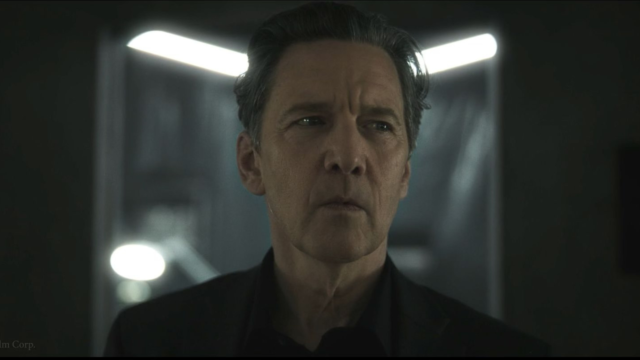
As the environment changes, so does Jim’s presentation. The formally dressed, authoritative interrogator gives way to a seemingly more authentic figure, his glasses, loosened appearance, and absence of a tie suggesting that the carefully maintained institutional façade has finally fallen away.
Bouwer explains the visual progression: “From the beginning, it’s much more kind of brown, desaturation. And just before he breaks through the fake wall, it starts to come incrementally over a long time. The scene goes slightly from desaturated to more saturated.” That increasing saturation accompanies the apparent emergence of the real Jim.
“For me, that saturation brings, like, ‘Oh, now I meet a real Jim.’ Here he is with his glasses. He’s got his tag off. He doesn’t have a tie.”
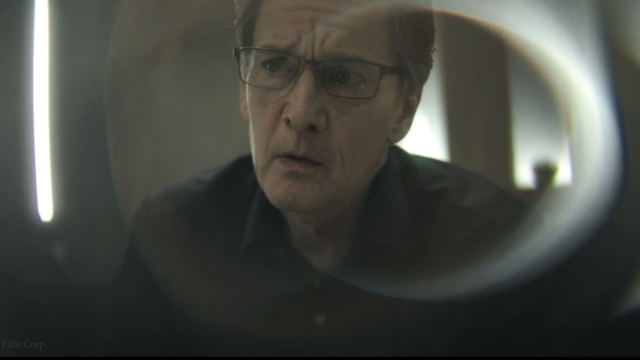
But Bouwer is doing something wonderfully deceptive. By introducing greater color and a more naturalistic presentation, he encourages the audience to associate the visual change with authenticity. We believe we are finally seeing the truth because the film’s visual language makes us feel that we are seeing the truth.
Yet ORION has already established that perception is an unreliable witness.
“Even with the grade with Kruta, we had a slow kind of—from desaturated in the beginning, over about an hour and something. Then it becomes more and more and more saturated.” The eventual transition beyond the false wall also introduces a dramatic change in lighting methodology.
“There we just worked with practical lights, no film lights. So it was quite jarring when it should be.” That jarring quality is entirely intentional. The shift from the meticulously controlled interrogation environment into a seemingly less constructed reality creates another psychological adjustment for Apollo and the audience. But even here, Bouwer refuses to guarantee that the newest revelation is the final one. The closer we believe we are getting to the truth, the more essential it becomes to question the evidence of our own eyes.
Yet for all the opportunities to indulge in elaborate visual technique, Bouwer remained committed to restraint. He acknowledges wondering whether contemporary audiences, accustomed to constant visual stimulation, would remain engaged with such a deliberately paced film. “Sometimes I feel like maybe I should have done more visually to keep the attention. We live in such a visual age. I don’t know if people can sit through stuff like this anymore.” But his creative instincts prevailed.
“It was a conscious choice to embrace restraint. To not want to do more fancy camera movement, to really just stay with them and let the story reveal.”
That decision gives ORION much of its power. The camera does not constantly announce itself. The editing does not manufacture urgency through excessive cutting. And the film allows its actors, its silences, and its carefully composed images the time necessary to resonate.
AN ALIEN LANGUAGE BEYOND THE FAMILIAR
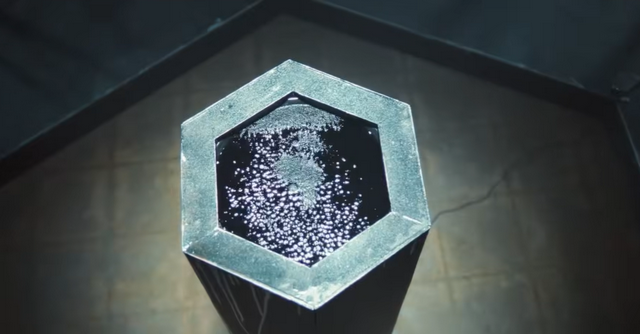
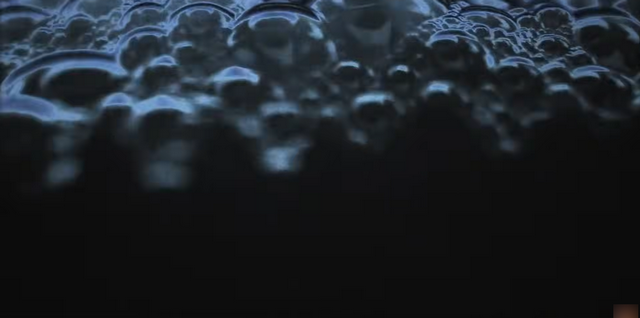
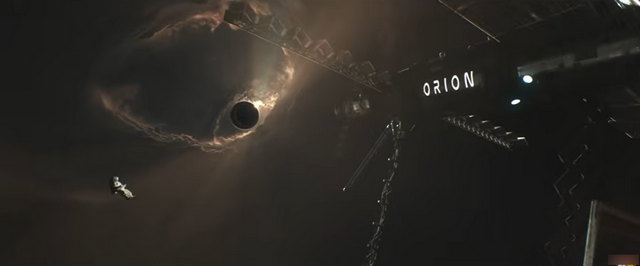
Bouwer’s fascination with communication and perception extends to the design of the film’s alien entity. Rather than relying on the familiar science-fiction vocabulary of creatures with limbs, tentacles, or recognizable biological anatomy, he envisioned something more abstract. A black orb. A reflective presence. A form shaped by vibration, sound, and the possibility of life beyond familiar physical categories. “Within that really austere space, to have this kind of black orb was always visually there.”
The concept developed from the film’s exploration of language, waveforms, and patterns. “The semantics and the linguistics and thematic waveforms and patterns—that was always an idea that I wanted to execute, so that it is composed out of sound waves.”
The entity is contained within an electromagnetic field, its freedom of movement restricted by the technology surrounding it.
But Bouwer was equally interested in what the audience might project onto an unfamiliar form. “We always think aliens might be things with legs and tentacles and what have you. But other life can be a gas, it can be a fungus, it can take on totally different ways of what we think we know.”
The alien’s reflective qualities introduce yet another layer of interpretation. “It also sometimes becomes a mirror that reflects the other. So you see yourself in it.”
Kruta introduced Bouwer to the visual possibilities of ferrofluid during their early preparation, providing another influence on the entity’s distinctive appearance. Bouwer admits that part of him would have loved to realize the alien entirely through practical effects, but the production’s time and resources made that impractical. He remains pleased with the work of the visual-effects artists. The finished design exemplifies the same principle guiding the entire film: create something visually memorable while allowing mystery and ambiguity to remain intact.
FINDING THE FILM IN THE EDIT
For editor Ian Holden, ORION presented a particularly demanding challenge. With so much of the narrative unfolding through extended dialogue, carefully timed silences, subtle performance shifts, and incremental revelations, the balance between mystery and clarity was crucial.
Bouwer admits that he had initially hoped to edit the film himself but was committed to directing a series immediately afterward. The collaboration with Holden required considerable experimentation. “We went through quite a few permutations. It took a long time to get the right balance.”
Different editorial emphases could fundamentally change how audiences interpreted Apollo’s circumstances.
“Is Apollo possessed? Does something come back with him? All those layers are there in a subtle way, but you can always edit it in a way that it becomes much more in the forefront.”
The task was to preserve those possibilities without allowing any single interpretation to dominate prematurely. “It really took a long time to find that sweet spot of where it is at the moment.”
The production schedule created additional challenges. With as many as ten to twelve pages of dialogue being filmed in a day, the actors were frequently required to sustain lengthy takes. “You do basically one take of twelve minutes per time, depending on the setup and how we deconstruct the scene. They had to really know their words. It almost becomes like a play.”
That theatrical foundation proved invaluable, allowing the film’s extended exchanges to develop their own internal rhythms while providing Holden with performances capable of sustaining the necessary tension.
And there were the less glamorous realities of production.
Shooting during the summer in Syracuse meant temperatures approaching 30 degrees Celsius, while the fictional environment demanded an entirely different climate. “Drew is wearing a jersey, and you’re talking about the sound design. It’s amazing, but the raw sound has this huge aircon in the back, trying to pump in cold air for the poor actors.” It is an amusing reminder of the physical realities concealed beneath ORION’s carefully controlled atmosphere.
What audiences experience as a cold, austere, mysterious environment was often created under decidedly uncomfortable conditions. Yet even those practical challenges became part of the filmmaking process.
WHEN LIMITATIONS BECOME COLLABORATORS
For Bouwer, ORION ultimately became more than an exercise in visual and sonic storytelling. It became a lesson in the creative possibilities of limitation.
The filmmaker’s reflections on the experience reveal a philosophy that connects every aspect of the production—from the negative space and minimal sets to the deliberate pacing, controlled performances, and carefully withheld information.
Asked what he learned from bringing such a thematically and technically ambitious film to life, and how the experience might influence his future projects, Bouwer offered a particularly revealing answer.
“The biggest thing Orion taught me is that a limitation is a collaborator, not an obstacle. We had no stunt coordinator, so instead of cutting the action, I rewrote it into a body-possession idea. It pushed the film and some of its strongest beats came out of that.”
It is a striking example of the way practical constraints can generate unexpected creative solutions. Rather than regarding the absence of a stunt coordinator solely as a problem to overcome, Bouwer found an alternative that enriched the film’s narrative possibilities. And the experience reinforced a second principle—one that had been guiding ORION all along.
“It also taught me the second lesson: restraint is a craft decision. When you can’t show everything, you have to choose what to withhold, and withholding is what keeps an audience leaning in. So next time, I’ll ask what the limit is offering before I fight it.”
exclusive interview 10/29/2026
ORION is now available on Prime Video, AppleTV and other streaming platforms.