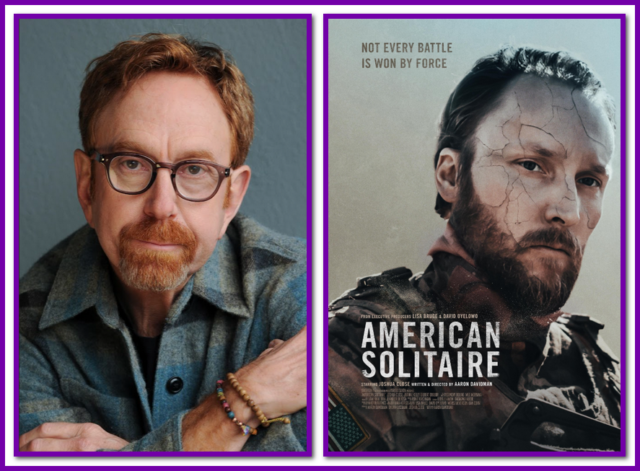
With AMERICAN SOLITAIRE, writer/director Aaron Davidman does not settle for a familiar PTSD narrative.
Yes, his first narrative feature centers on a wounded veteran, Slinger, played with deeply felt restraint by Joshua Close, as he struggles to reintegrate into civilian life after war. But Davidman is after something larger and more difficult than a portrait of trauma alone. He is probing the cultural ecosystem surrounding that trauma: guns, masculinity, generational violence, father-son inheritance, faith, shame, and the emotional damage carried by men taught to equate silence with strength.
That ambition is what gives AMERICAN SOLITAIRE its power. It is also what makes the film so fascinating to watch. Davidman is not simply asking what war does to a veteran. He is asking what kind of country sends men into war, welcomes them home with platitudes, and still has so little language for healing the psychic wounds that follow.
“I started wanting to address gun violence in America,” Davidman says, “and try to create a depolarizing narrative that would allow us to ask different kinds of questions and have a different kind of conversation than our typical heightened black-and-white, this-side-or-that-side debate.”
That impulse led him across the country, listening to people talk about firearms and the complicated roles they play in American identity. One of the voices that stayed with him belonged to a veteran in Tennessee whose layered, conflicted relationship with guns and mental health helped crystallize the film’s dramatic path. Davidman realized that the veteran, in particular, carried a unique moral and symbolic authority within the American imagination. “If I could bring a veteran on a journey from one end of the spectrum to the other,” he says, “and reevaluate some of these underlying issues that drive gun violence, then maybe there was something there.”
There is.
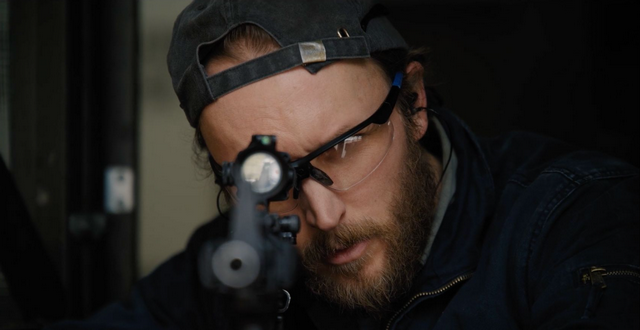
What emerges in AMERICAN SOLITAIRE is a film that is less interested in slogans than in excavation. Slinger’s PTSD is only one layer of the story. Around him are other men and boys wrestling with violence as inheritance, expectation, temptation, and survival strategy. Davidman builds that structure thoughtfully, using Slinger’s best friend Auggie, Auggie’s nephew Emmett, and Slinger’s own fraught relationships with his father and son to examine how violence passes down through generations, sometimes openly, sometimes quietly, but almost always intimately.
“The arc of this film,” Davidman says, “is really, how do we disrupt that? How do we disrupt the narrative of men passing violence on to younger men?”
That question becomes the film’s beating heart.
It is visible in the painful, bruised history between Slinger and his father, Dominic, a man whose harsh, militarized expectations have left their own psychological scar tissue. It is visible too in the distance between Slinger and his own son, where affection exists but genuine connection remains elusive. And perhaps most poignantly, it is visible in Slinger’s relationship with Emmett, Auggie’s nephew, a young boy already absorbing the logic of fear, defense, and armed self-protection before he is emotionally equipped to understand any of it.
This is where AMERICAN SOLITAIRE is especially strong. The dynamic between Joshua Close and Jamir Vega gives the film some of its most emotionally resonant moments. Close brings to Slinger a quiet, watchful damage, while Vega’s Emmett carries the wary alertness of a child trying to make sense of adult loss and adult violence before he should have to. Their scenes together have a tenderness and purpose that help ground the film’s larger thematic ambitions in something immediate and human.
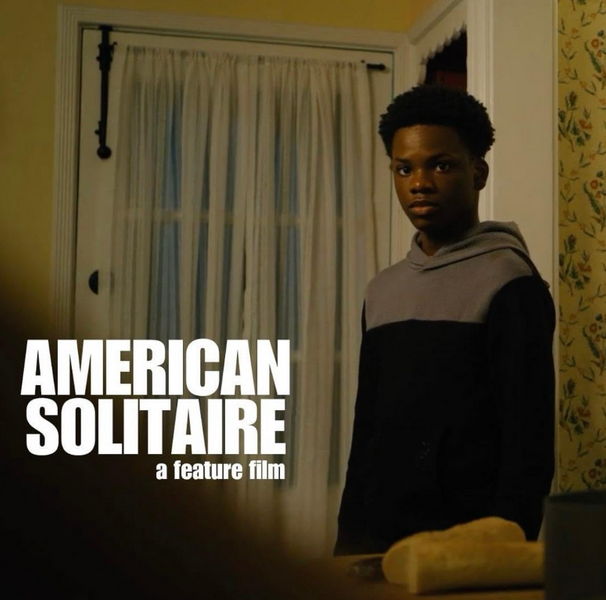
Davidman acknowledges how fortunate he was with the casting. “We got lucky,” he says. “Jamir had a real quiet kind of inner turmoil… and we were able to really capture that. His reaction shots really hold a lot in the film.” They do. Emmett is not simply a supporting character or narrative device. He becomes a crucial mirror for Slinger, a younger life in which inherited patterns might still be interrupted.
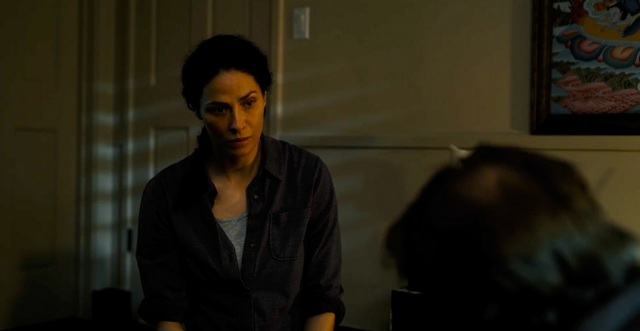
That possibility matters because Slinger himself is only beginning to find his way toward healing. Davidman smartly surrounds him with two contrasting figures: Auggie, still in active service and buckling under the weight of his own unspoken torment, and Athena, a former service member who has moved through trauma and toward a different kind of spiritual and emotional equilibrium. The three trajectories create one of the film’s more elegant structural ideas: one man still trapped in the machinery of damage, one man tentatively trying to emerge from it, and one person who has already done some of the painful inward work necessary to survive it.
Davidman may modestly claim he did not fully recognize that structure while writing, but it plays clearly onscreen. The film effectively charts the road already traveled, the road currently being walked, and the road that still lies ahead.
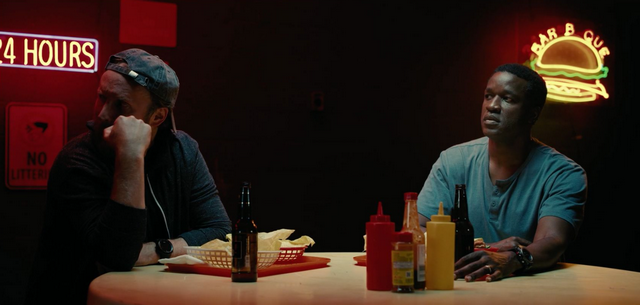
That sense of emotional architecture is reinforced by the film’s visual approach. Working with cinematographer Hana Kitasei, Davidman avoids the most obvious aesthetic choices for material this heavy. AMERICAN SOLITAIRE is not drenched in murky blues, funereal grays, or visual gloom for its own sake. Instead, it often remains in light, in open air, in spaces that feel grounded and lived-in. The choice proves wise. By refusing to smother the film in darkness, Davidman and Kitasei leave room for the characters and themes to breathe.
Davidman credits Kitasei as an essential collaborator in shaping that grammar. Coming from theater rather than film, he found in her not simply a director of photography, but a storytelling partner. “She became, very quickly, one of the deepest collaborators I’ve ever had,” he says. Rather than chasing flashy visual signatures, the two anchored their decisions in meaning, performance, and emotional truth.
Where the film does allow itself a more overt visual expression is in Slinger’s nightmare sequences, which are among the picture’s strongest and most striking images. Washed in red, these visions transform skin, hair, uniforms, roads, and trees into a blood-soaked psychic landscape, evoking guilt, violence, memory, and the lives taken in war. Davidman says the look emerged through his collaboration with cinematographer Hana Kitasei. “We looked at photos, these infrared photos of these child soldiers in Congo, and they were just beautiful,” he says. “The way the greens turned red in these jungles and stuff like that, we were like, ‘Whoa, this could be really interesting.’” The result is haunting, expressionistic, and memorable without overwhelming the rest of the film’s grounded aesthetic.
If AMERICAN SOLITAIRE stumbles at all, it is largely because Davidman has so much on his mind. The film is rich with ideas, and most of them are worthwhile. At times, however, the sheer volume of thematic material threatens to outrun the narrative’s ability to fully develop every strand with equal weight. But even then, the film remains engaging because the central inquiry is so earnest and so clearly felt. Davidman is not stacking issues for effect. He is trying, sincerely, to make sense of how violence reproduces itself in a culture that often mistakes hardness for strength.
The edit, he admits, was the most difficult part of the process. “It took me a long time to find what I would call the editorial tone of the film,” he says. Working with editors Libya El-Amin and later Dagmawi Abebe, Davidman reshaped the structure and searched for the right balance between the story’s many currents. That effort is visible in the finished film, sometimes in ways that suggest strain, but more often in ways that reveal how carefully he was trying to keep multiple emotional and ideological threads in conversation with one another.
What ultimately makes AMERICAN SOLITAIRE work is that it never becomes sermonizing. For a film dealing with guns, veterans, masculinity, spiritual practice, intergenerational trauma, and America’s contradictory myths of protection and power, it is remarkably uninterested in preaching. Instead, it asks viewers to sit with discomfort and contradiction. It offers both Christian and Buddhist frames for inner struggle and healing, not to flatten faith into metaphor, but to suggest that the battle worth fighting may not be the one American culture most often glorifies.
Davidman speaks of this directly. Referencing the Buddhist deity Mahākāla as it appears in the film, he contrasts the mythology of the outward-facing American warrior with the inward spiritual battle required for genuine healing. “Can we turn inward to find our healing?” he asks. In AMERICAN SOLITAIRE, that question lands harder than any polemic could.
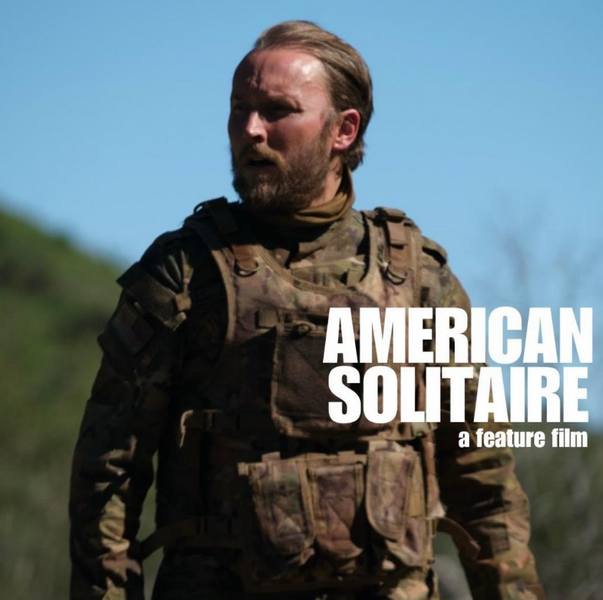
Close is instrumental in carrying that weight. His performance as Slinger is unshowy but deeply affecting, rooted in a man who is not merely haunted by war, but by the long emotional genealogy that preceded it. Joanne Kelly brings a welcome steadiness to Athena, while Gilbert Owuor gives Auggie a painful dignity that lingers beyond his screen time. And Vega, as Emmett, proves an invaluable emotional hinge for the film, embodying both vulnerability and the stakes of whether the cycle will continue.
By the time AMERICAN SOLITAIRE reaches its final movement, Davidman has earned something increasingly rare in films tackling large social themes: hope that does not feel facile. Not easy hope. Not sentimental hope. But the possibility that inherited violence can be interrupted, that masculinity might be reimagined, and that healing begins only when the myth of external control gives way to the harder work of internal reckoning.
What ultimately gives AMERICAN SOLITAIRE its emotional lift is the strength of its third act, where Davidman draws on the biblical notion of “turning weapons into plowshares” to suggest a path forward. It’s a gesture that introduces a measure of faith—spiritual, emotional, and communal—without tipping into sermonizing, allowing the film to land on a note of earned, rather than imposed, hope.
For a first narrative feature, that is no small achievement.
AMERICAN SOLITAIRE may carry more thematic freight than it can always fully unpack, but its intelligence, sincerity, and emotional conviction are undeniable. More importantly, Davidman understands that America’s crisis of violence is not only political or ideological. It is familial, spiritual, psychological, and generational. In tracing one veteran’s journey through that thicket, he gives us a film that is at once intimate and searching, wounded and quietly humane.
by debbie elias, exclusive interview 04/17/2026
AMERICAN SOLITAIRE opens April 17, 2026, at the Cinema Village in NYC and expanding to select theatres thereafter.