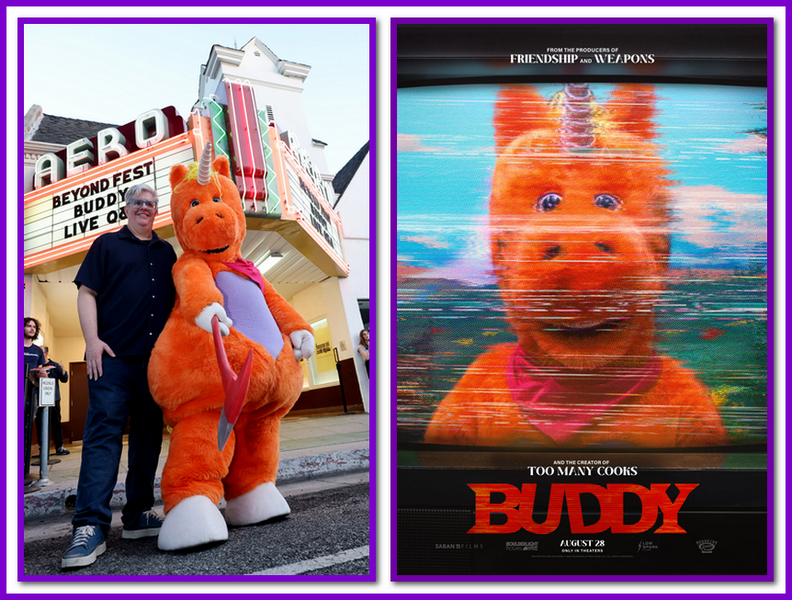
Forget Barney. Or at least don’t stop there.
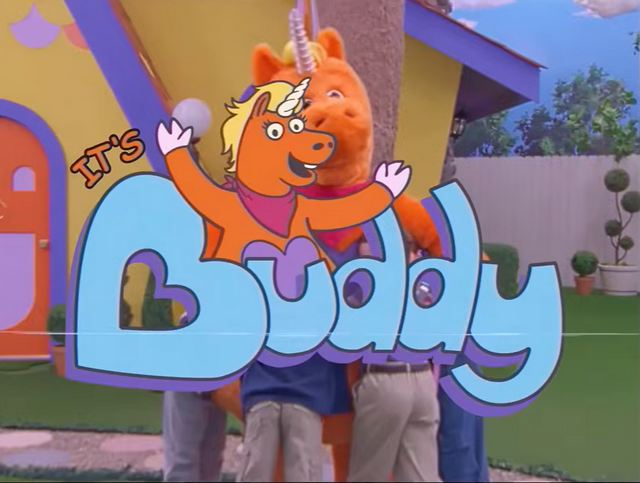
BUDDY may invite the easy shorthand of “R-rated Barney,” but CASPER KELLY‘s film reaches much farther back. Its real spiritual kinship lies with the earnest, brightly colored children’s programming of the 1960s and ’70s—especially NEW ZOO REVUE, with its anthropomorphic characters, songs, moral lessons, and unapologetically theatrical world-building—along with the handmade fantasy of Sid and Marty Krofft.
Kelly understands that world well enough to know that the surest way to destroy it is first to make us believe in it.
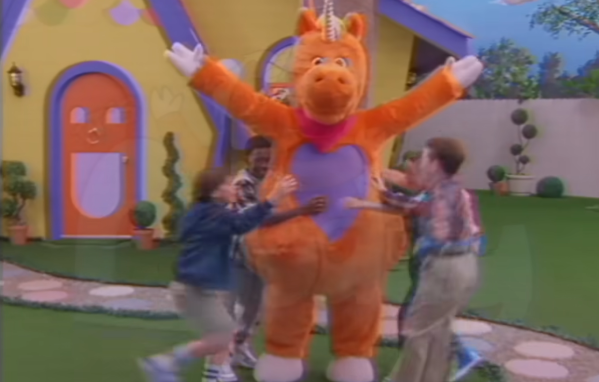
Bright, cheerful, relentlessly educational, and constructed with loving analog artifice, BUDDY initially plays its children’s television conceit absolutely straight. There are no knowing winks telling us how ridiculous this all is. Talking animals, singing children, friendly household objects, cardboard fantasy kingdoms, and lessons about proper behavior are simply the rules of Buddy Park.
And then, slowly, cracks begin to appear.
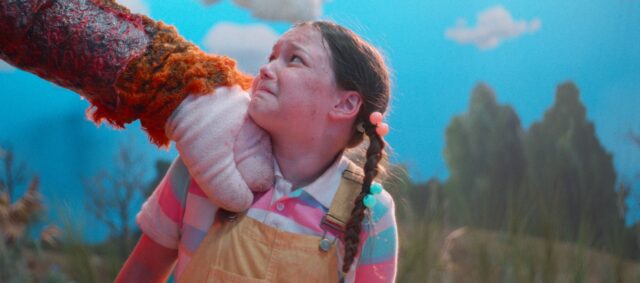
By the time Kelly is finished, those cheerful life lessons have given way to something considerably darker. Blood. Death. Dismemberment. Murderous puppets. Mangled bodies. And crimes against innocent children’s television furniture that should frankly land somebody in prison.
Seriously, Casper. Mr. Sofa?
Yet beneath the outrageous horror-comedy is something much more ambitious. Kelly wants BUDDY to entertain, certainly, but he also wants viewers willing to look beneath all that brightly colored fur to find something else.
“I guess I’m ambitious,” Kelly admits. “I want it to be art. I want it to be about things. I don’t want it to be just a good time. I want people to have a good time. But if you want to dig deeper, I want there to be things in the ground for you to find if you do dig deeper.”
There’s quite a bit buried down there.
From Children’s Television to Camazotz
One of the earliest clues that BUDDY has something more on its mind comes courtesy of Wade, arguably the most perceptive of the children, and the book he carries with him: WRINKLE IN REALITY.
For anyone who grew up loving Madeleine L’Engle’s A WRINKLE IN TIME, the reference is unmistakable.
Kelly readily admits that the fictional title is “absolutely” a direct homage to L’Engle’s novel, one that has haunted his imagination since childhood. His own introduction to A WRINKLE IN TIME came not initially from reading it, but through a television program in which passages from books were read aloud while an artist illustrated the story.
“It was very magical,” Kelly recalls.
One sequence in particular lodged itself in his memory: Meg, Calvin, and Charles Wallace arriving on Camazotz and encountering the terrifying uniformity of a suburban neighborhood where identical children emerge from identical houses and bounce balls in identical rhythm.
“That really haunted me,” says Kelly. “That really stuck in me.”
It isn’t difficult to understand why that image might resurface, consciously or otherwise, in BUDDY.
A WRINKLE IN TIME has been my favorite book since I first read it in third grade, and after hundreds of subsequent readings, seeing WRINKLE IN REALITY immediately raised my antenna. Camazotz isn’t frightening because it initially looks frightening. It is frightening because everything is orderly. Everyone conforms. Everyone behaves exactly as expected.
And here is BUDDY, unfolding inside a children’s television world built around teaching children how they are expected to behave.
Kelly doesn’t begin with a rigid intellectual thesis, however. He works far more intuitively, often discovering what he’s exploring only as he writes—or even after someone else points it out.
“If you want to know what a novel is about, the last person to ask is the author,” he laughs, noting that creators often operate on an unconscious level.
That intuition serves BUDDY well. The film doesn’t reject the life lessons inherent in vintage children’s programming. It retains them. Kindness, cooperation, friendship, obedience, and proper behavior still matter.
But Kelly also gives us permission to go to the dark side—and there are lessons to be learned there as well.
As Patrick Swayze memorably taught us in ROAD HOUSE: Be nice until it’s time to not be nice.
With Buddy, it is definitely time to not be nice.
Building Buddy Park
Creating a world convincing enough to corrupt required Kelly and his collaborators to establish very specific rules.
Working with cinematographer Zach Kuperstein, production designer Anna Kathleen, costume designer Shawna-Nova Foley, and the film’s puppet team, Kelly began defining everything from color palettes to the objects that could—or couldn’t—exist within a particular environment.
“Just kind of getting rolling up our sleeves,” is how Kelly describes the process. “Thinking about color palettes and the rules of what would be in this world, what wouldn’t be in this world, what colors would be in this world, and what wouldn’t.”
Notably, he doesn’t think of BUDDY as occupying one world.
“In my mind, there’s four or five worlds,” Kelly explains. “In a way, it’s sort of like TOO MANY COOKS, where it starts shifting genres and worlds as well. I guess I just like doing that.” Each of those worlds requires its own vocabulary.
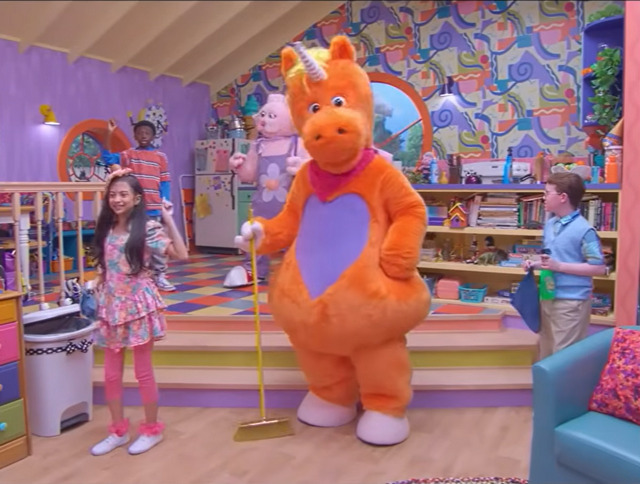
Inside the television program, the filmmaking embraces the limitations and aesthetics of vintage analog children’s television. The image is boxy and compacted. Vertical-hold imperfections reinforce the period illusion. Lighting is bright, broad, overhead, and remarkably even. Shadows have little place in this safe, happy universe.
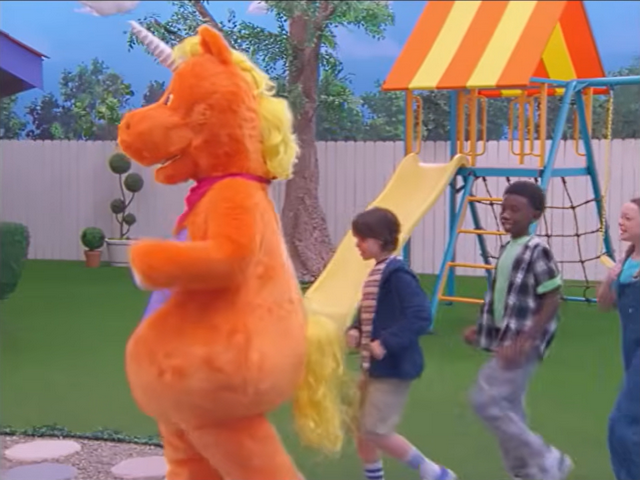
The production design similarly celebrates the handmade ingenuity of pre-digital children’s entertainment. Nowhere is that more delightful than Diamond City, with its tiny plastic-and-cardboard castle and strands of twinkle lights providing the illusion of a magical kingdom. It’s movie magic precisely because it looks handmade.
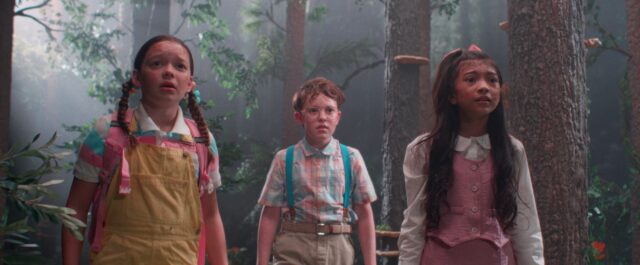
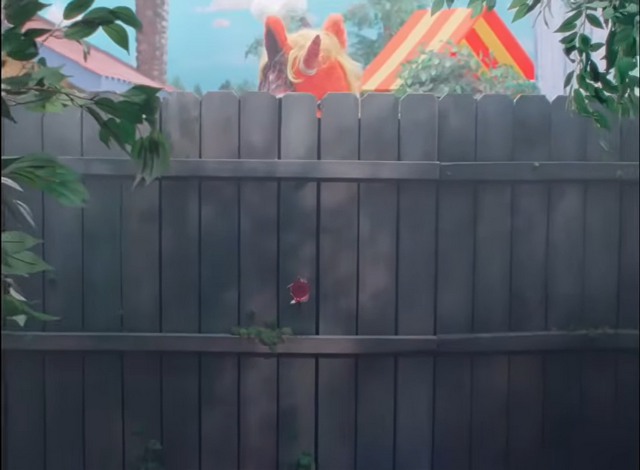
But once the characters venture over the fence separating Buddy Park from the unknown, the rules begin changing. The color palette shifts into deep greens—darker, wilder, yet still verdant and alive. The visual world expands, but so does the auditory one.
“The sound changes too,” Kelly points out. “It goes from stereo to 5.1 sound in a dramatic way.”
We don’t merely see that we’ve crossed into another world. We hear it.
From there, BUDDY continues mutating, moving through a barren landscape where an inexplicable broken-down circus wagon sits in the desert and Clint Howard adds yet another wonderfully bizarre creation to his seemingly bottomless character closet as Cowboy George. Eventually we arrive in a deliberately theatrical fantasy recalling THE WIZARD OF OZ, complete with cardboard construction, twinkle lights, and the tactile pleasures of analog illusion.
But these shifts aren’t simply changes in production design. The grammar of the filmmaking changes with them.
Zach Kuperstein and the Grammar of Different Worlds
This is where Kelly’s collaboration with Kuperstein becomes particularly fascinating.
For anyone familiar with Kuperstein’s work, Kelly’s mention of overhead diagrams comes as little surprise. Having previously spoken with the cinematographer about films including THE VIGIL and THE CLIMB, I’ve seen how methodically he thinks through the geography of a scene before determining how best to photograph it. He employed that kind of spatial mapping even on the largely exterior THE CLIMB, while THE VIGIL found him devising an elaborate system of apple boxes, lighting, and dolly track around a house to capture the nighttime horror unfolding within.
Different films, different environments, but the same underlying principle: understand the space, then determine how camera and light can best tell the story.
Kelly experienced that process firsthand.
“We really would do overhead diagrams of every set and figure out where the character is standing, where should the camera be?” he explains. “How can we mimic the blocking shot grammar of each sequence?”
For Kelly, that meticulous approach proved transformative.
Coming from the looser, improv-heavy comedy of YOUR PRETTY FACE IS GOING TO HELL, he was accustomed to protecting a scene through conventional coverage—a wide, close-ups, over-the-shoulders—giving performers room to improv and finding the rhythm later in the edit.
With BUDDY, he wanted something more deliberately cinematic, “Spielbergian, even,” where blocking, performance, and camera movement could reshape the composition organically within a shot.
“The way that you can do a scene in one or two shots, but you don’t even notice it because characters are walking up to the camera. It becomes a close-up,” Kelly explains. “That was really fun and helped me grow as a director, I think.”
But BUDDY demanded not one visual grammar, but several.
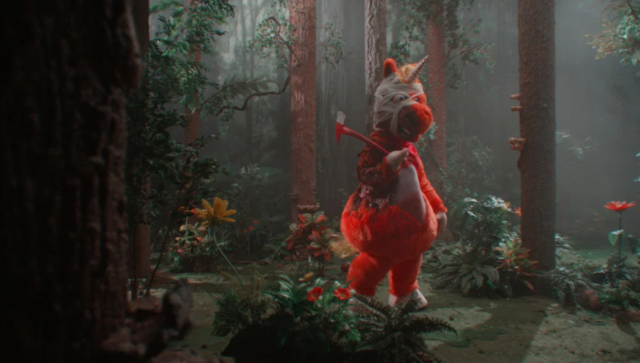
“There is a shift where we go into a world that’s like our world, and I wanted that to be like a modern horror movie, like SMILE,” Kelly explains. “And then there’s a shift that’s sort of like THE WIZARD OF OZ or OKLAHOMA.”
All those hours spent mapping sets, blocking performers, and determining where the camera should live allow Kelly and Kuperstein to change cinematic dialects along with the worlds themselves.
Then comes one of their most effective transformations. We return to Buddy Park.
But Buddy Park doesn’t look the same anymore.
For Kelly, one of the pleasures was returning to familiar territory after the film had crossed into darkness. “It was fun to revisit the BUDDY Park, but in a high resolution and with dramatic lighting,” he says. “How unsettling is that to see the same world, but with shadows?” Very.
Nothing about Buddy Park needs to change for Buddy Park to become frightening. Kelly and Kuperstein merely change the way we’re allowed to see it. The production design hasn’t betrayed us. The light has. And now those shadows can hide monsters.
Blood, Death, and Dismemberment. Oh My!
Once BUDDY barrels into its third act, forget lions, tigers, and bears. We’ve got blood, death, and dismemberment. Oh my!
The tonal rupture is extreme, but because Kelly and Kuperstein have already been steadily altering the visual rules, it doesn’t feel arbitrary. The filmmaking itself has prepared us for Buddy Park to become something it was never supposed to be.
Kuperstein’s extreme close-ups become particularly effective here, invading Buddy’s space and transforming the once-friendly tactile character into something disturbingly intimate.
And then there is the gore.
Kelly’s use of puppets and practical effects creates a particularly delicious contradiction. These characters are soft, colorful, artificial objects from a children’s television world. Until somebody cuts into one.
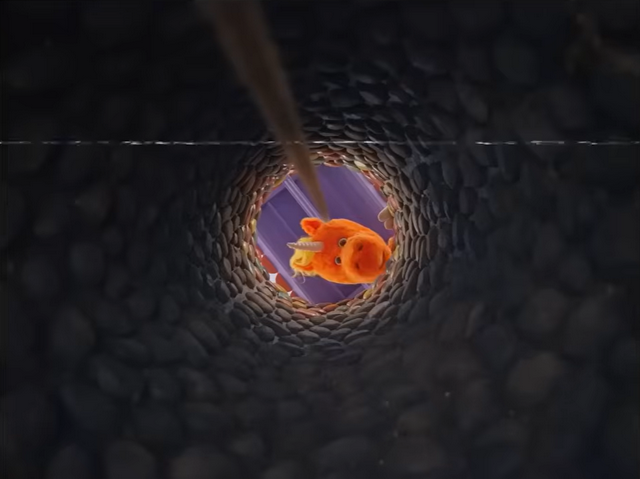
One of the few moments that actually made me cringe comes when Buddy, needing to fit down a well, takes a knife to his own thigh. The blade slices through the orange fur to reveal blood, tissue, and tendon underneath before the severed chunk drops to the ground in a beautiful close-up.
Yes, I said beautiful. This is horror. We’re allowed.
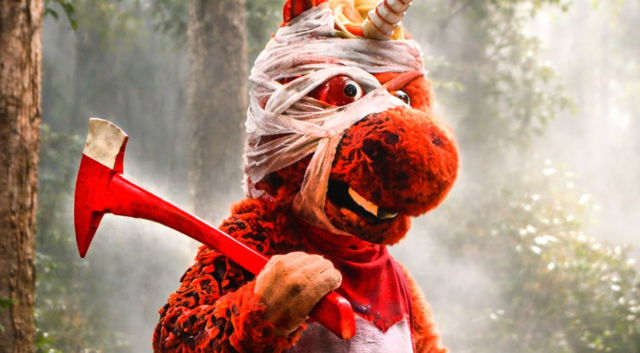
The image works because it violates something elemental about our relationship with these characters. Plush shouldn’t have flesh underneath it. Fabric shouldn’t bleed. A cuddly television mascot should not contain meat. But Buddy does.
And apparently Buddy Park furniture isn’t safe either. Mr. Mailbox suffers unconscionable indignities. Poor Charlie the Train. And Mr. Sofa gets killed.
There are limits, Casper!
The practical mayhem also presented Kelly with one of independent filmmaking’s least glamorous realities: They needed more money.
“This movie probably should have had quadruple the budget,” he says.
With few, if any, duplicate costumes or puppets available, production had to be carefully ordered around the carnage. Once blood covered a wall, suit, or puppet, resetting could be difficult or impossible within their schedule. Some effects essentially had one chance to work.
“You’re gonna get one of these, so you better make sure it works,” Kelly recalls. “Can I at least get a second camera?”
Blood could sometimes be washed out, but that took something the production possessed in equally short supply: time. At which point our conversation unexpectedly turned into a filmmaker service announcement. Having recently spoken with Ryan Johnson founder of New Rule FX in Northridge about its washable blood products, I passed the tip along to Kelly for future blood-soaked costume endeavors. “Good to know,” he immediately replied.
My reward? Apparently an extra role and a kill scene in a future Casper Kelly movie. I’ll take it!
The Magic—and Misery—of Puppets
Long before Buddy began bleeding, however, Kelly was already deeply enamored of puppetry.
From Smarf in TOO MANY COOKS to the Cheddar Goblin, puppets repeatedly find their way into Kelly’s work. “There’s just something magical about it,” he says. “I love it.”
That affection permeates BUDDY.
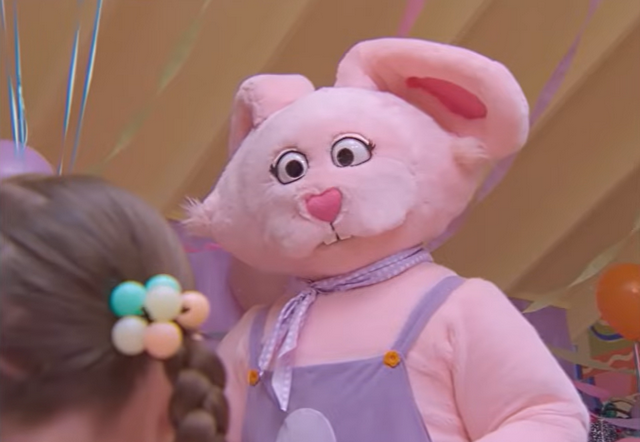
Kelly credits the puppet team and particularly notes the contribution of Sedwan Hooks, whose deep familiarity with BARNEY helped inform the design and personality of Betty Bunny. But one of the film’s most deceptively difficult performances comes from inside Buddy himself.
“If you can imagine, he cannot see out of that costume unless the mouth is open,” Kelly marvels of the suit performer. “He’s doing dance routines with kids and walking downstairs. It’s pretty amazing, and how his body language and hand movements will match the line.”
It’s the kind of work designed to look effortless precisely because an audience isn’t supposed to think about the human being buried inside all that fur.
Until, of course, BUDDY starts asking us to think about what’s inside the fur in an entirely different way.
Songs You Can’t Escape
No recreation of vintage children’s television would be complete without music. Lots and lots and lots of music.
BUDDY’s songs had been lodged in my brain for days by the time Kelly and I spoke, something I happily blamed him for. But that earworm quality is no accident.
During production, Kelly realized something deceptively important about children’s television. “Barney has wall-to-wall music in it to keep that tone,” he says. “We realized very quickly we needed that too.”
The realization created another significant challenge. Michael Yezerski’s score needed to navigate BUDDY’s constant genre shifts while simultaneously maintaining the musical saturation necessary to sustain the children’s-show reality. Meanwhile, Shawn Coleman, a longtime Kelly collaborator who also worked on TOO MANY COOKS, handled the songs performed within the show.
The lyrics are hysterical. The melodies are infectious. And they refuse to leave.
In its own strange way, that’s perfectly appropriate for BUDDY.
Long after you’ve escaped Buddy Park, Buddy Park hasn’t necessarily escaped you.
Finding the Magic in the Edit
Holding all these worlds together ultimately fell to Kelly and editor Josh Ethier.
They didn’t have the luxury of leisurely experimentation. With an October Sundance submission deadline looming, post-production meant long days, late nights, and weekends. Kelly loved it.
“Editing is my favorite part of the process,” he says. “It’s really magic to see something come to life and combining two shots, and it creates a feeling. It’s really magical.”
With BUDDY, that magic involved far more than determining where to cut.
The edit had to negotiate the film’s shifting visual sensibilities, changes in cinematic grammar, escalating horror, comedy, musical numbers, practical effects, and multiple realities without allowing the entire construction to collapse under its own ambition. And just when it seems Kelly has exhausted the number of worlds BUDDY can contain, he finds one more.
That’s all I’m saying.
The ending belongs to the audience.
Digging Beneath the Orange Fur
Kelly doesn’t rule out returning to this universe.
“People ask me about it,” he says of a possible sequel. “I’m definitely interested. I got some ideas.”
He should. Because BUDDY is far more than an R-rated riff on a purple dinosaur.
Kelly has reached backward through generations of children’s entertainment and pulled together its strange ingredients: the earnest morality of NEW ZOO REVUE, the handcrafted fantasy of Sid and Marty Krofft, the relentlessly musical reinforcement of later children’s television, the theatrical magic of pre-digital filmmaking, and even a childhood memory of Camazotz and the terror of perfect conformity.
Then he hands those ingredients to collaborators who understand how to make each world tactile and convincing before gradually dismantling everything that once made it feel safe.
Production design creates the playground. Puppetry gives it life. Music keeps everyone smiling. Kuperstein’s camera teaches us how to see it. And then Kelly takes us over the fence.
That’s where BUDDY becomes something more than nostalgia and more than parody. The lessons remain, but their meaning changes. The bright lights acquire shadows. The friendly characters bleed. The safe world turns dangerous.
And beneath all that orange fur, catchy music, cardboard magic, blood, death, and dismemberment are exactly the things Kelly hoped we might discover if we were willing to dig a little deeper.
Just don’t dig too deeply.
Buddy might be down there.
by debbie elias, exclusive interview 080/20/2026
BUDDY is exclusively in theatres on August 28, 2026.