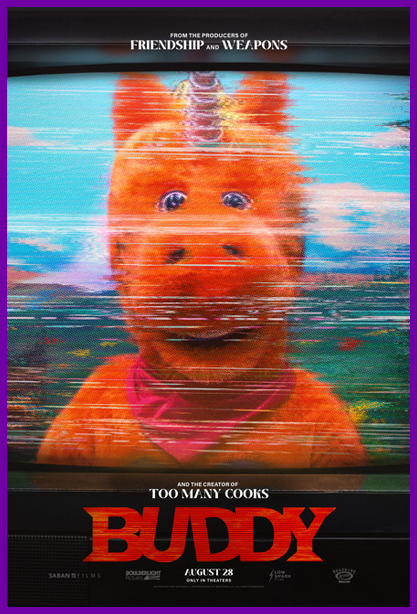
There comes a time in every child’s life when certain lessons must be learned. Be kind. Share with others. Help your friends. Listen. Cooperate. Respect the people around you.
And occasionally…
Run like hell from the giant orange children’s television character who is trying to kill you.
Welcome to BUDDY.
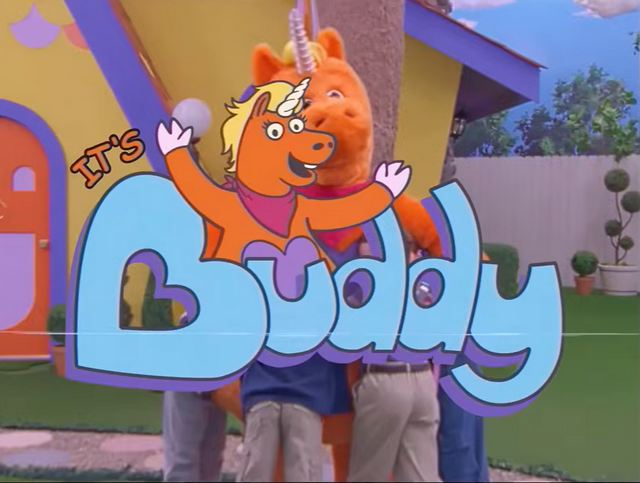
Sick, twisted, hilariously funny, unexpectedly thoughtful, and gleefully drenched in blood, director Casper Kelly’s BUDDY is one of those increasingly rare genre concoctions that feels genuinely fresh. It takes the comforting language of children’s television, lovingly recreates it rather than merely parodying it, and then slowly begins pulling at the seams until the brightly colored fabric comes apart and something considerably darker crawls through.
The easy shorthand will inevitably be “R-rated Barney.” It’s also not particularly accurate.
BUDDY reaches much farther back. Its real spiritual kinship lies with the earnest, brightly colored children’s programming of the 1960s and ’70s—especially NEW ZOO REVUE, with its anthropomorphic characters, songs, moral lessons, and unapologetically theatrical world-building—along with the handmade fantasy of Sid and Marty Krofft. H.R. PUFNSTUF is lurking somewhere in the family tree, as are countless locally produced children’s programs built from painted flats, fuzzy costumes, puppets, catchy songs, and the sincere belief that television could entertain children while teaching them something.
Kelly understands that sincerity. And that may be the smartest decision he makes.
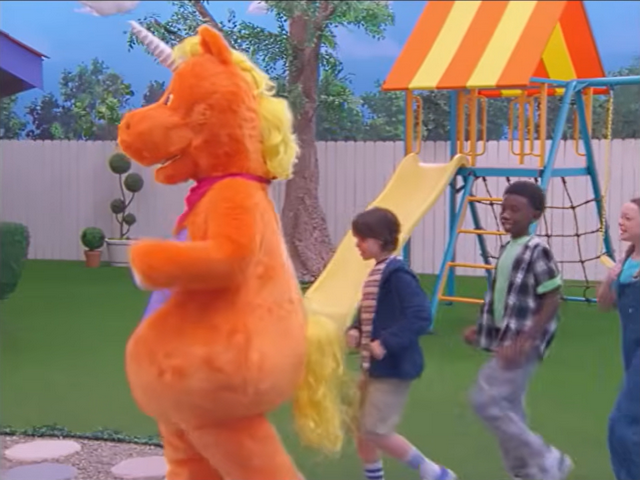
BUDDY doesn’t begin by sneering at this kind of television. It embraces it. The square television framing, flattened imagery, bright overhead illumination, limited dimensionality, analog imperfections, songs, characters, sets, and relentlessly cheerful life lessons are played remarkably straight. For a while, you could almost convince yourself you had stumbled onto some forgotten piece of children’s programming buried in an archive for forty years.
Almost.
Because something isn’t quite right in BUDDY Park.
And Josh knows it.
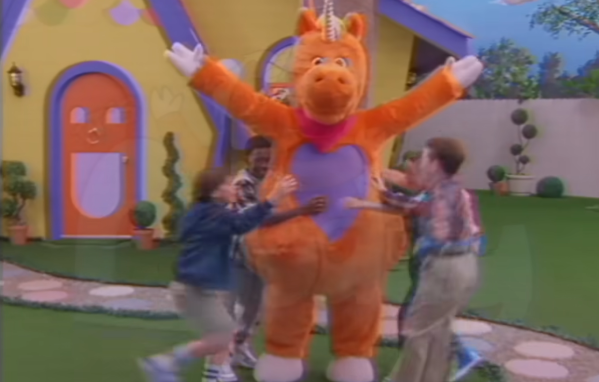
Of the children populating this seemingly benign little television universe, Josh is the one paying attention, questioning the world around him while the others more readily accept what they’ve been given. Central to his curiosity is a book called WRINKLE IN REALITY, an unmistakable nod to Madeleine L’Engle’s A Wrinkle in Time and something far more meaningful than a throwaway literary gag.
Much like L’Engle’s children discovering worlds in which conformity can masquerade as order and safety, BUDDY begins raising questions about the reality its characters have been taught to accept. Josh senses the crack before anyone else does. Which makes what happens to Josh particularly upsetting.
I’m still mad at you, Casper Kelly.
The children themselves are an intentionally uneven little collection. Wade follows suit on Josh’s concerns, especially when Josh’s beloved book is found in the trash can – – – covered in blood. Oliver is spectacularly annoying. Hannah practically drips sugary sweetness, a pint-sized Hannah Montana wannabe perfectly suited to this relentlessly cheerful television environment. Freddy initially makes less of an impression, although her importance grows considerably as Kelly starts revealing what BUDDY is actually doing.
But Josh? Josh is thinking. That can be a dangerous habit in a world built upon everybody following the program.
And then someone goes over the fence.
That crossing is where BUDDY really begins revealing its hand, not merely narratively but cinematically.
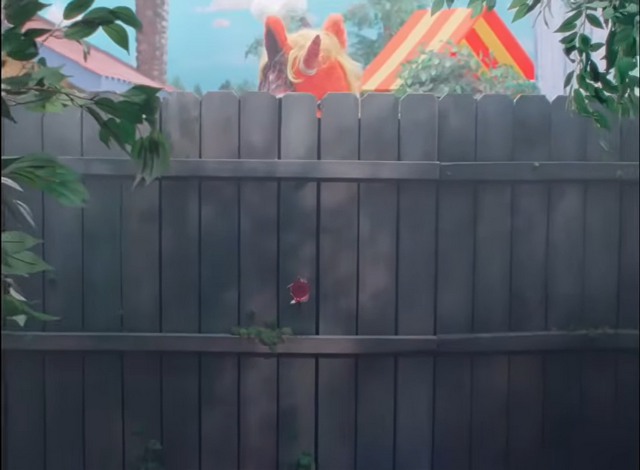
Cinematographer Zach Kuperstein does outstanding work establishing and then dismantling the film’s visual grammar. Inside the television show, light is broad, bright, frontal, and comparatively flat. Shadows have little purpose in a world where everything is supposed to be safe, legible, and happy. The constrained analog image reinforces the illusion.
Cross the fence and everything changes.
The palette shifts. Greens become darker, richer, verdant, alive. Shadows appear. Depth emerges. The world suddenly possesses dimension in a way BUDDY Park does not. Even the soundscape expands, moving beyond the deliberately limited sonic character of the television world.
It feels as though the movie itself has escaped from television.
Kuperstein’s cinematography is especially impressive because these visual transformations never feel like tricks laid over the movie after the fact. They arise from geography, blocking, lighting, lensing, and camera placement. The visual rules change because our relationship to the world has changed.
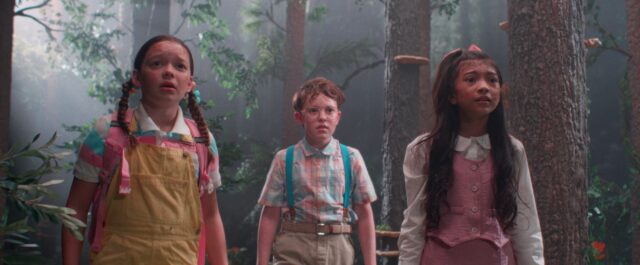
More importantly, those changes form a progression rather than a succession of visual styles. As the characters’ understanding of their world expands, so does Kuperstein’s visual vocabulary. Flatness gives way to dimensionality; uniform illumination gives way to shadow; containment gives way to increasingly expansive environments; and eventually the reassuring softness of the television image gives way to a tactile clarity capable of revealing fur, blood, flesh, and viscera. The cinematography doesn’t merely distinguish Kelly’s different worlds. It charts our awakening to them.
For anyone familiar with Kuperstein’s work, that attention to spatial design comes as little surprise. Having previously spoken with the cinematographer about films including THE VIGIL and THE CLIMB, I know how methodically he thinks through the geography of a scene before determining how best to photograph it. He employed that kind of spatial mapping even on the largely exterior THE CLIMB, while THE VIGIL found him devising an elaborate system of apple boxes, lighting, and dolly track around a house to capture the nighttime horror unfolding within. Different films. Different environments.
The same underlying principle applies to BUDDY: understand the space, then determine how camera and light can best tell the story. That thinking pays enormous dividends in BUDDY, particularly when Kelly eventually takes us back into spaces we thought we understood.
Buddy Park hasn’t fundamentally changed. The way Kuperstein photographs it has. And suddenly the friendly old neighborhood is terrifying.
The broad illumination disappears. Shadows carve into spaces that previously had none. Detail emerges where analog softness once protected us. And as the film barrels into its delirious third act, Kuperstein begins driving into terrific extreme close-ups of Buddy himself.
We are no longer watching a fuzzy television friend safely contained on the other side of a screen.
We are in his space. And Buddy is most definitely not our buddy.
Which brings us to the blood.
Oh, the blood!
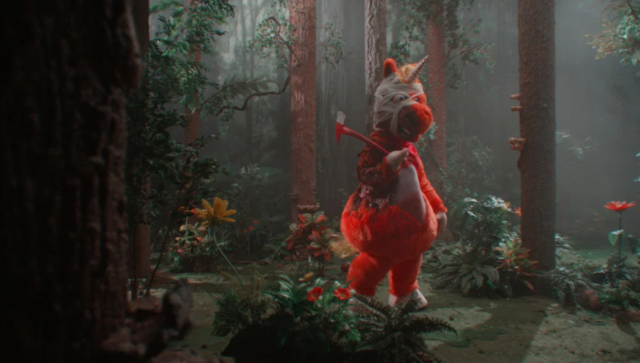
Blood, death, dismemberment, mutilation—Kelly eventually unleashes all of it upon characters and objects we’ve spent much of the film being conditioned to regard with the comfortable affection of childhood television.
Poor Mr. Mailbox.
Charlie the Train.
And, Casper…
MR. SOFA?
You killed Mr. Sofa?
Seriously?
There are lines, sir.
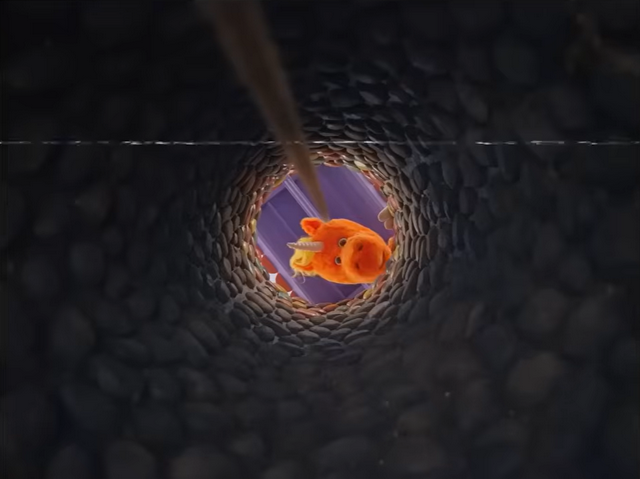
But it’s Buddy’s own mutilation that delivers one of the film’s most effective practical-gore moments. Faced with the problem of fitting his oversized body down a well, Buddy arrives at an eminently practical solution: There is simply too much Buddy. So some Buddy has to go.
Watching him take a knife and cut away a massive section of his own thigh is genuinely cringe-inducing. Kuperstein’s camera doesn’t politely avert its gaze. We see the blade moving through that familiar orange fur, then through what lies beneath it—blood, flesh, tissue—until the severed chunk finally drops away.
There is something uniquely revolting about seeing the visual vocabulary of a cuddly children’s character suddenly acquire anatomy. The fur isn’t a costume anymore. There is meat underneath it.
And the practical effects sell the moment beautifully.
It also makes Buddy’s color choice seem strangely appropriate. He’s orange. Rather like a prison jumpsuit. Which is where Buddy belongs.
But what makes all this carnage more interesting than a simple exercise in desecrating childhood nostalgia is that Kelly never entirely rejects the lessons BUDDY Park was designed to teach.
Kindness still matters. Friendship matters. Cooperation matters. Thinking for yourself definitely matters.
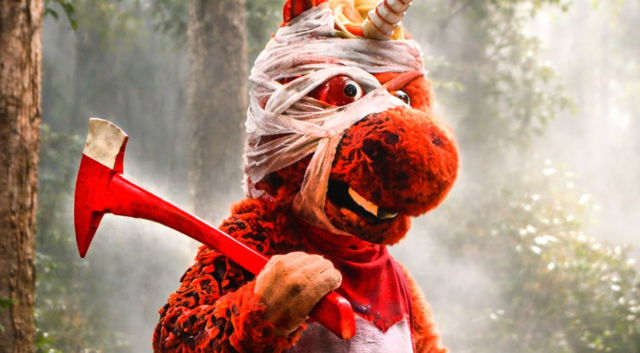
Kelly simply recognizes that there are circumstances in which cheerful platitudes are no longer sufficient protection against the world.
Or, borrowing the immortal philosophy of Dalton in ROAD HOUSE: “Be nice until it’s time to not be nice.”
With Buddy, it is most assuredly time to not be nice.
That tonal balance is tricky. Push too hard toward parody and the first act becomes meaningless. Push too hard toward horror and the cheerful television material becomes merely an elaborate setup for a gore gag. Kelly instead allows the two halves to contaminate one another. The sweetness makes the violence more transgressive, while the violence makes us reconsider what was lurking beneath all that sweetness.
Production design and costumes are essential to maintaining that illusion. Buddy Park has exactly the right artificial theatricality—the physical, handmade quality of a children’s television set rather than a slick contemporary recreation of one. It feels built. Painted. Sewn. Wired. Lit.
The further the adventure travels, the more the film delights in shifting its theatrical vocabulary.
A broken-down CIRCUS wagon sitting inexplicably in the desert feels like an artifact from some other story that wandered into this one and got stranded. Clint Howard appears as Cowboy George and adds another gloriously peculiar creation to the seemingly bottomless closet of strange characters he has accumulated throughout his career. There’s even a ventriloquial quality to George and Willie that sends the imagination all the way back to Edgar Bergen and Charlie McCarthy.
And then there’s Diamond City. Here Kelly leans wholeheartedly into pre-digital theatrical fantasy, giving us cardboard, plastic, twinkle lights, miniature scale, and old-fashioned movie magic that owes more to THE WIZARD OF OZ than to anything a computer might generate.
The artificiality is the point. We know it’s handmade. That’s why it’s magical.
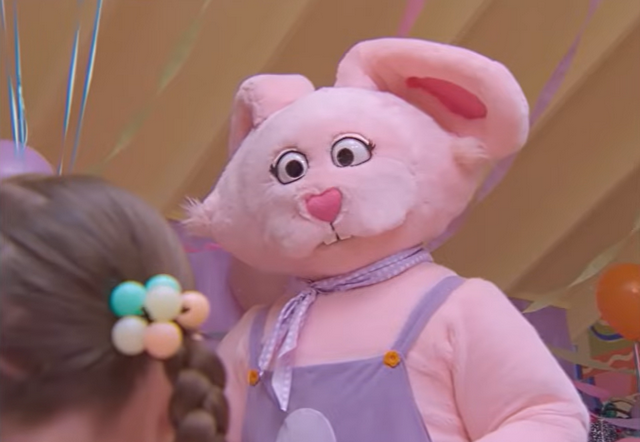
The puppetry follows the same philosophy and is one of BUDDY’s great pleasures. Head puppeteer Devin Ludlow, along with Sedwan Hooks, Jaminka Collins, the puppeteers and suit performers, gives these characters distinctive physical personalities. Betty Bunny, Mr. Mailbox, Charlie the Train, Strappy, and the rest aren’t merely props occupying a set.
And yes, I love Strappy (perfectly voiced by Patton Oswalt).
Suit performance deserves particular recognition because Buddy’s physicality has to evolve along with our perception of him. Early movement must belong convincingly to a television character performing for children. Later, that same physical form must become threatening without suddenly feeling like an unrelated monster wearing Buddy’s skin. That transition works.
And it becomes even more impressive knowing how little visibility exists inside these kinds of suits. Dance routines, stairs, interaction with children, comic timing, gestures synchronized with dialogue—none of it is as effortless as the finished image makes it appear.
Then Kelly starts destroying everybody. Because apparently puppets can’t have nice things.
The practical limitations actually help the carnage. Without endless duplicate puppets and costumes waiting off camera, destruction has consequence. Blood can’t simply be sprayed indiscriminately and reset ten seconds later. Shots have to count. And they do.
Editor Josh Ethier has perhaps the film’s most unenviable assignment: somehow make all these tonal and stylistic mutations feel like parts of the same movie.
Analog children’s television becomes fantasy adventure. Fantasy slips into contemporary horror. Horror explodes into gore. Musical comedy wanders through the proceedings. Reality itself eventually becomes negotiable. Yet BUDDY never feels randomly assembled. The shifts have escalation.
Each new visual and narrative rupture teaches us that the rules governing the previous section weren’t as permanent as we assumed.
Michael Yezerski’s score is similarly tasked with crossing those boundaries, while Shawn Coleman’s songs provide the maddeningly effective musical vocabulary of the children’s program itself.
And those songs… They stick.
That wall-to-wall musical quality is essential to recreating the period television aesthetic. Children’s programming of that ilk rarely trusted silence for long. There was always another melody, another transition, another cheerful musical reinforcement of whatever lesson had just been imparted. BUDDY understands that rhythm so well that its songs lodge themselves in the brain long after the blood starts flowing.
Thanks, Casper.
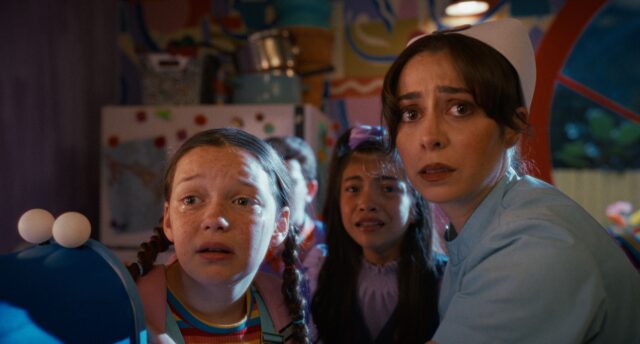
But it is the film’s final movement that transforms BUDDY from a wonderfully demented horror-comedy into something much more ambitious.
Without revealing where Kelly ultimately takes us, Freddy’s journey eventually leads to an extraordinary bank of monitors—an image that immediately evokes Orwellian surveillance and Big Brother, yet with a fascinating reversal. Screens cease simply being objects through which someone watches.
They become something else. Windows? Portals? Boundaries?
The film that began inside the comforting confines of an old television program suddenly asks us to reconsider what a screen actually separates.
And this is where WRINKLE IN REALITY stops looking like a cute A Wrinkle in Time reference and starts feeling like Kelly gave us the answer before we knew there was a question.
Worlds within worlds. Reality layered upon reality. The possibility that the universe we’ve spent the movie inhabiting is merely one among others.
Kelly wisely doesn’t explain everything.
He opens the door. And then he leaves us staring through it.
That final conceptual expansion is what makes me desperately want to see where he could take BUDDY next. There is clearly more world here—or perhaps more worlds—than this film has revealed. Give me a sequel.
Just resurrect Mr. Sofa first.
BUDDY begins inside a box—the square little confines of an old television screen—and spends the rest of its running time breaking out of it.
It breaks its visual rules. It breaks genre. It breaks bodies. It breaks the comforting boundary between television and reality.
And somewhere amid orange fur, catchy songs, severed limbs, puppets, practical effects, analog television artifacts, childhood nostalgia, and increasingly fractured realities, Casper Kelly manages to preserve something surprisingly sincere – The idea that the lessons we learned as children still matter, even after we discover the world is considerably darker and stranger than anyone told us it would be.
Sometimes you cooperate.
Sometimes you help a friend.
Sometimes you think for yourself.
And sometimes you run like hell from Buddy.
Just don’t kill Mr. Sofa again. Some things are unforgivable.
Directed by Casper Kelly
Written by Casper Kelly and Jamie King
Cast: Cristin Milioti, Delaney Quinn, Patton Oswalt, and Michael Shannon, with Topher Grace and Keegan-Michael Key
by debbie elias, 08/15/2026
BUDDY is in theatres on August 28, 2026.