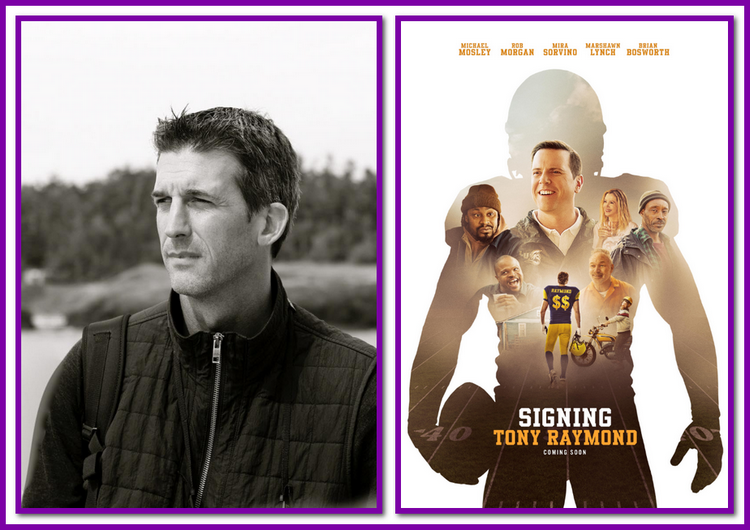
There is a lot of noise in college football recruiting. Money. Promises. Bag men. Ego. Hustle. Entitlement. The machinery around a top high school prospect can become so loud that the kid at the center of it all almost disappears.
Writer/director GLEN OWEN doesn’t let that happen in SIGNING TONY RAYMOND.
Set in rural Alabama and filmed in Rutledge, Georgia and Hard Labor Creek State Park, SIGNING TONY RAYMOND follows young college football coach Walt McFadden, played with grounded, understated charm by Michael Mosley, as he is sent to sign the nation’s top high school defensive end, Tony Raymond. What Walt finds is a town full of grifters, protectors, hustlers, family pain, rival recruiters, and one young man trying to figure out whether football is actually his future.
For Owen, however, the film was never intended as an exposé.
“It was never meant to be an exposé on college football,” says Owen. “More about this coach’s journey to find himself and find his true purpose. And really, Tony is on a similar path to find his purpose and calling.”
That journey unfolds amid the chaos of a recruitment system where money flows freely and moral lines blur quickly. Owen knows the terrain. A former college basketball player at the University of Georgia, he spent plenty of time around football players and heard the stories firsthand.
“They call them bag men,” Owen says. “A bag man would drop 100 grand in a Burger King bag at your door, and you sign with that school.”
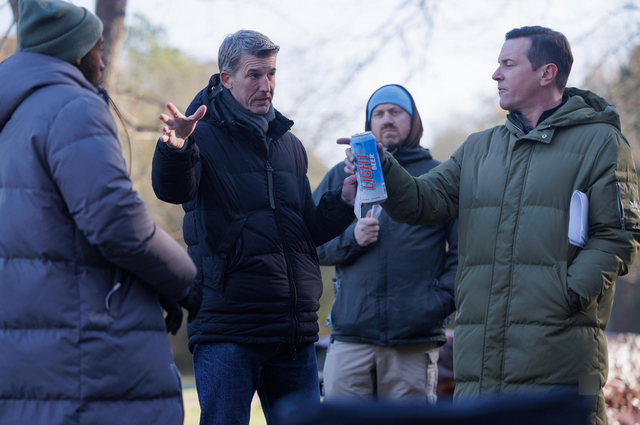
Those stories stayed with him. So did another one: a real-life tale of a top defensive tackle from Florida who walked away from college football because he wanted to become a motorcycle mechanic.
“That’s one little nugget of truth in the story,” Owen says, noting that Tony’s passion for motorcycle repair grew from that real-life inspiration. “He was tired of football. He didn’t like it anymore. This is really what he wanted to do.”
From there, Owen began shaping a story not just about recruitment, but about purpose, calling, self-awareness, and integrity.
“I wanted to explore staying true to your true calling,” he says.
That theme runs through every corner of the film, particularly in Walt, a coach who arrives with one mission and slowly realizes that selling his soul to climb the ladder may not be worth the cost. Mosley plays him not as a broad comic lead, but as the calm center inside a very chaotic storm.
“He’s almost a straight man in a way,” Owen says. “He’s got all these crazy things happening around him, but he’s staying focused. He doesn’t get to get too broad or have these big dramatic moments. He’s the center of gravity for the movie.”
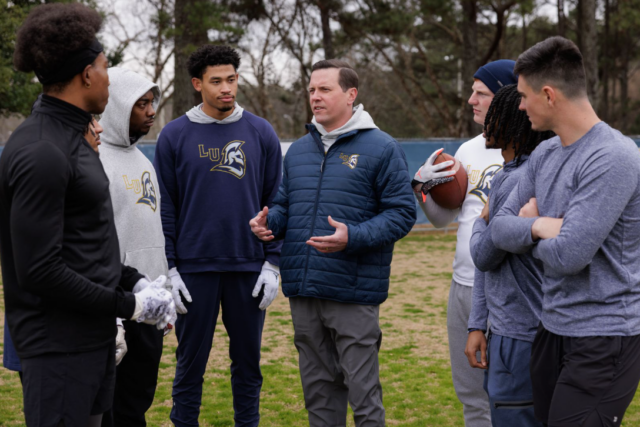
Owen had wanted to work with Mosley for years after seeing him in Seven Seconds.
“I was like, ‘Who is that guy?’” Owen recalls. “He does have a little bit of the Ted Lasso quality, very likable guy, but he’s also tough at his core. He’s going to do the right thing, and he’s going to stand up for himself.”
That blend is key. Walt may be decent, but he is not a pushover. He can be conned, cornered, tested, and tempted, but he also has grit. And as he spends more time in Tony’s world, his values begin to realign.
“His core is aligned with these people,” Owen says. “As his journey evolves, as he decides that selling his soul to sign the kid at any cost and climb the ladder is really not worth it, he pivots and leans into his true self.”
Those people—Tony’s family and the townsfolk around him—are written with a specificity that pushes back against easy rural Southern stereotypes. Owen, who grew up in Cartersville, Georgia, knows small-town life from the inside.
“In a small town, everybody is a melting pot of just different types of people that you’re exposed to very closely, intimately, over time,” he says.
That understanding is especially clear in Otis, played by a superb Rob Morgan. Otis is watchful, wary, shrewd, and deeply protective. He knows exactly what is happening around Tony, and he is not easily fooled.
“To me, Otis is the savviest character in the movie,” Owen says. “Otis is playing everybody, and you’ve got to really win him over.”
Morgan gives the film one of its most quietly powerful performances. In one scene, as Otis reveals the family tragedy that has shaped Sandra, played by Mira Sorvino, the film pauses just long enough to let pain breathe without turning sentimental.
“Rob, his performance in that scene was amazing,” Owen says. “In lesser hands, that could come off a little cheesy, a little sentimental, but he’s just so natural with it and so heartfelt and subtle that it really landed.”
Sorvino, too, gets room to stretch as Sandra, a mother carrying grief, damage, and fierce love in equal measure.
“At her core, she’s very smart, very savvy,” Owen says. “She’s a survivor.”

Owen deliberately avoids overexplaining Sandra’s past, trusting performance, behavior, and implication over exposition. We know enough. We feel the rest.
“She had a rough childhood,” he says. “That was always part of my backstory for her. But she’s a survivor, and she cares about her family fiercely.”
The film’s other standout maternal figure is Deputy Debbie Chisholm, played hilariously and warmly by Denitra Isler. Originally written as a white male character, Debbie became something much more interesting after Owen’s wife suggested rethinking the role.
“My wife said, ‘You’ve got a lot of guys in this. What if this is a lady?’”, Owen recalls. “I was like, ‘Oh my God, you’re completely right!’”
That change created one of the film’s most memorable characters: a mother who is not chasing money or status, but simply wants Walt to help get her son into college to play ball.
“This mama bear character that’s just willing to do anything to put her son in a position to succeed and help her son live his dream,” Owen says.
That balance of humor and heart is one of SIGNING TONY RAYMOND’s great strengths. Owen blends drama, sports satire, and small-town comedy without letting one overwhelm the others.
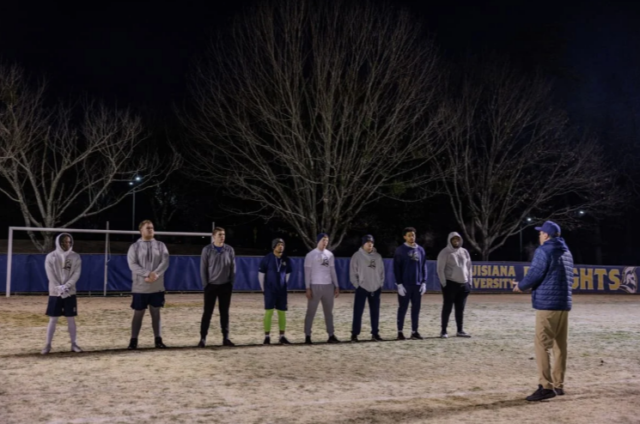
“I knew going into it I was blending genres,” he says. “I wanted to have the heartfelt vibe and the drama of the situation, but also wanted to give some levity to it.”
Editor Patrick Perry was crucial in finding that rhythm, especially in scenes that move in and out of comedy.
“The main thing is just the transitions in and out of those scenes,” Owen says. “We tried to let them breathe a little bit so it wasn’t too jarring.”
One of the funniest sequences is the poker scene, a hustling, booze-loosened, quick-cut delight involving Otis, Walt, and a room full of local mechanics. Owen knew it would play like a jump-cut montage, but Perry found even more comic energy in the edit.
“When I came in and saw what he did, I was like, ‘Oh man, this is so much fun,’” Owen says. “It was way too long. We had to keep trimming.”
That scene also captures Owen’s commitment to authenticity. Many of the extras were real mechanics from the garage location.
“All those extras were real,” Owen says. “Half of them worked at that garage where we filmed.”
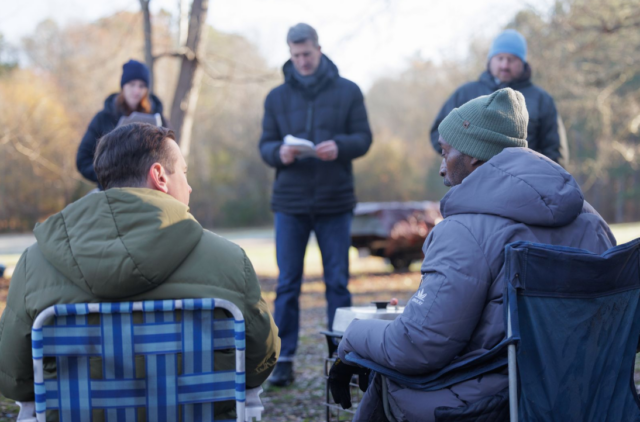
Authenticity also shaped the film’s visual grammar. Working with cinematographer Daniel Friedberg, Owen avoided flashy camera work in favor of clean, character-driven storytelling.
“We wanted the lighting to be very natural, very subtle, very clean, understated, and not pour on a lot of bells and whistles,” he says. “You can be a daiquiri, or you can be straight whiskey. We wanted to be straight whiskey.”
That “straight whiskey” approach gives the film its honest texture. The camera does not announce itself. It watches. It observes. It allows the characters and location to carry the weight.
“Old-school, clean storytelling is what we leaned into,” Owen says. “As opposed to a lot of camera gymnastics.”
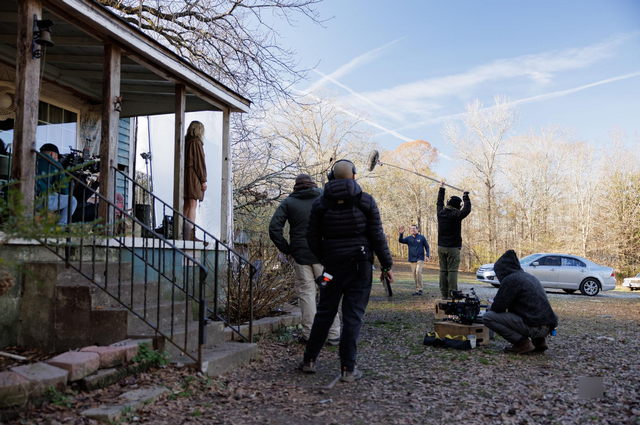
Location became just as important. Rutledge, Georgia, with its tiny crossroads, weathered storefronts, and rural stillness, gave the film the lived-in atmosphere Owen needed. Hard Labor Creek State Park provided the lake locations, bringing moments of visual purity and emotional quiet.
“The locations are so critical to the painting that you’re creating on screen,” Owen says.
He spent extensive time driving through Georgia, looking for the right house, the right road, the right sense of isolation.
“I wanted a house that had a long dirt road, that was super isolated, that had the right look,” he says. “It took a long time.”
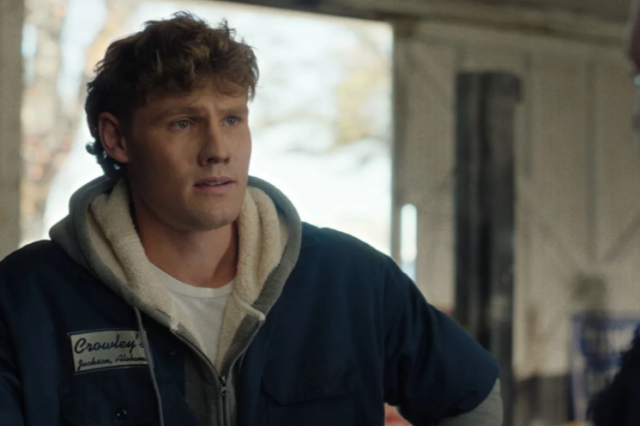
Music further grounds the film in region and mood. Composer and re-recording mixer John Timothy Roberts built a sound influenced by Mississippi Hill blues, specifically artists like Junior Kimbrough and R.L. Burnside.
“That was a soundtrack that I had in my head as I was writing it,” Owen says. “It’s a little bit more rhythmic type of blues, a little fuller, and I felt like it fit really well with the story and the journey that Walt was on.”
The score gives the film propulsion without overwhelming its gentler emotional beats.
“I wanted it to have a little bit of energy and propulsion to it,” Owen says.
Coming out of the actors’ strike, Owen found himself with access to an exceptional Georgia crew and a cast hungry to work. That collaborative spirit shaped the production.
“I felt very spoiled, to be honest with you,” he says. “Our crew was amazing. Our cast was phenomenal, and they brought so much to it.”
One of those gifts came from Sorvino during a kitchen scene in which Sandra attempts to seduce Walt. After the scripted “down, set, hut” moment, Sorvino improvised the rest.
“She was so brilliant with that,” Owen says. “It was stronger than what was written.”
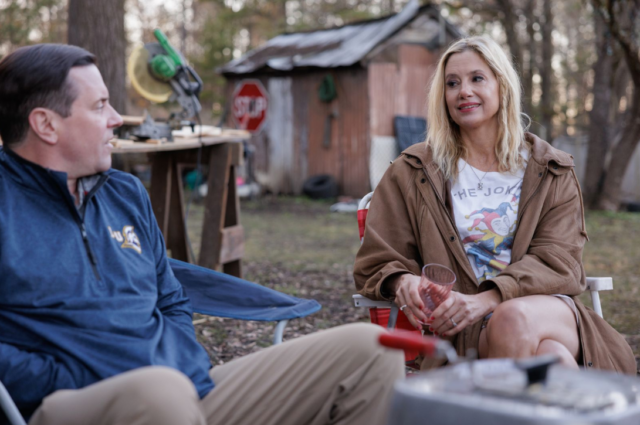
Those moments, he says, are why he does this.
“Those moments of inspiration with cast—that’s what I do it for.”
As for what comes next, Owen is drawn to stories that may vary in genre but return to similar emotional ground: purpose, family, resilience, and hope. He has historical dramas in development, including one set around the Trail of Tears and another about the last mass lynching in Georgia. Different tones, different worlds, but the same moral curiosity.
“I just write what I feel and what interests me,” he says. “At their core, every story that I have does have ultimately a similar message of hope amidst all the obstacles that you have to deal with.”
That is exactly what makes SIGNING TONY RAYMOND work. It understands the ugly machinery surrounding college football recruitment, but it refuses to become cynical. It finds humor without mocking, heart without syrup, and morality without preaching.
And in Walt McFadden’s journey, Glen Owen gives us something increasingly rare: a sports story where the biggest win has nothing to do with the scoreboard.
by debbie elias, exclusive interview 04/23/2026
SIGNING TONY RAYMOND is currently streaming on AppleTV and Prime Video.