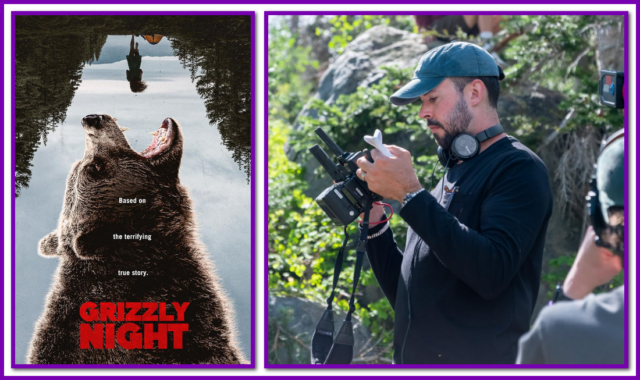
An in-depth interview with director BURKE DOEREN discussing GRIZZLY NIGHT.
SYNOPSIS: Based on true events, this terrifying survival thriller follows a rookie park ranger thrust into the fight of her life when Glacier National Park becomes the scene of deadly grizzly attacks. As panic spreads and communication breaks down, she must lead a group of frightened strangers through the darkness, confronting both the untamed wilderness and her own fears. What begins as a quiet summer evening turns into a night of chaos that changes the nation’s understanding of wildlife forever.
Directed by Burke Doeren and written by Katrina Mathewson and Tanner Bean, with story by Bo Bean, Katrina Mathewson, and Tanner Bean, GRIZZLY NIGHT stars Charles Esten, Oded Fehr, Lauren Call, Joel Johnstone, Josh Zuckerman, Matt Lintz, Ali Skovbye, Sophia Gray with Brec Bassinger and Jack Griffo, and Tag the Bear.
*****
Some true stories arrive pre-loaded with dread. The August 12, 1967, grizzly attacks at Glacier National Park—two fatal incidents miles apart on the same night—changed the nation’s relationship to wildlife and wilderness. In GRIZZLY NIGHT, first-time feature director Burke Doeren tries to honor that history with authenticity, restraint, and a horror that’s often delivered through what you hear rather than what you see.
Doeren describes the film as a “dramatic historical thriller with horror elements,” grounded in real events detailed in the book Night of the Grizzlies. What drew him to the project as his debut feature was not shock value, but consequence. “I love historical dramas,” he explains, pointing to films that immerse audiences in serious events without sensationalizing them. “You’re hearing something serious, seeing it, experiencing it in a new way… so we tried to keep it as authentic as possible.”
That authenticity extends beyond period detail into theme. For Doeren, the attacks are inseparable from a broader reckoning with how people once treated national parks—and wildlife—as extensions of entertainment culture. In 1967, baiting bears and leaving trash unsecured were accepted practices meant to enhance the visitor experience. Grizzly Night makes clear how dangerously that mindset backfired.
“Ultimately, the story can be seen as a metaphor for respecting nature as a whole,” Doeren says. “At that time, national parks did not have the respect for wildlife that they do now… there was a lot of baiting… to try to attract bears and create an experience for the park goers. Obviously, as you watch the film, you can see how that plays out.”
Engineering danger without putting people—or animals—at risk
Working with a real grizzly bear named Tag forced Doeren into a safety-first directing style that relied on planning, choreography, and cinematic sleight of hand rather than proximity. “We did a lot of very interesting things to shoot the bear separately from the actors, most often,” he says, “but also make you still feel like you’re right there with the bear and right there with the actors.”
Close passes over sleeping bags were staged using mannequins rather than people, while the actors’ performances were captured separately. When viewers see Tag looming overhead, the danger feels immediate—but it’s engineered through perspective and editing, not risk. “When you’re right there with Roy and Julie looking at each other’s faces,” Doeren notes, “there actually is no bear right there.”
To help actors respond truthfully in the absence of the animal, the production created physical stimuli—pulling sleeping bags with “pseudo bear claws” so performers could react to real sensations. “Both she and Matt Lance… just unloaded all emotion into this moment,” Doeren recalls, emphasizing how important it was that fear feel earned, not imagined.
The same philosophy applied to Squirt, the mini Doberman featured in the film. Handled by a dedicated trainer and shot separately from Tag, the dog was never placed in harm’s way, even when the finished scenes suggest otherwise. As Doeren puts it simply: “It’s movie magic.”
A classical visual grammar with period intent
Visually, Doeren wanted GRIZZLY NIGHT to feel like it could have been made in 1967. To achieve that, together with his cinematographers Brian Mitchell and Ian Start, the production shot open-gate on two ARRI Alexa 35 cameras paired with Cooke Panchro Classic lenses—modern mechanics with vintage character. “They feel just like the original lenses from the era,” he explains, “but they’re mechanically new. The coatings match, the color matches.” The goal was to have a classical, period-true texture that never feels like a modern, “slick monster movie”.
Camera movement follows a similarly restrained philosophy with a clear behavioral rule for the camera. Most of the film is built around “very stable and thoughtful framing, intentional in how it moves or doesn’t move, evoking historical dramas. That calm is punctured selectively by frenetic, subjective moments—particularly during the attacks—where perspective tightens and motion becomes visceral. “You feel like you’re the perspective of Roy as he’s sprinting away from the bear” or lying beneath it.
One of the most intimate setups places a Canon C70 camera directly between two actors in their sleeping bags, aligned to their eyelines. “It really feels like you are either Roy (Matt Lintz) or Julie,” Doeren says, “looking across at each other, trying to gather strength in this moment to be silent despite what becomes unimaginable pain.”
To sell the proximity of humans to bears without risking anyone, bear and actors were usually shot separately. Close passes above the sleeping bags used mannequins in the bags. When we see the actors’ faces, “there actually is no bear right there”; the art director yanks the bags with “pseudo bear claws” so performers have something physical to react to. A remote-controlled gimbal doubles as Roy’s POV as the bear moves up his body toward his chest.
The production shot 90–95% of the film on a single mountain location near Park City, Utah, at about 9,200 feet, plus real vistas in Glacier National Park. At night in the real woods, “it is so dark… there’s nothing.” No ambient city light, no spill—an ideal canvas for unseen horror. Gaffer Steve Lundgren built a system of boom arms and large cranes with remotely movable lights, pre-rigged so that while the crew relocated, he could re-aim big sources and have the next patch of forest ready, maintaining deep, naturalistic darkness with selective pools of light.
The aerial work follows the same realism-first rule. They shot their own helicopter footage, combining drone passes with true air-to-air work using a GSS long lens stabilized system mounted on a chopper. Because flying that terrain at night is unsafe, they filmed around sunset and performed day-for-night conversions, adding stars and deepening skies in post. The result is wide shots where the blue rescue helicopter threads mountain silhouettes in a legible, contrast-correct “night,” before cutting to true night on the ground when the aircraft lands.
Taken together—period accurate glass, composed framing, carefully rationed POV chaos, genuine wilderness locations, and disciplined night lighting—Doeren and his cinematographers Brian Mitchell and Ian Start craft a visual language that feels authentically 1967, grounded and observational, even when the film is at its most terrifying.
Sound as the primary delivery system for horror
If the visuals establish credibility, sound delivers the terror. Doeren worked with Mobile Sessions, a team that brought a mobile Atmos-capable recording studio directly to set. Scenes were captured with multiple microphones at varying distances and positions, preserving the spatial reality of the woods and allowing silence to play as loudly as noise so they could later recreate the feeling that “you’re there and you’re hearing real ambience and real echo and reverb and feeling the space.” On top of this, they captured real wildlife and bear sounds from Tag himself, building the bear’s presence from location recordings, not generic library roars.
Doeren structures the attack audio like a slow tightening vice as we begin in near silence—burned out campfires, midnight woods, no civilization hum. Then come subtle approach sounds: soft footfalls, sniffing, breathing, fabric movement, the weight of the bear “above” the sleeping bag. Only then does he allow full screams and chaos, often paired with minimal imagery—fluff from a torn sleeping bag, a single blood spot—so the audio carries most of the horror. The pattern becomes, “we hear silence, we hear growls, then we hear screams”—a consciously Hitchcockian rhythm that uses what you hear and don’t hear to ratchet tension.
“In a lot of these moments, the horror is sonically driven,” Doeren explains. The film favors restraint: silence gives way to distant movement, breath, fabric shifting, and stealthy approach before violence ever enters the frame. Bears don’t charge screaming out of the dark; they arrive quietly, and that quiet is what unsettles.
One of the most unsettling sequences is Julie’s (Brec Bassinger) chest wound. Special effects lead Abigail Steele created a prosthetic that “pulls in air and then pushes it back out” as if her lung has collapsed. In close up, each gasping inhale/exhale is accompanied by wet, bubbling movement and the sound of Dr. John’s (Oded Fehr) gauze pressing and sealing the wound. The moment is designed to make you squeamish… without being gross. It’s the sound of damaged breathing and fragile tissue, not splatter, that gets under your skin.
Balancing that sound design with score required patience. “The audio mix is quite subjective,” Doeren admits. “When you hit pause on a visual edit, you can see that frame. When you hit pause on audio, it’s silent—you’ve got to loop through it, listen, try it back at home, go back to the studio, try it again.” The goal was always clarity: bear and environment first, dialogue always intelligible, music shaped around—not over—the danger.
With so much detail in the bear and nature soundscape, the score had to be woven carefully around it. Doeren’s priority was that “you really feel the bear” and the environment first. Composer Dan Reckard then built a score of eerie harmonica, dobro, guitar textures, piano, and folk-tinged elements that fill the space but don’t compete with the sound design or ambient sound. Dialogue remains clear—a must in an ensemble where every voice matters to the historical record—while leaves, distant storms, stealthy footfalls, and ripping fabric are preserved with just as much importance. Mixed for Dolby 5.1 after extensive iteration—looping scenes at home and back in the studio until it “felt right”—the final track uses restraint, real-world recordings, and spatial detail to tell you, in sound alone, exactly how close you are to the edge.
Doeren may be a first-time feature director, but he approached his bear like a veteran: build the danger into the camera, the cut, and the soundscape—then let nature do the rest. And for the record: no bears or mini dobermans were harmed in the making of this movie magic.
by debbie elias, Exclusive Interview 01/28/2026
GRIZZLY NIGHT is now available on VOD and Digital.