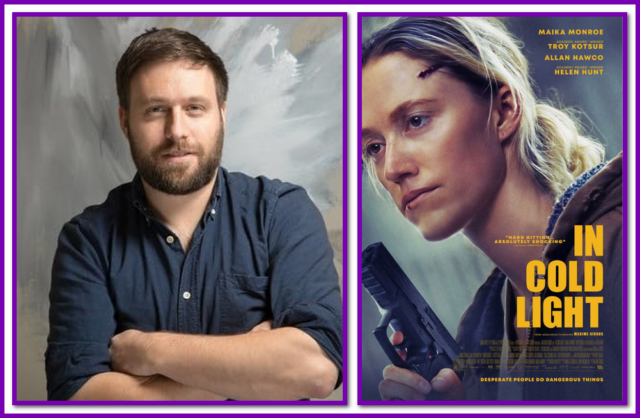
An in-depth exclusive interview with director MAXIME GIROUX discussing the crime thriller IN COLD LIGHT.
SYNOPSIS: Ava is freshly released from prison and fighting to reclaim her criminal empire—only to be framed for murder and hunted by both the police and a ruthless crime boss played by Helen Hunt. As the walls close in, Ava is forced to confront her estranged father (Troy Kotsur), turning a fractured family bond into a brutal fight for survival.
Directed by MAXIME GIROUX, with script by Patrick Whistler, IN COLD LIGHT stars Maika Monroe, Helen Hunt, Troy Kotsur, Jesse Irving, and Allan Hawco.
*****
For director Maxime Giroux, IN COLD LIGHT was never meant to be a conventional crime thriller. Even before the film’s structure, pacing, and visual grammar evolved in unexpected ways, Giroux was drawn to the project for its refusal to explain itself too neatly — and for a protagonist who moved through a brutal, male-dominated world without apology or adornment.
The script by Patrick Whistler, which came to Giroux via producers Mike MacMillan and Yanick Letourneau, immediately stood out for two reasons. First, there was Ava — played by Maika Monroe — a woman navigating power, violence, and survival on her own terms. Second, the story itself resisted familiar narrative signposts.
“The reason why I was interested by this movie was because of the character,” Giroux explains. “And the second reason… is because the script is really unexpected. We go in different directions. I’m a little bit tired of all those things that all look the same.”
For Giroux, surprise is not a gimmick but a philosophy. He gravitates toward cinema that trusts the audience to observe rather than be instructed — a sensibility that would become central to In Cold Light as the film transformed during production.
A Film That Learned to See Differently
That transformation began in earnest when Troy Kotsur was cast as Ava’s father, Will. In the original script, Will was not deaf. The moment Kotsur entered the conversation, however, the film’s emotional and visual architecture shifted.
“When Troy Kotsur was suggested, it completely transformed the film,” Giroux says. “Suddenly, there was an extra barrier of communication between Ava and her father. It changed the script itself… it changed everything.”
Making Will deaf introduced not just logistical challenges, but a deeper psychological framework for Ava. Communication became fragmented, internalized, and restrained — qualities that define her presence throughout the film. Growing up without the need to shout or verbalize, Ava absorbs more than she releases, a trait that sharpens her survival instincts and isolates her emotionally.
The change also rewrote the film’s visual language. Sign language had to be honored clearly and consistently, reshaping blocking, framing, and coverage.
“You need to see the language,” Giroux explains. “So you cannot do a close-up. You cannot do a wide, wide shot. You have to stay in the middle shot.”
ASL experts were present on set — one to facilitate communication between Giroux and Kotsur, another stationed at the monitor to ensure accuracy and performance continuity. Subtitles became essential, but the real work happened in the camera’s restraint. The film learned to listen visually.
What began as a casting decision ultimately redefined the film’s emotional grammar, deepening Ava’s silence and giving the story a layered tension that dialogue alone could never provide.
A 24-Hour Descent, Shot in the Dark
Structurally, IN COLD LIGHT unfolds over a continuous 24-hour period — a real-time conceit that placed enormous pressure on both production and post-production. Scenes could not be rearranged or removed without collapsing the logic of Ava’s physical journey through the night.
“The reason why it was challenging to edit this movie,” Giroux says, “it’s because it’s taking place in 24 hours. You need one scene after another. Even if a scene is not working well, you need that scene because she has to move from one point to another.”
Compounding the challenge were night shoots in Calgary, where true darkness lasts only five to six hours during the summer months. Sunset hovered near midnight; sunrise arrived before dawn. Every night sequence became a logistical puzzle, demanding precision from cast and crew alike.
Despite the constraints, longtime editor Mathieu Bouchard-Malo shaped the film’s rhythm with purpose. The opening stretches remain observational and measured, allowing the audience to absorb the landscape of crime, family, and power. Around the 40-minute mark, the film accelerates sharply — a “roller coaster,” as Giroux describes it — before slowing again for an unexpected emotional landing.
“When the roller coaster is happening, the pace is super fast,” he says. “But at the end of the movie… the roller coaster is over. She needs to be there.”
A Visual Grammar Built on Trust
That sense of control amid chaos is inseparable from Giroux’s decades-long collaboration with cinematographer Sara Mishara, with whom he has worked for nearly 28 years.
“I cannot do a movie without her,” Giroux says simply. “We don’t have to talk a lot. We understand the script in the same way.”
Together, they envisioned IN COLD LIGHT as a “film noir in color” — stylish but imperfect, raw rather than polished. Influences ranged from Cassavetes’ grainy intimacy to the neon-inflected melancholy of Paris, Texas. The goal was to avoid the immaculate gloss of contemporary streaming aesthetics in favor of something rougher, more animalistic.
“We want it to be raw and greedy and animal,” Giroux explains. “Just like the rodeo.”
Handheld camerawork dominates, anchoring the audience firmly in Ava’s point of view. Lighting becomes narrative — nowhere more powerfully than in the backyard ASL scene between Ava and Will, where a motion-sensor light flickers on and off as their fractured communication surfaces.
“It seems simple,” Giroux notes, “but it’s not simple at all.” The scene took an entire night to shoot, with electricians cueing light changes live to match emotional beats. The result is a quiet turning point — a visual metaphor for connection, rupture, and exposure.
Chaos, Blood, and the World Closing In
That raw aesthetic extends to the film’s most volatile environments, including the rodeo sequences shot at Ponoka, outside Calgary. Denied access to the family-oriented Calgary Stampede, the production embedded itself in a real rodeo with a live audience — capturing key moments in mere minutes amid noise, animals, and unpredictability.
Animals proved far more challenging than the film’s youngest cast member. Despite dire warnings, the twins who played Ava’s brother’s baby were, in Giroux’s words, “perfect.” Horses, cows, and bulls, however, added another layer of controlled chaos to an already demanding shoot.
Visually, the film grows increasingly confrontational, with extreme close-ups of blood and reflective surfaces forcing characters — and viewers — to confront their complicity in the violence. The world presses inward, mirroring Ava’s psychological free fall.
Women at the Center of the Storm
While IN COLD LIGHT unfolds in a criminal underworld dominated by men, Giroux is deliberate — and unapologetic — about centering women within it. Ava’s primary adversary, Claire, is played with icy authority by Helen Hunt, whose introduction — bare feet propped on a desk — instantly defines her dominance.
“That was her idea,” Giroux says with admiration. “You understand the character just by that position.”
For Giroux, these choices are not statements but instincts. “It’s not about saying, ‘Let’s make a badass movie about a woman,’” he explains. “It just happened that the character was a woman. For me, it’s normal.”
What the Film Left Him With
By the time IN COLD LIGHT reached completion, Giroux emerged with his convictions reaffirmed rather than rewritten. The film was more difficult than anticipated — technically, emotionally, logistically — but its success rested on something simple and fundamental.
“To do a movie like this,” he reflects, “you need a great team behind you. It’s the most important thing.”
Surrounded by longtime collaborators and actors willing to let the film evolve, Giroux allowed IN COLD LIGHT to become something more layered, more silent, and more observant than initially imagined — a crime film that doesn’t shout its intentions, but watches carefully as its protagonist fights, endures, and ultimately survives the night.
by debbie elias, Exclusive Interview 01/20/2026
IN COLD LIGHT is in theatres on January 23, 2026.