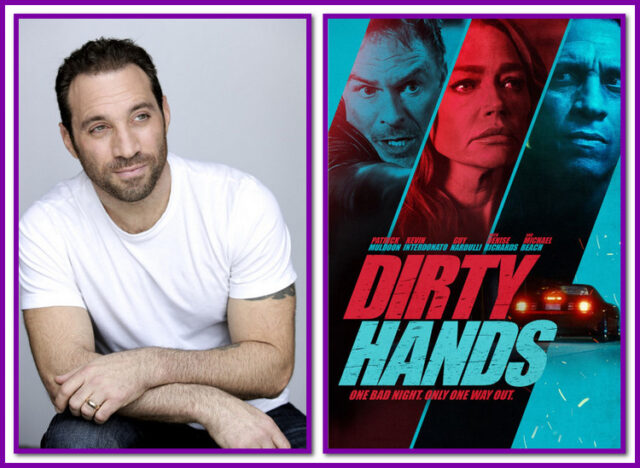
There’s nothing clean about DIRTY HANDS. And that is exactly the point.
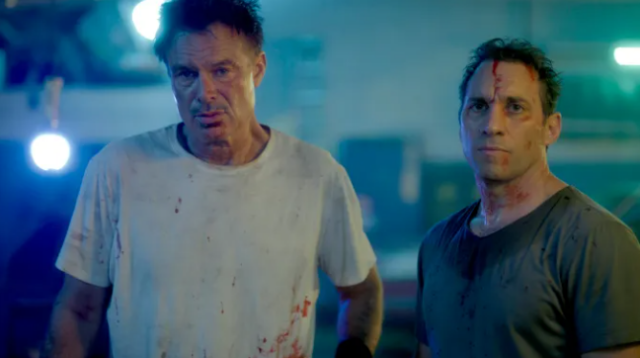
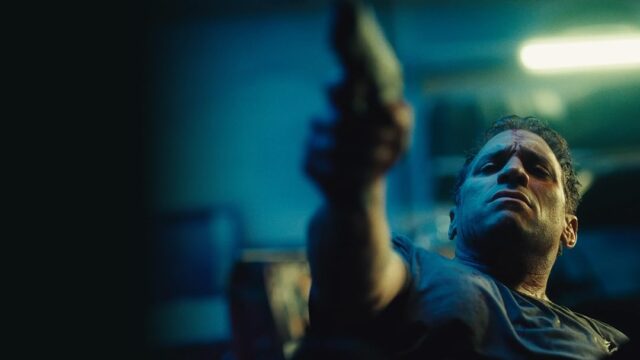
Written and directed by KEVIN INTERDONATO, who also co-stars opposite the late Patrick Muldoon, DIRTY HANDS is a bruising, contained, one-night pressure cooker built around the Denton brothers, Danny and Richie, after a routine drug deal goes sideways and survival becomes the only option. But beneath the violence, the blood, the blue-washed garage light, and the escalating danger, Interdonato’s film is rooted in something far more primal: brotherhood.
“The root of the story existed first,” says Interdonato. “First words, pen on paper, was two brothers and putting them, knowing their past, in dire situations. I just wanted to raise the stakes as much as possible and see what would happen.”
That brotherly connection became even more poignant in the wake of Muldoon’s sudden passing just days before our conversation. Interdonato spoke movingly about his friend and co-star in a separate remembrance, but within the context of DIRTY HANDS, Muldoon’s presence is inseparable from the film’s emotional core.
Interdonato first met Muldoon through Guy Nardulli, Muldoon’s longtime best friend and also part of the DIRTY HANDS cast. The connection was immediate.
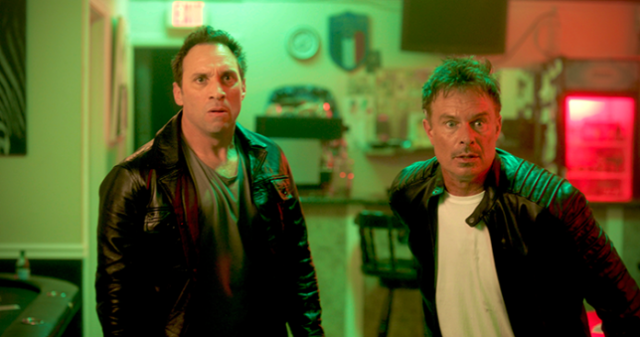
“When I met Pat for the first time, I was received with a big hug,” Interdonato recalls. “He picked me up off the ground — he’s like a foot taller than me — and he swung me around, and we were punching each other and having beers within five minutes. And I’m like, this is perfect.”
For Interdonato, that off-screen chemistry was everything.
“It just felt right off camera,” he says. “That’s when I knew that was my guy, because we had it off-screen and there was no acting.”
That rejection of “acting” is key to Interdonato’s approach, both as filmmaker and performer. He bristles at the word “performance,” calling it “result-oriented.” What he wanted from Muldoon, and from the film as a whole, was something lived-in, unpolished, raw, and emotionally present.
“I really wanted someone to sink into it and not think about my most hated word, performance,” he says. “We both talked about that extensively, and just staying in the moment, not knowing what’s going to happen. And he jumped in wholeheartedly and really embraced that.”
That authenticity extends to the film’s violence. DIRTY HANDS has action, but Interdonato doesn’t see it as an “action film.” Its physicality comes from street-level reality, not stylized heroics.
“For me, that’s irrelevant,” he says of genre labeling. “It’s not an action film. This is the world I grew up in. I know this stuff.”
He wanted the violence to feel abrupt, messy, and painful — not choreographed into cinematic fantasy.
“Real life is not Jason Statham flying kicks,” he says. “It’s raw. It’s unpredictable. It just kind of happens. And sometimes people can just walk away from it 30 seconds later and pick up a phone call from their mom.”
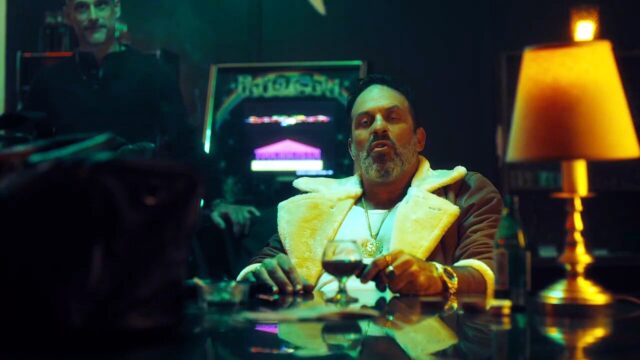
That same rawness informed the visual design. Interdonato calls the 1970s “the best era for film,” citing its purity and grit, and that sensibility runs through DIRTY HANDS. Working with cinematographer and production designer Eric Miller, he built a visual grammar around contained space, practical limitations, and emotional pressure.
Much of the film unfolds inside a mechanic’s garage, a location that serves both budget and story. For Interdonato, the garage was not simply economical. It was thematic.
“With the idea of being in the mechanic garage for that long, symbolically, that was the best way I could tell the audience that their backs were literally to the wall,” he says. “There was nowhere to go.”
That space is bathed in blue, a choice that gives the garage an odd duality: claustrophobic and strangely calming, a trap and a temporary refuge.
“The blue wash was really a calming point when they entered the garage,” Interdonato explains. “Blue just represents that cool, calm, relaxing ocean, but there was an electric feel to it.”
That “electric feel” came partly from one of the film’s most effective details: a blinking, buzzing halogen work light. Added to interrupt the steadiness of the garage, it becomes visual texture, tension builder, and sonic irritant all at once.
“It almost felt like it was a living, breathing space,” he says. “It was not totally silent. And then people kept coming into their world and interrupting it.”
Sound design became one of the film’s most important invisible weapons. Interdonato and his team were “adamant about every little sound,” from the buzzing light to the amplified textures of night. He drew from childhood camping memories and his military experience, remembering how small sounds in darkness can become almost deafening.
“It’s so quiet at night,” he says. “But if you really listen, the smallest sounds almost become deafening — crickets and cicadas and leaves rustling. You hear everything so clearly. I just wanted to enhance as much as possible any sound to really color the world and the moment they were in.”
That attention to detail carries through the production itself. The garage, secured through Nardulli’s Chicago connections, was nearly turnkey. The owner handed over the keys at night, let them shoot, and even offered up a junk car to destroy.
“He said, ‘Don’t worry about getting blood on the floor. I’ve got to clean the floors in a week anyway,’” Interdonato laughs.
Even wardrobe became part of the film’s economy. Because DIRTY HANDS unfolds over one night and was shot largely in chronological order, continuity could be maintained with a handful of duplicates.
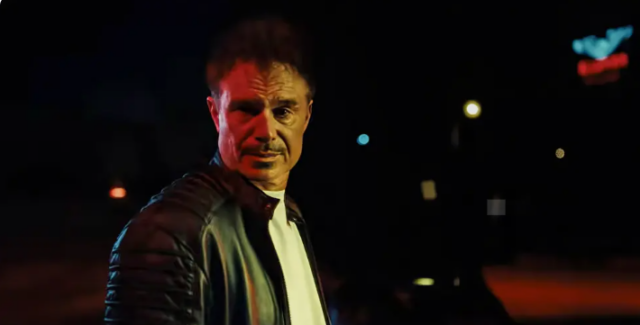
“At the end of the day, I just bought four pairs of jeans and four pairs of Hanes T-shirts, and we were good to go,” he says.
When asked whether he went for the three-pack or five-pack, Interdonato didn’t miss a beat.
“I got the Hanes that were five to a pack. I went for it. I sprung for the extra ten bucks!”
That’s the Jersey boy, and that’s the filmmaker: practical, specific, funny, and unwilling to spend where he doesn’t need to. But that economy is not limitation masquerading as virtue. It is a methodology.
“You could do a lot with a little,” he says. “Coming from the world I come from, I don’t know how to spend lavishly.”
He likes small crews, tight locations, and people who are all-in.
“It’s important to surround myself with, for lack of better words, a crew of gangsters,” he says. “Everybody that’s all in it. Everyone’s excited to come to work and get their hands dirty.”
That same precision applied to the edit. Editor Nicholas Larrabure has been part of Interdonato’s creative circle for years, and Interdonato describes their shorthand as almost instinctive.
“He just completes my thoughts,” he says. “We have that kind of relationship on a creative level.”
Fight scenes, meanwhile, were anything but casual. Though resources were limited, Interdonato brought in stunt coordinator Jason Mello, along with Travis Staton and additional stunt performers. Muldoon, Nardulli, and Interdonato rehearsed in New Jersey for five days, eight hours a day, using cardboard boxes and pool noodles to map out the violence before heading to Chicago.
“Every hit, every move, every punch was orchestrated,” Interdonato says. “We did it enough so we were comfortable with the movements and didn’t have to think, and then we could actually live in the moment and react.”
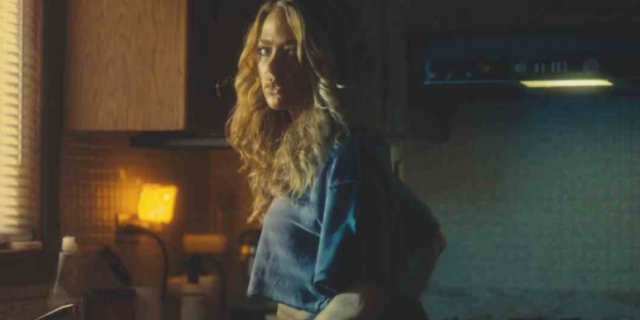
The film also gives Denise Richards a surprising dramatic showcase as Sheila, Richie’s wife. Interdonato says Richards came to set with a depth he had hoped for but did not fully expect.
“She was just electric,” he says. “That role of Sheila was really the only person that was stable. She was unhappy in the situation, but she was the person that was the victim of everything, and she really brought her A-game.”
Interdonato encouraged her to forget the camera and sit inside the discomfort of the role.
“I said, ‘This is not about performance. I really need you to know that there’s no camera here. There’s no nothing. I just want you to go to that place that’s so grounded and really just sit in this and live it out. I need you to be comfortably uncomfortable.’”
At one point, she was so locked in that Interdonato forgot to call cut.
“We were just watching the monitor,” he says. “She just kept going. And she’s like, ‘Are we done?’ I said, ‘Oh yeah, sorry, Denise.’ She was magnificent.”
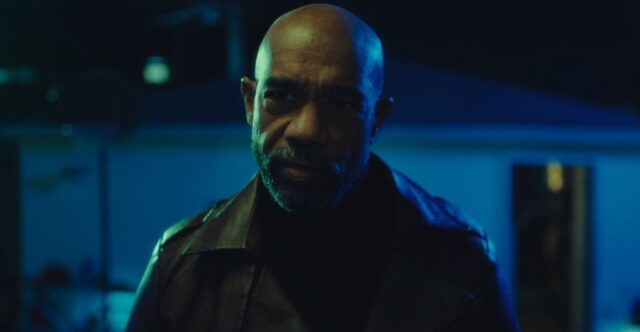
Michael Beach, he says, needed no such direction.
“I didn’t have to say anything to Mike,” Interdonato says. “He’s just such a pro. He brought it and elevated everything.”
For a filmmaker who built his acting career on improvisation, Interdonato is surprisingly strict as a director. Improvisation, he notes, does not mean comedy. It can mean silence, behavior, or a small adjustment that improves a moment. But on DIRTY HANDS, the script mattered.
“I write everything for a reason,” he says. “There was not a lot of improv on this film at all. It was scripted.”
Looking back, DIRTY HANDS reinforced something Interdonato says he is still learning: to trust his instincts.
“If it’s coming to me and it just feels right in my gut, I just go harder with it and stick to my guns,” he says.
That instinct is rooted in his lifelong relationship with movies. Before he was an actor, writer, director, or producer, he was a film fan looking for escape.
“My escape was film,” he says. “Even as a teen, my escape was film. So I’m a film fan first. I always think of the audience and how they would take it, how they would receive it.”
And for Interdonato, that is the goal — not polish for polish’s sake, not violence for genre’s sake, not performance for acclaim’s sake.
“At the end of the day, Debbie, I just want to move people,” he says. “If I can just give back to people the same joy from film that I received, that I look for, then my job is done.”
With DIRTY HANDS, Kevin Interdonato does exactly that. He strips things down to blood, breath, brotherhood, bruises, buzzing lights, and survival. Then he lets the night close in.
by debbie elias, exclusive interview 04/23/2026
DIRTY HANDS is now available On Digital and On Demand