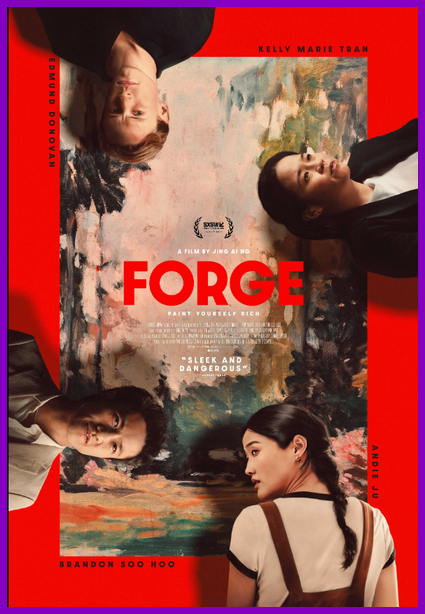
There’s a fascinating irony at the center of FORGE. In a film about counterfeit masterpieces, stolen artistic identities, fabricated provenance, and criminal deception, writer-director Jing Ai Ng delivers something refreshingly authentic: a confident feature debut with a sharply defined visual voice and a compelling emotional core.
Inspired in part by the infamous Knoedler Gallery art forgery scandal that rocked the New York art world, FORGE takes audiences into the wealthy, image-conscious landscape of Miami’s elite art scene, where appearance, status, and perceived value matter just as much as truth. But rather than constructing a traditional cat-and-mouse procedural centered on law enforcement, Ng makes the bold choice to emotionally align viewers with the forgers themselves — specifically Coco Zhang, played with mesmerizing intensity by Andie Ju.
That decision transforms FORGE from a standard crime thriller into something far more psychologically layered.
Coco and her brother Raymond (Brandon Soo Hoo) operate a thriving underground forgery business out of their family’s orbit, creating counterfeit masterpieces and false provenance documents for wealthy collectors willing to spend enormous sums chasing artistic prestige. Their operation escalates when disgraced millionaire Holden Beaumont (Edmund Donovan) recruits them to “restore” his family’s supposedly damaged collection, opening the door to larger profits and far greater risks. Meanwhile, FBI Art Crimes agent Emily Lee (Kelly Marie Tran) begins quietly piecing together the growing wave of sophisticated forgeries infiltrating South Florida’s art market.
But the true brilliance of FORGE lies in Ng’s refusal to reduce Coco to a simplistic criminal archetype. Coco is not driven solely by greed. She genuinely reveres art. She studies it, cherishes it, and desperately longs to be recognized as an artist herself. That yearning becomes the film’s emotional heartbeat and its greatest tragedy. Coco’s dream is not simply to make money — it is to be seen.
Even if the work hanging in the gallery carries someone else’s name.
Ng’s screenplay understands the complicated emotional terrain between fraud and artistry, asking unsettling questions about authorship, legitimacy, and value in a world increasingly obsessed with perception over authenticity. Thematically, the film arrives at an especially timely cultural moment as debates surrounding AI-generated imagery and creative ownership continue to dominate artistic conversations. Remarkably, Ng conceived the story before those conversations fully exploded into the mainstream, giving FORGE an almost accidental prescience.
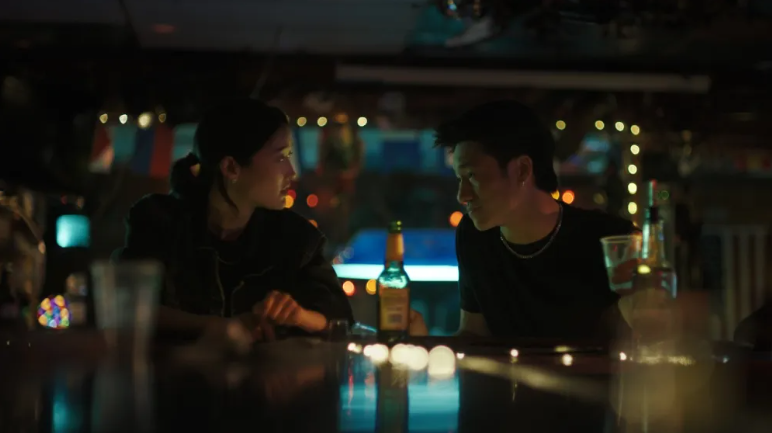
Visually, the film is striking from its opening moments. Working with cinematographer Leo Purman, Ng crafts a controlled and disciplined visual grammar built around warm tropical palettes, restrained lighting schemes, and strategic bursts of color that often emerge through the paintings themselves. The artwork becomes visual punctuation throughout the film — seductive, luminous, and emotionally revealing.
Purman’s lensing excels not through flashy camera tricks, but through thoughtful spatial storytelling. Production designer Arielle Ness-Cohn creates three distinctly realized worlds that subtly define character psychology: the warmth and intimacy of the Zhang family restaurant; the expansive, shadowed warehouse studio where Coco paints; and Holden Beaumont’s cold, glass-and-steel world of inherited privilege and performative sophistication. Each environment reflects the emotional and moral condition of its inhabitants.
The warehouse studio, in particular, becomes a fascinating extension of Coco herself — isolated, cavernous, creative, and haunted by ambition.
Equally impressive is editor Briana Chmielewski’s work. Ng leans heavily into montage throughout the film, but these sequences never feel like stylistic filler. Instead, they function as emotional acceleration and tonal evolution. One standout sequence intercuts Coco painstakingly aging canvases and recreating masterpieces while Raymond fabricates supporting documents and identities, visually building the illusion piece by piece. Later montages seamlessly crosscut Coco’s increasingly obsessive creative process against Agent Lee’s methodical investigation, allowing tension to build organically without excessive exposition or melodramatic confrontation.
These editorial choices give FORGE a rhythmic elegance that feels far more sophisticated than many larger-budget crime dramas.
The score by Marco Carrion and Ian Chang further deepens the film’s hypnotic atmosphere. Blending electronic textures with Asian instrumentation and percussive motifs, the music often feels tethered directly to Coco’s interior emotional state. Dreamlike passages accompany her moments of artistic immersion, while darker tonal shifts gradually emerge as her carefully constructed world begins collapsing around her. The score does not simply support the narrative; it actively places viewers inside Coco’s fractured emotional perspective.
Andie Ju delivers a breakout performance as Coco. Quietly magnetic and emotionally layered, Ju never asks the audience for sympathy, yet earns it nonetheless. She plays Coco as a woman consumed by longing — not only for success, but for validation, recognition, and permanence. Even when Coco manipulates, lies, and commits increasingly dangerous crimes, Ju allows flashes of vulnerability and sincerity to surface beneath the deception.
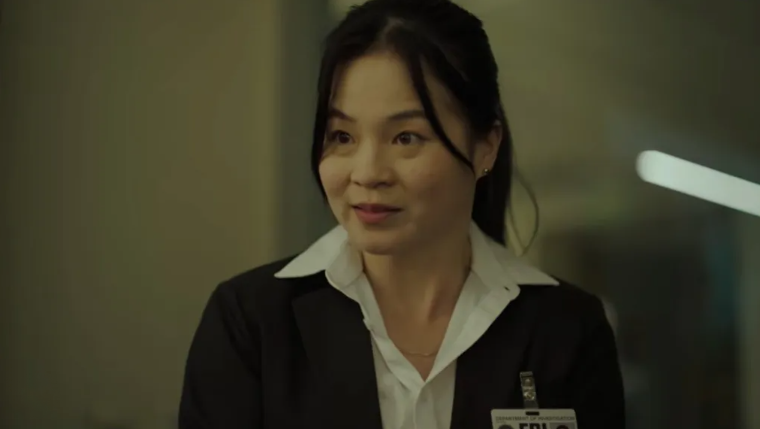
Kelly Marie Tran provides excellent balance as Agent Emily Lee. Ng smartly avoids glamorizing the character, grounding Emily in the practical reality of an actual working FBI agent rather than a polished Hollywood fantasy. Tran plays Emily with patience, intelligence, and restraint, making her less a heroic adversary and more an observer slowly untangling a deeply human tragedy.
Edmund Donovan proves wonderfully slippery as Holden Beaumont, embodying the kind of inherited entitlement and performative sophistication that makes the character simultaneously pathetic and dangerous. Donovan wisely avoids caricature, revealing Holden as a hollow man desperately trying to maintain the illusion of importance and status long after the foundation beneath him has eroded.
What lingers most after FORGE ends, however, is its final emotional irony. As Coco’s world implodes and the truth finally surfaces, the recognition she always craved arrives in the most twisted form imaginable. In that moment, Ng crystallizes the film’s central idea with devastating clarity: in a culture obsessed with image and reputation, notoriety can become its own form of artistic immortality.
With FORGE, Jing Ai Ng announces herself as a filmmaker with tremendous promise and a sophisticated understanding of visual storytelling, tonal control, and character psychology. Stylish without becoming superficial, emotionally layered without sacrificing tension, and thematically resonant without feeling self-important, FORGE is less interested in the mechanics of forgery than in the aching human desire to leave behind something worthy of being remembered.
Even if the signature at the bottom doesn’t belong to you.
Written and Directed by Jing Ai Ng.
Cast: Kelly Marie Tran, Andie Ju, Brandon Soo Hoo, Edmund Donovan, Eva De Dominici
by debbie elias, 05/04/2026
FORGE opens with week-long theatrical runs in Los Angeles beginning May 15 at the Landmark Nuart Theatre, followed by New York beginning May 22 at Quad Cinema followed by rollout to additional markets.